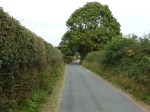
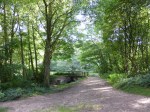
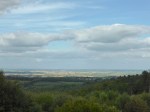
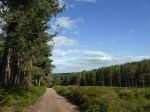
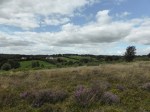
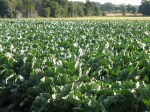
September 3rd – In recent weeks I’ve mentioned the cereal harvest quite a lot, but there are other crops in the fields, too. Potatoes, the parsnips at Home Farm in Sandhills, sugar beet, sprouts and other vegetables are nearing readiness, too. Here near Shenstone, a field of what I think is either kale or cabbage looks lush in the afternoon sun, and the air smells distinctly.

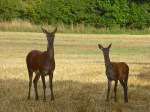
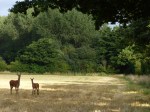
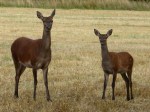
September 2nd – This was a pleasant surprise. Riding home along Green Lane in Shelfield, I glanced, as I always do, through the gate of the field opposite the Mob Lane junction. Loafing on the freshly-cut stubble on Jockey Meadows were two red deer. It appears to be a mother and child, and they seemed to be in fine condition. I’ve seen deer here before, but never at this time of year. There was no sign of a larger group, but they might have been in the scrub towards the stream.

A fine sight, and one I’m still shocked to see in Walsall Wood on a parcel of land surrounded by industry and housing.

September 1st – A dull, unremarkable autumn day, with a steady, draining wind. I headed out to Middleton and back along the canal through Tamworth to Hopwas. At Camp Road, I spotted a massive bracket polypore fungus growing at the foot of a huge oak tree. This fungi was the biggest I’ve ever seen. It must have been 20 inches wide, and seemed to be supporting a variety of bug life all of it’s own.

Near Bassetts Pole, hops growing wild in the hedgerow.

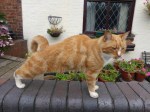
The view of Middleton over the fields is still gorgeous, and the cat at the lock cottage in Bodymoor Heath was an affectionate, sociable chap.

The day finished with the most remarkable sunset I’ve ever seen. But more of that later…

September 1st – Seasonal warning. Yes, it’s the hedge cutting season again, when our farming brethren flail the hawthorn hedges, in turn leaving the roads stewn with thorns made of some material that just glides into tyres. If you’re not rocking puncture proofs, avoid Gravelly Lane in Stonnall right now. It’s also quite grim up in Footherley too.

I don’t know why they don’t make weapons out of the same stuff hawthorn spines are made of. They’d never go blunt and pierce absolutely anything.

Like the Murphy’s, I’m not bitter…

August 31st – Autumn knocked on my door today, and I reluctantly let her in. I set out lunchtime for a ride over the Chase – after exploring Bevin’s Birches and the old quarries last week, my quest to find the remoter parts of this beautiful place has intensified. The wind – although no terribly bad – felt like it had been wrought on Satan’s back step, after the relatively still summer. It was chilly, too, and I felt the edge of the cold. The bracken is turning, the puffballs are growing well, and there is a hint of autumn everywhere you look, from the heaths of Gentleshaw, to the charm of Birches Valley. 

As fellow cyclist @Accidentobizaro said on Twitter:  ‘I know autumn is fab.I do.Mists, mulberries, colours, walks, scarves, cyclocross. I know. But [weeps inconsolably]’

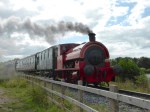
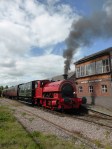
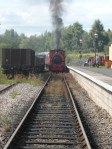
August 31st – Chasewater Railway is a hidden gem, enjoyed by folk who know Chasewater, but it isn’t widely known outside the area. Running on a short, preserved section of the Norton Line, it goes from the south shore of Chasewater at Brownhills West to Chasetown, near the rugby club. Not a huge distance, but a great ride with lots of interesting trains and rolling stock, all preserved and run by keen amateurs. Today, I raced this fine red locomotive along the causeway. It looked splendid, and was smoking well. 

A fine thing indeed.

August 30th – Cycling down the bridleway from Wall Lane to the Birmingham Road at Harehust Hill, near Wall, I noticed the remnants of the wheat harvest. This spilled grain is natural, and happens at every harvest time. Trailers lurch and spill, grain falls from machinery in transit and the wind blows it into gutters and potholes. This is what my grandfather called ‘Gleanings’, and spoke of the old right the poor had to collect it for their own use. He also called the noisy, shrieking guineafowl that were often kept as yard birds in the area ‘gleanies’, as they were often fed on the gleanings.

It’s quite rare to see guineafowl these days.

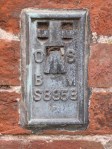
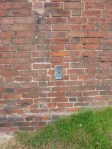
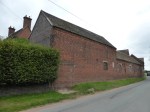
August 30th – Out for an afternoon spin, I came through Wall, just south of Lichfield. Just as I was approaching the junction of the old Watling Street and Wall Lane, I noticed that on the side of the old barn at Manor Farm, there was an Ordnance Survey Flush Bracket. This is a type of benchmark that was used for map surveying – in the notches on the plate, surveying equipment could be mounted at a height known to the surveyor, called a Datum, or benchmark. The flat tip of the arrow indicates the precise height  point, and this is benchmark reference S8958. 

I must have passed this wall hundreds of times and have never noticed this feature.