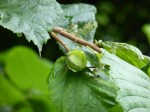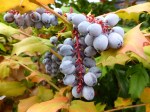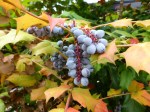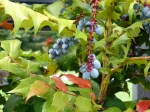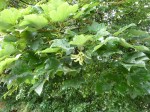
August 5th – I returned in heavy rain and the photography was lousy. I did notice, however, that may trees seem to be fruiting better than the hazels of yesterday. This Sycamore at Sandhills has fine, plump seeds, already turning brown in preparation for what is, in their case, genuinely a fall, all be it a blade-moderated one. In my childhood, these seeds were called ‘Helicopters’, for their notorious (and I think, unique) spinning action as they fell.

Hips and haws are also doing well in the hedgerows right now, but the photos were terrible, sorry.
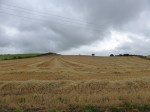
August 5th – It seems the harvest had started just before the rains came over the weekend. These fields near Stonnall were still full of wheat on Thursday, and are now no more than neat rows of cut straw, with crows looking for food in the gleanings. I noticed other fields had been cut at Springhill and Summerhill too. 

And so the season ticks on. It doesn’t seem long since there were deep snowdrifts here..

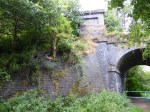
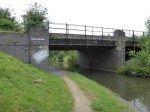
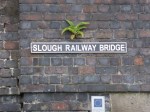
August 4th – 3 former rail bridges in Brownhills, from 3 separate railway lines, all three suffering with age and the destructive tenacity of nature. The lone arch at the top corner of Clayhanger Common is slowly being pushed apart by shrubs and weeds, and is in what must be the final stages of natural reclamation. The Slough bridge, over the canal near Coppice Side, now serves as a pedestrian and cycleway over the Wyrley and Essington for National Cycle Route 54, but the familiar blue Freakley bricks are being pried apart here too by gentle, instant hydraulic pressure.

The third bridge is arguably the most interesting. One of only two listed buildings in the town, it is considered of rare enough design to be worth preserving, although it too is suffering the ravages of lack of care. As if to compound the misery, It has recently had a new nameplate installed, which reads ‘Pelsall Old Railway Bridge’.

This isn’t Pelsall, you muppets.

August 4th – By the canal in Brownhills, opposite the Watermead Eastate, there’s a little secret not many people seem to know about. It’s a hedge of hazel trees. I guess they were planted here 25 years ago when the refuse tip that had been on this site was reclaimed. Now mature, and tall, they are covered in dense, beautifully green leaves. I’d never remotely consider eating the nuts considering the previous use of the land below, but it’s moot anyway, as normally the squirrels strip these trees bare of fruit before it’s even ripe. 

Sadly, the squirrels will not be so fortunate this year, as in the whole length of the hedge, I spotted only two nuts. It must have been a bad season for these trees. 

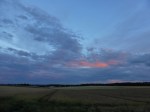
August 3rd – I’d been poring over maps most of the day and was tired and bleary when I headed out early evening. I cycled along the canal, and it looked like I was just too late to catch the best of what looked a beautiful sunset. I guess that part of the season is approaching again.

It was still nice though, over Home Farm, where the clouds caught the reflected light from the west; Chasewater’s sunsets are now a bit more tricky due to the wake lines and towers.

Sadly, I blew a puncture on the way back, and without a spare, I walked home dejected and annoyed. Never leave home without your tool kit…

August 2nd – The destructive power of storm water left it’s mark on Main Street, Stonnall. When we had the heavy rains, this storm drain blew it’s lid and ruptured the tarmac of the road. It’s been re-rolled flat now, but some remarkable damage was done in the downpours of the previous Saturday. Ultimately, I suspect, these drains will have to have their access chambers rebuilt due to the water damage.

It must have been a sight to see when it happened.

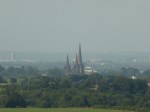
August 1st – I came home over Shire Oak Hill, and stopped at the old quarry entrance to see if there was a decent view now – recently, the southern boundary of the site has had a mound landscaped, which partially obscures one of the best views around here.

Thankfully, it was still good for a view of the distant Lichfield Cathedral. and although the day was hazy, it was still clear enough to pick out the Coors (formerly Bass) silo at Burton and the wooded hill of Swadlincote. 

This is a great view, and not many folk really seem to notice it.

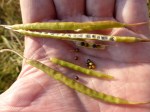
August 1st – Passing Grove Hill near Stonnall in the late afternoon sun, I noted that it was surrounded by a fine crop of oilseed rape. Where this had been a sea of vivid yellow in spring, it was now going a soft, golden colour. 

The plant is harvested by special equipment, which flays the pod from the tiny, tiny seeds which are black when ripe. These then go for crushing to extract the oil, both for biofuel and cooking.

There’s gold in those tiny, spherical seeds.