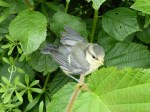
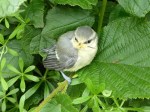
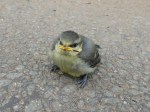
May 31st – He was in the middle of a busy lane at Shenstone Woodend, just sitting there. I spotted him by chance, and just swerved to miss him. I screeched to a halt and thought what to do.

He could fly short distances, but was clearly exhausted, and I couldn’t get him out of the road for love nor money. I know you’re not supposed to touch fledging chicks, but he was going to get squished under the wheels of the many vehicles that come this way.

I gently picked him up, and popped in in the hedge right next to where I found him. I hope he survived.

Anyone know what he is? I think he’s a tit of some sort.

Edit: Thanks to Fatuoussunbeams – he’s a blue tit. Thought he was, but after my recent dire attempts at botany I’m hedging my bets! Cheers…

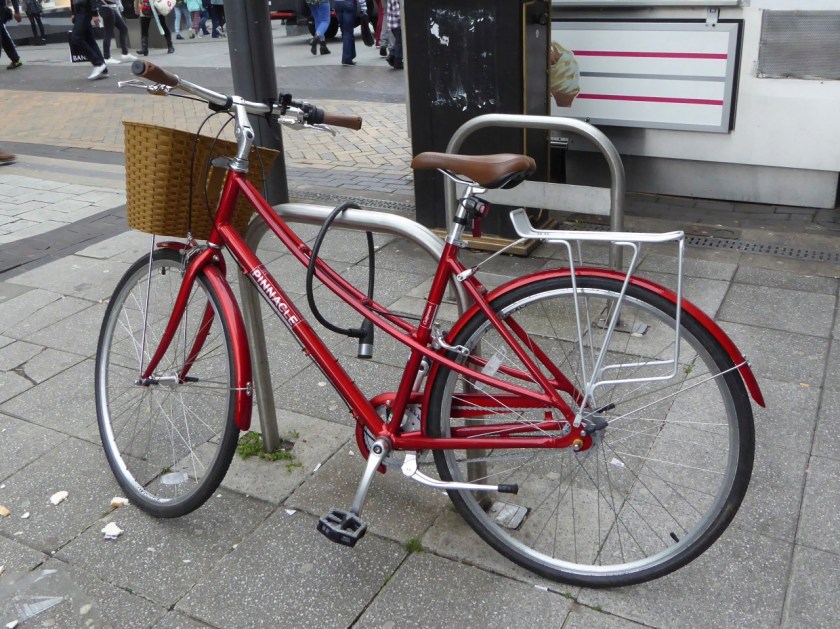
May 30th – Later on, in Birmingham city centre, I noticed this curious ladies bike. Nice colour, virtually brand new, three speed. It’s Pinnacle, a brand I think may be unique to Evans Cycles, who have a branch nearby – this is a bike aimed at a specific market, and probably price point, too. I think it’s Shimano three speed, and the saddle, grips and comfort features like the adjustable stem are nice, but the brakes – callipers on a bike likely to be heavily loaded – are a bit crap, to be honest. The choice of a white chain and chain set are interesting, too. I’m also intrigued by the frame design; not quite a Mixte frame, it seems a bit pointlessly complex for what it actually is.

I also note the rear light on the seatpost that can’t actually be seen from the rear due to the carrier. Bit worrying that, and why I don’t like seatpost lights, which are often inadvertently obscured by overhanging jackets, too.

It’s a lovely thing, though, really. I’m interested in the way city bikes like this are evolving – they’re coming on a bit from the costly and huge Pashley hulks of a few years ago.

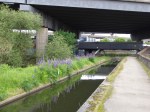
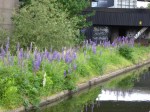
May 30th – Under the rumble and roar of Spaghetti Junction, beside a quiet, limpid canal, on an aqueduct above the River Tame, a little oasis of wildflowers in a built, otherwise hostile urban environment of steel, concrete and brick.

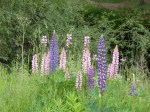
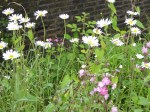
Lupins, poppies, ox-eye daisies, red campion.

That’s my Birmingham, right there.

May 30th – I spent the morning at work, then late afternoon, cycled into Birmingham to meet with a couple of colleagues. I headed down to the canal at Tyburn for a decent run, and followed the canal into central Birmingham.

One of the little-known features of canals that helped keep them open for years after their commercial value declined was the fact that under their embankments and towpaths, utilities found a direct route through cities for their pipelines and cables. By laying services alongside the waterways, many of the issues with traffic and complexity of installation could be avoided.

Along the canals here in Birmingham run gas, high voltage electricity, fibre optic telecommunications links, and petrochemical fuel pipelines. The keen-eyed explorer can often spot the evidence on the surface in the form of markers, bulkheads, valve access chambers and other infrastructure.

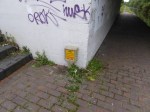
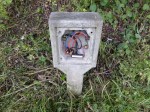
These small, concrete gas pipeline markers indicate a high pressure gas pipeline runs below, but also serve another purpose, as can be seen in this example which has had the cover prised off. The pipeline is metal, and to prevent corrosion, a system of cathodic protection is applied; a low voltage DC supply is connected between the pipe and electrodes – called anodes – in the ground nearby. The flow of current between the anodes and the pipe means that the anodes corrode sacrificially instead of the metal they’re protecting.

A similar system is being fitted to metalwork in the supports of Spaghetti Junction to protect it from water damage.

The markers – about 50m apart along the towpath – house junction boxes for the protection wiring and test points, and contain a magnetically operated switch for test purposes. Large brass studs in the side allow connection of test equipment. 

You can find out about cathodic protection here.
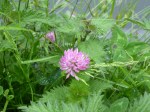
May 29th – Meanwhile, further on near the Pier Street Bridge, a chance to catch up with the flowers whose photos turned out badly the day before. Clover, the unsung hero of the pasture, meadow and verge is always beautiful, but very overlooked. Nutritious in fodder and attractive to bugs and butterflies, clover does it’s violet thing pretty much unnoticed. 

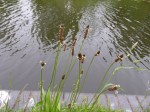
Another very common flower that goes unremarked is the ribwort plantain – it’s brown flower heads with the white corona don’t look like flowers, but they are. Exceedingly prolific this year, they’re everywhere that grass grows. As kids, we’d pick them at the base of the stalk and play conkers with them. I think they’re fascinating, and demontrate the utter diversity of plant life in the UK.

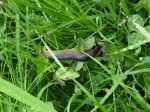
The damp conditions may not be improving my humour any, but that slug looks in fine fettle. Much misunderstood creatures, that I think are actually rather interesting.

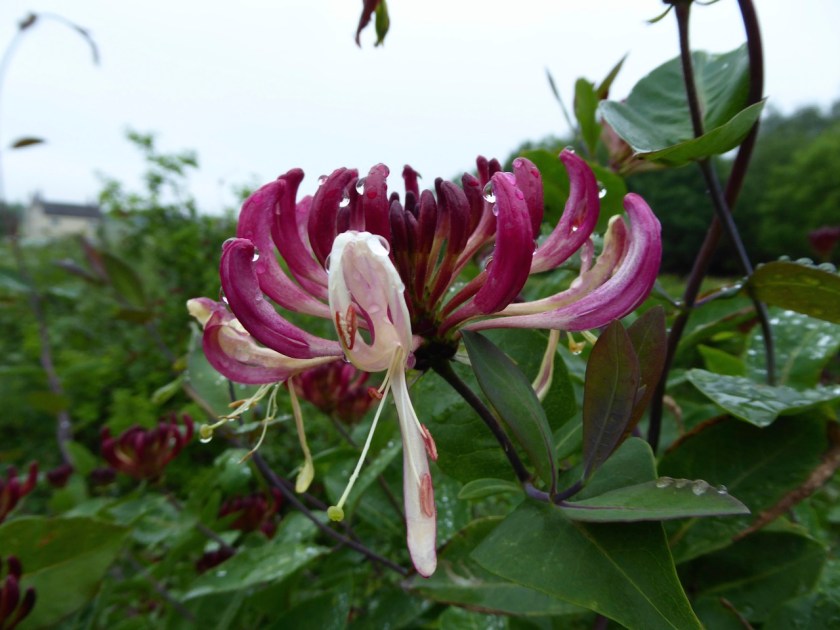
May 29th – Just over a week ago I noted that the honeysuckle bush overgroing the barrier at the Black Cock Bridge was in bud. Today, on another wet, grey commute, I noted that the shrub was now coming into flower. Already, it smells delightful, and is becoming a riot of colour, from yellows to dark, dark crimson, and every shade inbetween. 

Honeysuckle grows like a weed these days in many hedgerows, scrubs and canal embankments. It’s delightful, and the insects love it. It fascinates me and always looks a little prehistoric.

May 28th – I took loads of photos of flowers on the canal bank tonight. They looked super in the rain.

Sadly, the lens had an unnoticed rain smear on it and they were all terrible. Such is life.

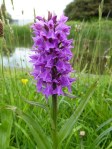
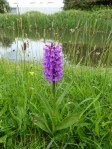
I did manage to record more marsh orchids. Not sure if they’re the same kind as the northern marsh orchids of yesterday – these are some way away – but they look similar. I’m fascinated by them, as they seem to be recent arrivals here. I’m sure I’d have noticed such a gorgeous flower before. 
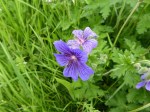
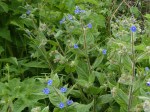
Thanks to Susan, Guest and Indesperateneedofsomeadventures for wildflower identification corrections and advice yesterday. I’ve come to the conclusion I’ll never be any cop with botany. I really am useless with the flowers.

However, I have decided my guide book is cobblers – I’m using the Collins Guide, and the pictures are too small (which explains maybe why I default to mallow!) – what guide would folks recommend? The internet isn’t much use for identifying flora and fauna.

Suggestions gratefully received!

May 28th – A foul commute to and from work, characterised by constant drizzle, wet greasy roads and drivers not concentrating. Nearly wiped out on the way to work, a lady pulled out on me from a factory forecourt so closely her car snapped the reflector off my rear mudguard. Had I been slightly slower, she’d have clipped my wheel and I’d have been off. She didn’t even stop.

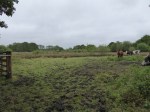
Returning on a no less intemperate journey home, I was cheered to see the cows still on Jockey Meadows; a fair-sized herd, there seem to be about 12 or 15, and they were looking wet and fatalistic as only cows can. 

I’m convinced they’re here to maintain the meadow and churn it up, whilst spreading the fertile love in the form of cowpats. They certainly seem to be having a good go. 

They were fascinated by me and my bike. I’m sure they’d all have come to the gate had I waited long enough.
May 27th – I got taken to task by a good pal the other day for suggesting – erroneously in their view – that the summer blooms were purples, reds and darker colours. Yes, there are some yellows and whites, but just look at these, all spotted in a 30 meter section of Aldridge canal bank.

I’m just about to make a prat of myself and name them, but welcome correction from anyone. Are you there Susan? Wilymouse, perhaps?

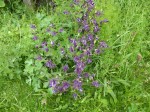
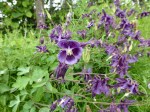
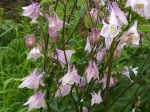
I think the top three are known as granny’s bonnet, aquilegia or columbine. I think the nest two are mallow. We have a rather excellent marsh orchid – first this year for me – then, I think, green alkamet.

Last one is a puzzle, but I’m guessing some sort of campion?

Whatever they are, they’re beautiful.

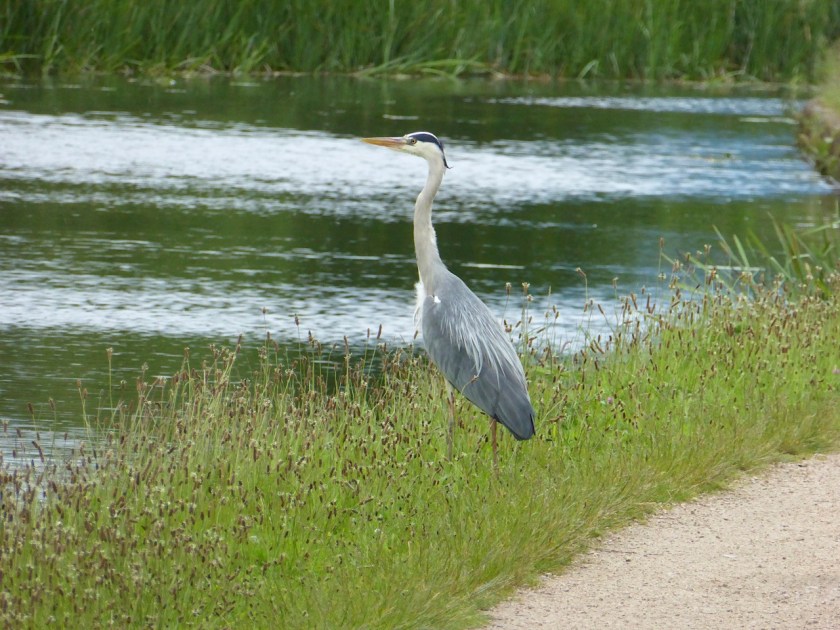
May 27th – Just on the canal in Aldridge, this skittish fellow. I gently placed the bike down to take a better picture. By the time I raised the camera again, he’d flown off.

This journal can never have too many herons. I adore these gangling, shabby and patient fishers. To me, they’re a symbol of the cleanliness of todays canals, and how far they’ve come. When I was a kid, you’d never, ever see this.

It’s a thing to treasure.