February 18th – I had a blast around Shenstone, Wall and Stonnall, and really blew the cobwebs away. Reaching the tiny hamlet of Chesterfield, I realised how nice it looked at sunset. The architecture here really is understated and gorgeous. It’s a shame that a couple of houses further up the village to wards Wall seem to be unoccupied…

February 18th – Down at the junction of Barracks Lane and Lichfield Road, in Brownhills, not far from where the Staffordshire Hoard was found, there’s a filed of horses, which I think belong to nearby Warrenhouse Farm. At the entrance to this field, I spotted this two delightful patches of snowdrops in the hedgerow. Beautiful and delicate, yet somehow hardy, they are a marker, a signal. THeir appearance means that spring cannot be far away…

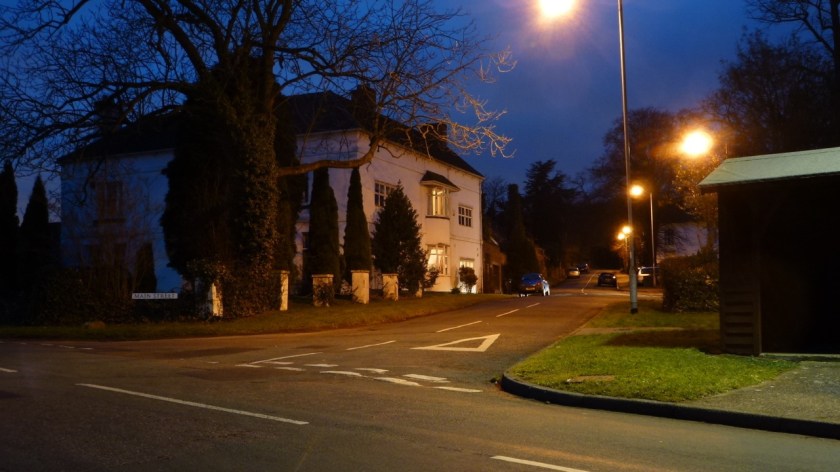
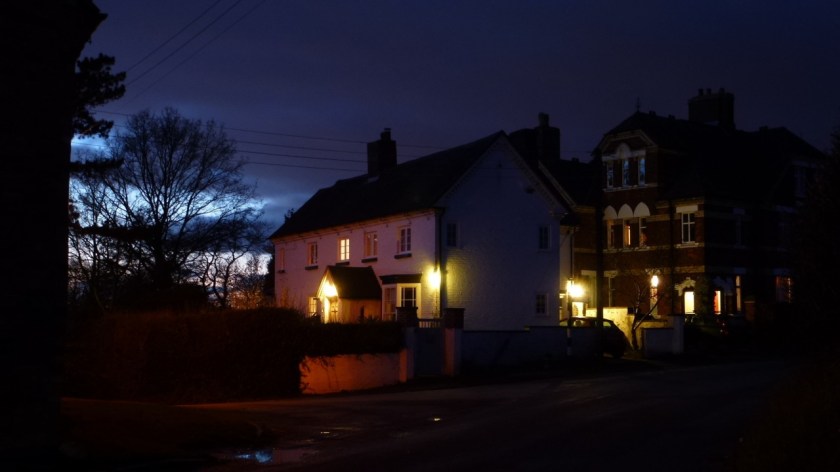
February 17th – Meanwhile, down in Stonnall, the village was as lovely as ever at night. By day, it’s plain, very modern-estate like, and somewhat redolent of Metroland; the village history utterly swamped by modern housing and unsympathetic pattern development, cashing in on the semi-rural cachet… By night, the character of the physical geography of the village comes out, and complex, historic buildings like the Manor House show their true imperiousness.

Taking night photos in Stonnall is odd. I always feel the twitch of curtains, and I never really feel that anywhere else. Beginning to wonder if it’s a Midlands Midwich, or possibly Stepford…

February 17th – Riding down into Stonnall from Brownhills for a change, just to stretch the legs a little at dusk, I stopped to take in the view from the entry to Shire Oak landfill – what used to be Sandhills quarry. Watching the lights come on over this landscape is always captivating. I could waste hours here, watching the light change and daylight pass into evening. It’s sad that the view – which is excellent – doesn’t lend itself terribly well to photography.

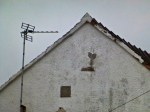
February 17th – I’ve no idea what’s going on here. This building, sat halfway along Lindon Road, Brownhills, was once a gent’s barbers. Latterly workshop of Maurice Baker, genius but grumpy engineer, it was converted back into a house in the mid-80’s. I’m unsure what the joke is or was, but whoever restored the building embedded the tail fin of a bomb into the gable wall just below the eaves. Originally painted red, it has fascinated me for years. There is, as far as I can tell, no record of the property being bombed. Anyone got any idea what it’s about?

The house has since been converted to flats and is in some disrepair. I’d love to know what this distinctly Brownhillian bit of wit is all about.

February 16th – Another odd feature of Brownhills (or at least, Brownhills West) is that we have – or had, until it was purloined by Shugborough – the oldest signpost in the country, allegedly. This wooden fingerpost is a modern replica, itself in a sorry state. The plaque at it’s foot tells the story. Until about 4 years ago, I had no idea this existed, and I found it by accident. I wonder what other surprises are lurking, yet to be found?

It actually says (to the east) ‘To Lichfield 5 miles, Tamworth 11 miles, Atherstone 17 miles’ and to the west ‘To Chester 61 miles, Newport 21 miles, Salop 35 miles’ and on the post ‘1777’ – I’d actually debate it being the oldest, but there you go…
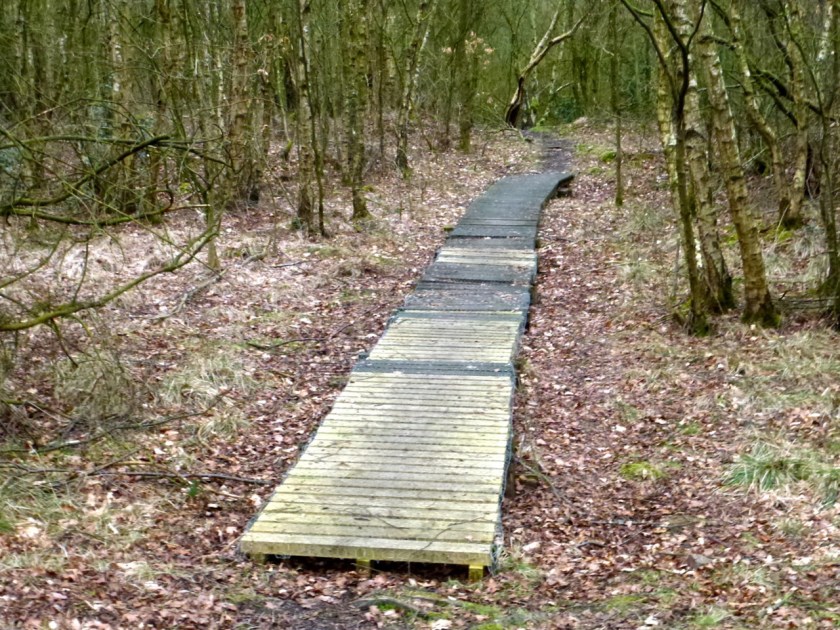
February 16th – There are some things that Wasall Council does very well. It’s countryside services and estates team are wonderful. Rangers, craftsmen and volunteers work hard to look after the acres and acres of common, heath, park and woodland that the borough covers – most of which remains unknown and unexplored to the majority of citizens, which is sad. Here, taking a spin round Brownhills Common on a grey Thursday I noted that someone is gradually repairing the boardwalk, and appears to be doing some coppicing. Excellent stuff.

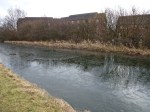
February 15th – Late afternoon, heading into Brownhills along the canal from Aldridge. The unseasonal warm weather seems to have returned, but the ice was still loosening its grip on the canal. As the last of it melted away, I noticed the fabulous crazing pattern it generated on the surface as it broke up and wasted to nothing. I was captivated by the fantastically complex patterns. The simplicity of nature can sometimes catch you quite unawares.

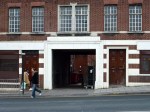
February 15th – One of the last vestiges of ‘old’ Park Street in Walsall isn’t actually to be found in Park Street at all – it’s in St. Pauls Street, just behind the old Bus Station Offices, themselves sited in what was built as the Victorian Blue Coat School. On a loading bay door, normally propped open with stillages, there’s a sign indicating that this is the correct entry to the bar of The Priory Hotel, which, as far as I recall, closed in the 1980’s. The access way now forms the loading bay to MacDonalds, but it is the clothes shop next to it that was the pub. Probably better closed, in my day it had a fearsome reputation. Now all that remain are this sign, classically 70’s Ansell’s brewery style, and the two odd mosaic artworks on the front.

February 14th – Hidden away in  back street of Walsall, surrounded by factories, sits a real gem. The New Inn – or Pretty Bricks, as it is known, is a real, bustling Black Country boozer. Offering a variety of real ale, a real fire and a lively bar, this pub has been a staple of traditional ale aficionados for years. In the late sixties and early seventies, there was a folk club upstairs where acts like Billy Connoly and Jasper Carrott gigged. It closed for a while, but the hostelry has reopened, and seems to have a good future ahead. The ‘Pretty Bricks’ name stems from the attractive, tiled frontage. This is a pub worth journeying to.