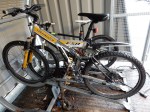
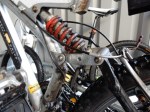
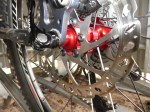
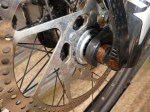
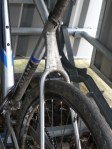
November 21st – In a familiar bike shed at a client’s premises, a neat illustration that the common or garden bicycle, whilst being a marvel of engineering in many ways, is still riddled with design conflicts and the whiff of mechanical compromise.

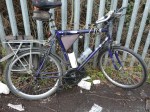
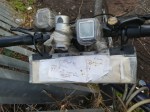
Here, a well-used and muddy mountain bike, not a cheap one by any stretch. The lack of mud and water shielding means and mud and detritus carried on the back tyre ends up not just as a skunk-stripe on the rider’s back, but also on the front gear mechanism and transmission.

In areas of hard grit like the Peak District, this continual spray works like grinding paste, gradually eating your wearing surfaces.

All for the want of some shielding.

Still, if you were a designer today, and proposed the derailleur system of gears – relying on forcing a flimsy roller chain between gears using side play as a conformal drag factor – you’d be laughed out of industry.

Except there’s nothing much better.

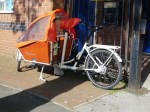
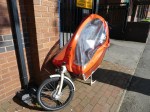
May 23rd – Spotted in Walsall late this afternoon, parked up outside the Saddlers Health Centre – this Dutch box bike, clearly used for transporting a child.

This one is made by Workcycles of Amsterdam, and features roller hub brakes, a nexus hub gear and small wheels. 

I’d imagine it weighs a tonne and rides like a tank. Majestic and stately come to mind – but what a wonderful thing.

My compliments to the pilot!

March 4th – Lovely to see the jumble still popular – it’s a yearly tradition, and much of the stock has been coming to this longer than I have – and that’s been a good few years now!

As ever, I bought a few things, but the enjoyment is seeing old faces (’The wagons not got you yet, Bill?’) reawakening old scores and shooting the breeze. And of course, studying the steeds and curious solutions of other utility cyclists.

It was nice to spot a John Perks original. Older readers may remember his shop in Aldridge.

I very rarely miss this – it’s the closest thing cycling in these parts has to culture.

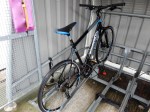
February 8th – A poor photo, but this could have been expensive. In the bike shed at Telford, a brand new, barely used Boardman bike. Like the Carrera a few days ago, a Halfords own-brand bike, and like Carrera, pretty good quality for the money.

Sadly, the owner isn’t familiar with this kind of cycle rack – his front wheel is in the channel correctly, but his rear beside it. Hooked over the channel at the back end of the rack, waiting to get bent or snapped, the bike’s rear gear mechanism.

I gently lifted it out, and later in the day, found the owner and explained to them how close they were to a costly repair – works bike sheds are far from gently places at knocking off time!

February 3rd – Also on the square, the tell-tale sign of a secondhand steed.

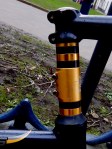
This road bike – a Carrera (Halfords own band) low end job – has been clearly bought by someone who’s a wee bit too big for it. The saddle is so high as to make the geometry look unsettlingly wrong, and the steerer – the fork tube the stem and handlebars mount from has been extended by a ‘suicide’ riser. This is a device to increase the height of the bars relying on clamps to keep it secure. 

Often the clamps slip or come loose, hence the nickname.

Finally, the flat bars are far from original.

People, buy a bike that fits, even secondhand. It’s a lot safer and comfier in the long run.

November 23rd – Spotted in a customer’s bike shed, this venerable, full suspension Specialized bike. In the day, I think this would have been a fairly expensive bike and it’s interesting to see the complexity of the rear linkages, which seem heavy and very intricate. Particularly noticeable is the pivot ahead of the dropouts, just on the chain stays.

Obviously well ridden as commuter, it looks like a hard bike to ride on road, particularly with those tyres – but I also note the old school leather shoe straps and general patina of road grime.

Other people’s bikes are endlessly fascinating.

September 20th – Spotted in a customer’s cycle shed, two bikes side by side that illustrate something that annoys me.

Shimano, the Japanese industrial giant that revolutionised cycling are not what many people imagine them to be. They are essentially production engineering experts, probably more than they are bicycle technology or fishing equipment manufacturers.

Shimano make loads and loads of great, well thought out products that I love. their work to refine the derailleur gear system in the 80s and 90s, their clipless pedal systems and electronic gear technology have changed cycling for the better immensely. But something more than these innovations has had a massive influence.

Shimano sell innovative kit to bike manufacturers. That means they also sell and produce the tooling to manufacture bikes en masse. Shimano often market products to manufacturers because they’re cheaper or easier to assemble on a production line, but sometimes of little discernible end-user benefit.

Shimano pioneered the external bottom bracket, a frankly piss-poor idea that is hated by lots of cyclists for it’s increased wear and susceptibility to corrosion. Shimano invented it to make assembly of bikes from one side far easier. It shifted to producers in large numbers and is now, sadly, ubiquitous.

Similarly, for years, bicycle disk brakes – which I love as a technology – had their rotors attached to the wheel hubs by six M5 screws, like the bike in the top picture. This ‘6 bolt’ design has been a standard for more than a decade, and works well. You can feel if there’s a securing issue without the loose disc being dangerous, and the rotors are light and easy to replace with standard workshop tools – usually an Allen or Torx driver.

Shimano recognised that a big cost in disc brake adoption to mainstream bikes was assembly of the disc onto the wheel – six screws require either a complex, mutispindle head or an operator repeating the same action 12 times per product. So they invented Centerlock(sic).

The lower picture shows a bike with a Centerlock rotor.

Centerlock uses a splined male dog on the hub, and a special brake disc with a mating female recess. The rotor slides onto the splines, and is held in place by the same type, thread and tooled ring that holds the gear cassette on a rear wheel, thus requiring one tool to fit the cassette and two brake rotors, a huge cost saving in production.

Centerlock rotors are heavier, and you need a special tool to fit or remove them. If the ring comes loose, there’s nothing else to hold it.They limit consumer choice of aftermarket replacements.

There’s a whole industry sprung up around centre lock to 6 bolt adaptors.

This change in technology was introduced purely for the benefit of bike manufactures, arguably to the detriment of consumers and to me, is inferior.

Rant over.

August 3rd – The delights of a client’s bike shed again: this clearly quite expensive Giant mountain bike confounded me. I’m sure it’s a great ride, but the number and quality of joints in the aluminium frame are astounding. Look at the fabrication in the seat tube to accommodate the unusual rear suspension arrangement.  And the joints and design on the upper seat stays where they meet the pivot seem bizarre. And the tyre clearance on that crossmember is minimal.

I don’t know how designs like this come about. Aesthetically, to me, it’s hideous, and I can’t see any engineering or user advantages. 

Is this complication for the sake of it?

April 27th – I keep noticing this Giant bike at Telford; I don’t know who it belongs to, but it annoys me irrationally every time I study it. Giant are an American brand whose bikes I’m not a huge fan of; like fellow US companies Cannonade and GT they often have a non-standard, peculiar approach to design resulting in bikes with odd features or incompatibilities, usually only noticed after purchase when something goes wrong.

This one annoys me for two reasons: one is design, the other is just happenstance. The rear seat-stay seems to be 2 parts, a U formed tube for the stays and a curious, welded linkage interpenetrating between the U form and seat tube. The weld, being aluminium, is rough, not square and looks absolutely awful. What on earth was the designer thinking?

The other thing is that rear quick release. Who would leave it closed facing backwards in such a vulnerable position? I want to sort it but would never touch another’s steed.

A mystery are the two M6 tapped holes on the non-drive side dropout; they aren’t present on the opposite side, and serve no apparent function, but designing them, machining them and fabricating the form they’re in was clearly serious effort. What are they for, does anyone know?

An odd bike. Never been fond of US designs.