February 9th – A puzzle, for sure. Shimano metal sintered disc brake pads for hydraulic brakes: what happens to them that renders them useless beyond recovery?

Usually the rear set, all of a sudden they loose stopping power,  and often become screechy. They are not contaminated with oil, although it feels like it. Deep cleaning in the dishwasher doesn’t work. Ultrasonic cleaner with solvent doesn’t, either. Neither does surface grinding as much as .75mm off the surface.

It’s like they just glaze, and some structural or metallurgical change takes place, and that’s it. Only thing to recover stopping power is new pads. Or using them in the rain; when wet, and only then, do they stop better.

At £20 a set, this is not fun. Anyone any ideas please?

March 11th – A nasty graunching from the rear brake on the way home was severe enough to have me check it out as soon as I got home. Much to my shock, I found the stock, soft resin-organic brake pads in my rear calliper were just a bit worn.

Ahem.

The new sintered metal ones are at the rear, the ones I took out in front. That’s bad. Should have spotted it sooner – luckily I don’t seem to have damaged the disc.

Never take your eyes of those essential maintenance tasks, people!

April 9th – Whoops. The bike I’ve been riding over the past few days has been having an issue with the front brake pats just lightly touching the disc. The noise was irritating me, so before I set out today, I got down to realigning the caliber, and then noticed the pads were a bit worn. Having spares on the bench, I whipped the old ones out.

Oh dear. The bad set, for those not in the know, are on the left, the replacements on the right. The pad on the one side is so worn, it’s to the metal, and the spring is mashed, too.

I also had an issue with the piston sticking. Hopefully that’s sorted.

Hydraulic brakes wear pads quicker. I must remember that. 

October 7th – An odd bike spotted in a rack near work. It was so odd, I had to take a closer look.

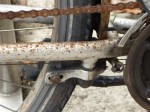
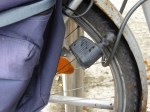
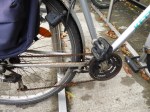
It’s a Kettler city bike. Kettler are, I believe, a German brand with an office in Redditch selling into the UK. It’s a large bike, and looks very heavy indeed. Dynamo lights powered by a bottle, rather than hub generator and rim brakes – the rear an unusual crossover cantilever design mounter under the chainstays – mark this bike out as being a cheap model. More expensive steeds of this type would have hub brakes.

The bike clearly needs some love – the chain was as dry as old bones and red rusty, as were many of the components. I’m tempted to pop back just to lube the chain. It must squeak like hell in use.

An unusual thing, for sure…

August 19th – I’m fussy about brakes. Very fussy indeed. Urban cycling – particularly in heavy traffic – demands the ability to control speed and stop with certainty and dependability in all conditions.

Since I discovered disc brakes a few years ago now, I’d never have a bike fitted with anything else. After using cable controlled versions – the excellent Avid BB7 – these days, I use hydraulic brakes by Avid (part of what used to be Sachs for old timers reading out there) and by Shimano.

They are both excellent kit. Being hydraulic, however, they absolutely devour pads.

Modern cycle disc brakes started on mountain bikes, where braking is usually short, or at relatively low speed. With similar units on commuting and road bikes, engineering questions of heat dissipation, wear and glaze on the pads are critical.

Discs and callipers get fearsomely hot very quickly. It’s not unusual to see my discs steaming on wet rides. Prolonged use can cause the surface of the brake pad to become shiny and lose grip, ‘glazing over’, and the wear is constant. 

There are two general types of brake pad; sintered metal and resin (AKA ‘organic’) – sintered last a long time, are great in the wet but can howl in use and wear discs heavily. Resin pads wear quickly, are silent, and generally offer softer control and better ‘modulation’.

I’ve been very, very pleased with the Shimano brakes, which have been on the bike for about 4-5 months now, but the resin pads they came with haven’t impressed me. The pads for these units come on a heatsinking vaned plate, and are very easy to change, which is a blessing as the rear set were never the same after I cleaned the bike using normal bike cleaner. The front ones glazed out a few days ago.

I went to sintered on the back when they became poor, and was shocked at the huge difference made, and the fact that so far they’ve been silent, so today, I popped some in the front, too. (The new sintered pad is on the left; the knackered resin on the right).

Braking harmony restored.

I must say, recent experience is leading me away from resin or organic pads.
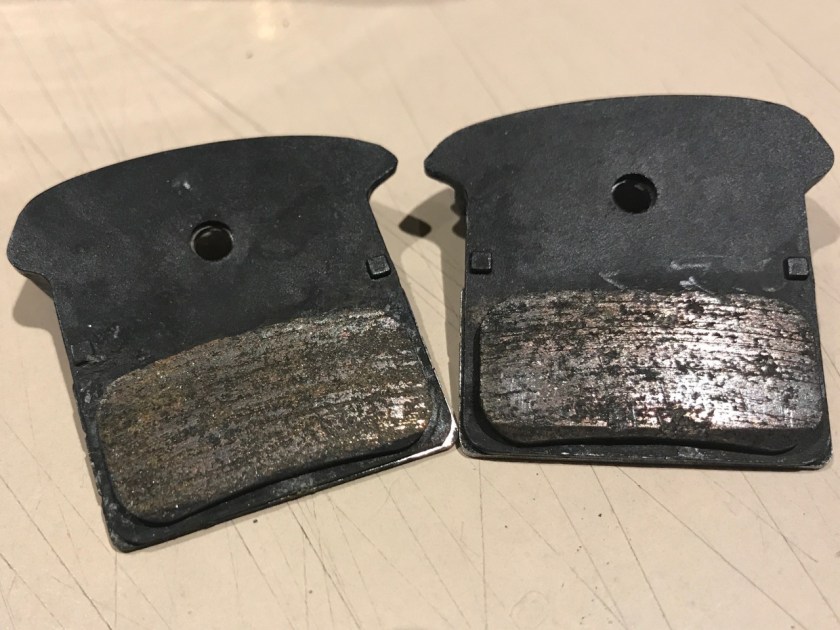
October 21st – Time for a techy bit. Disc brakes are my favourite kind of bicycle brake – resilient, reliable and good in the wet, they need care if they’re to maintain performance. The brakes on the current commuting bike are hydraulic, and very powerful; they eat brake pads, especially in wet weather. In the wet, the grit from roadwash and grindings from the pads and disc combine to make an abrasive paste that makes the brakes noisy in use and causes wear to all braking surfaces. After a wet ride, wherever possible, I flush the discs in clean water to clear any residue off. If this is ignored, larger particles become embedded in the pads and score the disc surface, impeding performance and causing high-pitched noise.

I’ve also noticed with these appreciable wear on the discs. These were changed 3,000 miles ago and I can feel now feel quite a step between the surface and unworn part of the disc.

If your bike has disc brakes, look after them, and they’ll be there when you need them. It’s especially important in weather like this.