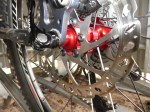
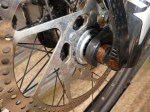
September 20th – Spotted in a customer’s cycle shed, two bikes side by side that illustrate something that annoys me.
Shimano, the Japanese industrial giant that revolutionised cycling are not what many people imagine them to be. They are essentially production engineering experts, probably more than they are bicycle technology or fishing equipment manufacturers.
Shimano make loads and loads of great, well thought out products that I love. their work to refine the derailleur gear system in the 80s and 90s, their clipless pedal systems and electronic gear technology have changed cycling for the better immensely. But something more than these innovations has had a massive influence.
Shimano sell innovative kit to bike manufacturers. That means they also sell and produce the tooling to manufacture bikes en masse. Shimano often market products to manufacturers because they’re cheaper or easier to assemble on a production line, but sometimes of little discernible end-user benefit.
Shimano pioneered the external bottom bracket, a frankly piss-poor idea that is hated by lots of cyclists for it’s increased wear and susceptibility to corrosion. Shimano invented it to make assembly of bikes from one side far easier. It shifted to producers in large numbers and is now, sadly, ubiquitous.
Similarly, for years, bicycle disk brakes – which I love as a technology – had their rotors attached to the wheel hubs by six M5 screws, like the bike in the top picture. This ‘6 bolt’ design has been a standard for more than a decade, and works well. You can feel if there’s a securing issue without the loose disc being dangerous, and the rotors are light and easy to replace with standard workshop tools – usually an Allen or Torx driver.
Shimano recognised that a big cost in disc brake adoption to mainstream bikes was assembly of the disc onto the wheel – six screws require either a complex, mutispindle head or an operator repeating the same action 12 times per product. So they invented Centerlock(sic).
The lower picture shows a bike with a Centerlock rotor.
Centerlock uses a splined male dog on the hub, and a special brake disc with a mating female recess. The rotor slides onto the splines, and is held in place by the same type, thread and tooled ring that holds the gear cassette on a rear wheel, thus requiring one tool to fit the cassette and two brake rotors, a huge cost saving in production.
Centerlock rotors are heavier, and you need a special tool to fit or remove them. If the ring comes loose, there’s nothing else to hold it.They limit consumer choice of aftermarket replacements.
There’s a whole industry sprung up around centre lock to 6 bolt adaptors.
This change in technology was introduced purely for the benefit of bike manufactures, arguably to the detriment of consumers and to me, is inferior.
Rant over.
 BrownhillsBob's #365daysofbiking