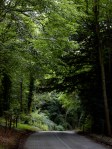
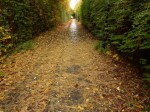
October 29th – As I noted a few days ago, Autumn is a beautiful, but hazardous season. The leaf littler on the cycleways is wonderful to look at but very slippery, and is now turning to a very soapy, lubricant mulch. Added into this are small twigs, various needles and fallen berries and fruits, often concealing potholes and other hazards. 

I normally mash up here hard and come back downhill even faster, but with conditions as they are, I take this route very gently at the moment, and avoid using the front brake as much as possible.

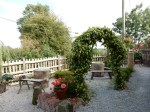
September 11th – I tried out Cobwebs coffee shop near Abbots Bromley – and fine tea and cake was enjoyed in a beautiful garden spot, which I seemed to be sharing with several hundred wasps. 

This is a great place and I will be back, and this sunny, warm afternoon was perfect for it.

August 30th – A grey day, but I needed a ride. It’s been a few weeks since I had a good one, what with the cold and everything else. Conditions were pleasant enough, and it was warm with a little drizzle.

I went out to Whittington, and back across the heath to Weeford. I forgot how nice Weeford is, and what a curious little marooned village it is: built as a demonstration of his architectural prowess by noted ecclesiastical architect John Wyatt, it clings to a hillside in rolling countryside bisected by the A38.

The late summer colour was nice, and the roads were peaceful.

I need more of this in my life.

July 3rd – As readers who follow me elsewhere will know, I have been extremely busy with work and other stuff in the last few weeks. Today was no exception and very heavy: I had an 2pm afternoon meeting near Eastbourne to attend, so I handballed my bike on the train, rode across London Village from Euston to Victoria, arrived at my destination – Polegate – and then took advantage of a great traffic free trail to arrive bang on time. 

In the early evening I returned, again crossing London, and got home near midnight.

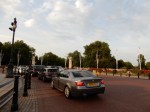
I loved cycling in London – around Trafalgar Square, down the Mall – and I understand a lot more why the city has such a notorious cycling reputation: If you leave 3″ of space, there’s either a tourist, a taxi or a cement truck in there. You have to be assertive, attentive, and dare I say it aggressive.

But what a blast.

I have spent most of the weekend after knackered. Maybe I’m getting to old for this shit…

June 16th – Bottom brackets are a pain in the arse. I can’t believe that after more than a century of cycling technological innovation, they’re still so rubbish.

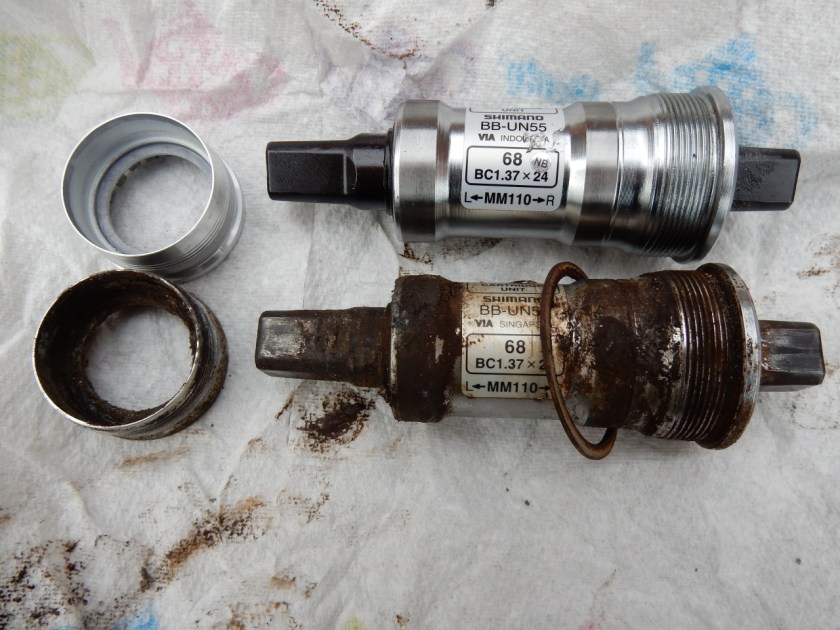
The bottom bracket is the spindle that the cranks mount on through the bottom of the frame, which spins freely allowing your pedals to rotate. As a mechanical component, the bottom bracket experiences the worst abuse – epicentric, unbalanced point loading, muck, water and corrosion. My bottom brackets take my full weight, plus that of the bike and load. They work hard.

Several solutions exist for bottom brackets – the component axle and loose bearings – the old way and fiddly to adjust and maintain; the ‘sealed cartridge’ (above) – a disposable insert designed for easy changing; the external – a frankly daft idea that’s gained traction in the last five years; the thoroughly insane press fit, preferred by the weekend Wigginses with plastic bikes.

All are rubbish, really.

On Sunday, I noticed the cranks on my bike had alarming play within the frame. The non-drive side bearing had collapsed in the cartridge. It’s done about 20,000 miles. Removing it is easy if you have the right tools and the person who fitted the last one did it properly. 

Cranks are removed with a special extractor, and the cartridge is removed with a special socket tool from the DRIVE SIDE. It is a left hand thread, meaning the unit is turned clockwise to unscrew it. That fact escapes many, and has led to loads of skinned knuckles and damaged frames.

The cartridge is left hand threaded to prevent it loosening in use due to precession.

There is a support bush on the other side that unscrews normally using the same tool. The threads are cleaned with a small wire brush and degreaser, dried, greased with anti-seize paste and the new one fitted. Half an hour tops.

If the threads are not greased, the unit will be very, very hard to remove in future.

A replacement is about £15-£20. I’ve tried expensive alternatives – they make no difference.

See you again in another 15-20,000 miles.
April 25th – A recovery day, mainly resting and pottering around attending to mechanical issues with the bikes. Long-term readers will remember my bizarre crank failure last spring, and at the time I suggested I’d never see it again: well, I was wrong. 

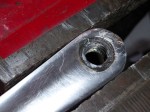
This is an identical Lasco crank from my other bike. There are clear cracks growing either side of the pedal mount bore. Thankfully, I had a spare so changed it over on discovery, hopefully forestalling an unexpected failure.

I‘m not sure if this is a poor design, manufacturing failure or a sign that I should lose some weight…

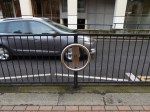
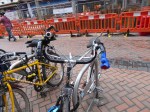
March 14th – Where do you leave a pair of bikes when you’re exploring a lost Mall? Well, loads of railings and street furniture nearby…

Cue rant.

Birmingham is a lousy city to cycle around at street level. For decades, the City Council have paid lip service to cycling, with a road system that routinely ignores the needs of more vulnerable road users, like Moor Street Queensway. They were given millions in cycle funding, which they used to resurface miles of perfectly good canal towpath.

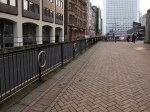
And then, there’s aresehattery of this calibre. No cyclist would ever have managed this. I guaran-damn-tee the person responsible for this act of civic idiocy last rode a bike in school.

What am I upset about?

Cyclehoops are the round fittings bolted to these railings. They are great items of cheap street furniture designed to be fixed to existing street furniture to provide anchor points for bike parking. We have some in Walsall on lampposts. They’re brilliant because they stop your steed flopping around the post, and provide a secure lock rail that’s hard to remove.

Oddly enough, railings already provide that feature.

Birmingham City Council bought a bunch of Cyclehoops and instead of fitting them in places where they would be useful, bolted them to railings that already perform the purpose Cyclehoops fulfil.

You normally have to make an appointment for this kind of idiocy.

Stick a fork in the Council’s backside and turn it over, it’s done.

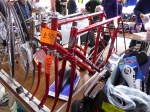
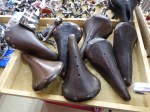
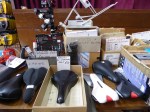
March 7th – Ah, the first decent ride of the year is always the day of Erdington bike jumble. Held at a church hall, it’s a chance to say hello to stuff I see at every such event (mainly bald tyres and old shoes), but also to old mates, acquaintances and to collectively jog each others memories.

Last year had been a muted affair due to a conflicting event, an I had wondered if this thing’s time had passed; but I arrived late for this one and it was still very busy. The usual old hands were there, but also the fixie kids and utility cyclists. There was also strong beardage from the hipsters. 

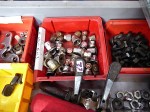
This is the kind of place where you find really, really odd bits you can imagine nobody ever needing again – like an ancient eccentric bottom bracket. I’ll let others work out for themselves what purpose that bizarre bit of cycling design serves. For cottered cranks, no less.

It was nice to see a venerable event back up to full health again.

March 5th – Never let it be said that I do not consider cycling a broad church; from the moment any of us owns a bike, we make it our own, unique. We confer upon it our patina, our personality and our individual stamp. We personalise, adjust the fit, add our own accoutrements, dial it in until it fits.

The handle bar area – christened by the great Bike Snob of New York blog as The Cockpit, is probably one of the most individual bits of any steed. I have a personal arrangement of controls, add-ons and positions on my rides that is unique, comfy and tried and tested.

However, wandering through Birmingham city centre on a dull  Thursday afternoon, even this easy-going freewheeler found a cockpit that confounded him.

The bars. The brakes. The light pointing at the ground. I’m hoping the owner has swivelled the bars up as a theft prevention technique, but I’m not convinced.

Coo, gosh! As Molesworth might say.

February 6th – I’m also getting used to the regular pebble-dashings from gritting trucks, spreading salt as a de-icer on the roads. As a cyclist, I’m generally quite slow moving, and because I ravel at particular times of day, my journeys often coincide with the council salt runs. On cold days they’ll be out in force, plodding down the roads of the borough, making the surfaces crunchy to ride on.

Many people have a mental block with grit: they expect it to be magic, like fairy dust, and when they find roads still icy, they’ll tell you the trucks never came, or that the council is useless. In reality, spreading rocksalt is not an exact science, and is only to improve conditions, not complete ameliorate them.

Driving skill we still be required after the glitter has gone.

I often feel for the crews, who work long hours on a generally thankless task. So I don’t mind the evening coating of grit.

Up the council gritter!