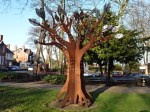
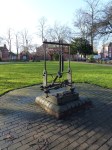
December 13th – Darlaston, like most places, seems to possess its fair share of public artwork. The sculptures in Victoria park have no plaques, but their root is fair clear; they’re harking back to an industrial past. I’m not sure if the hammer is a genuine old machine or a composite, but I can’t really see how it worked, whilst the tree seems to be suffering the same rust affliction that befalls the Walsall Wood Pithead. Looking like a child’s approximation of a tree, I find this sculpture odd; it’s hugely detailed in the leaves, which contain items of Darlaston’s past; nuts and bolts, washing machines (Servis were just down the road) and so forth, yet the ensemble gives the impression of something simplistic and cursory. I’m not sure the best tribute to a true seat of precision engineering should look like this, but folk seem to like it.
Tag: Darlaston

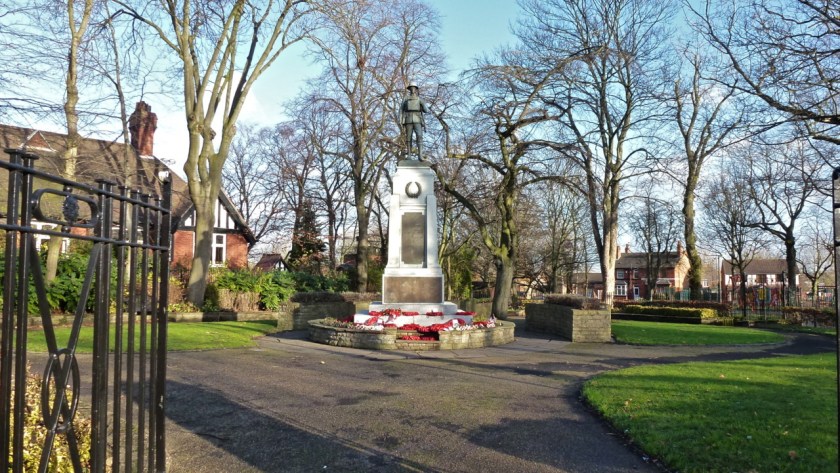
December 7th – The war memorial in Darlaston is also one of the best locally. Far more personal and intimate than that of Walsall, for me the only one to challenge it for beauty and presence is Wednesbury. I love the gardens and spaces to sit around it; the sympathetic, sharply observed Great War Soldier modelled on top. I love the way if fits beautifully into it’s urban environment, and the fact that there’s a playground and nursery nearby. I think those remembered here would appreciate the noises and joyful hubbub of the children playing nearby.

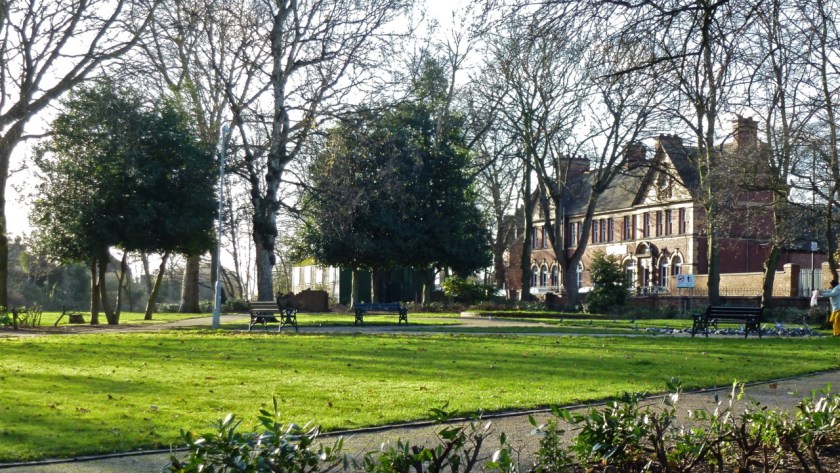
December 7th – On this bright, but rather windy winter’s morning, Darlaston was again looking stunning. Here, the Police Station overlooks Victoria Park. In summer, it’s leafy and green, and in this mild season, the view has opened out yet the lawns still remain verdant. This is the Black Country in all its aesthetic glory. Yet who outside of the immediate area knows of the beauty of this place? A tragedy that Darlaston is not better appreciated.

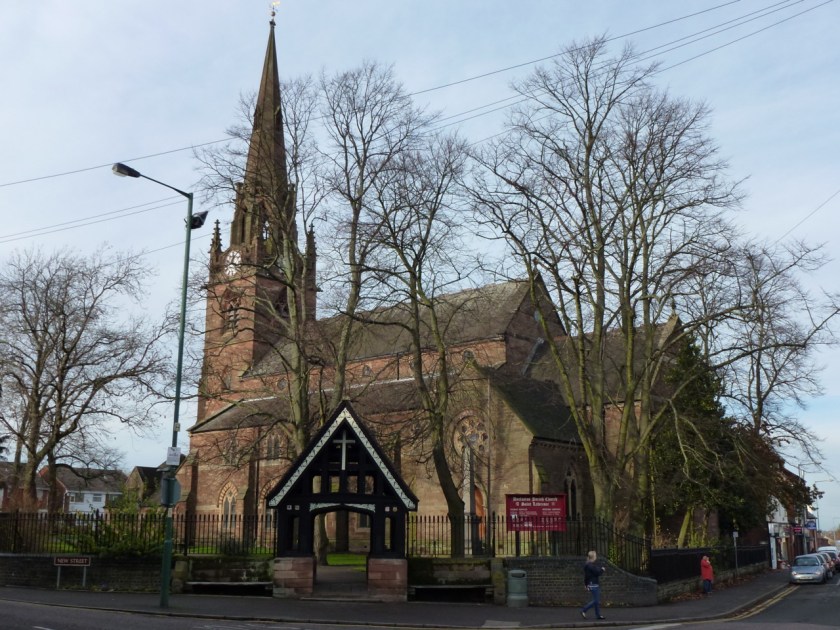
December 1st – One of the nicest things about winter and the defoliation of the trees is that it opens up views that in summer’s cauldron are concealed from view. Darlaston Church – normally hidden by the surrounding trees – is usually impossible to photograph. This is a shame, as St. Lawrence’s is a gorgeous example of the south Staffordshire sandstone epoch, with commanding, elegant spire and intricate clock. But please don’t cut back the trees, I love those, too…

December 1st -Darlaston is full of odd little corners. Often architecturally stunning, as I’ve previously noted, this villagey little Black Country town is also peppered with delightful green spaces of various sizes. The site of the former railway station, close to the centre of town, is now known as Victoria Park, and still maintains the profile of a cutting.This wonderful stretch of greenery is a quiet spot crossed by a lovely wooden bridge. The walkway beneath also extends under the busy Walsall Road, providing a safe underpass for pedestrians.
August 24th – On my way home at sundown. Walsall Road, Fallings Heath, Darlaston. Watch for the car coming out of the side road on the right. Lights on front and back didn’t stop this dozy woman in the black car from not seeing me. To compound the irritation, she smiled at me and waved me on, like I was in the wrong. They just don’t get it…

August 24th – Another late night at work, but I managed to escape by sundown. Cruising back through Darlaston and Pleck, the urban landscape was bathed in pleasant light. I noticed this house on the corner of an unmade drive on the Walsall Road in Pleck. It’s a peculiarly gingerbread house for this area of largely red brick terraces and townhouses. There are quite a few old, imposing homes on their road; it must have been quite important and exclusive in it’s day.

August 18th – Continuing this week’s Darlaton exploration (I’m working near here), I’m determined to show that this is a beautiful, complex and historic place. It’s easy to dismiss the Black Country as grimy, dirty and without aesthetic or cultural merit. That is wrong, very wrong. This is the top end of town, near the church and the beautiful and haunting war memorial. If you showed anyone from outside our area this picture, they’d never guess where it was taken. We don’t appreciate our area enough.
August 18th – It’s arguable that the most powerful economic force in the development of modern Darlastion was GKN, or Guest, Keene & Nettlefolds, a fastener manufacturing company that, until the 1980’s, loomed large in the Black Country industrial psyche. GKN had massive factories in Eastern Darlaston along Station Street, and companies that supplied them and competed were attracted nearby by the availability of skilled labour – Companies like Charles Richards, Kinnings Marlow and Deltight. GKN, of course, are still a massive powerhouse in British engineering, yet in the 1981, decided to end fastener production in the UK. Tens of thousands in Darlaston and Smethwick were made redundant. These were not just factories, but communities, that had their own doctors, carpenters and decorators on site. The National Blood Service used to come here for days on end, and blood donation was seen as an easy break by many of the workers who donated blood.
Here at Station Street, the GKN buildings remain, now housing ZF Lemforder and Caparo, both shadows of the manufacturer that abandoned Darlaston to the Wolves. GKN’s footprints are all over this town, and ingrained into the social history of this proud place.
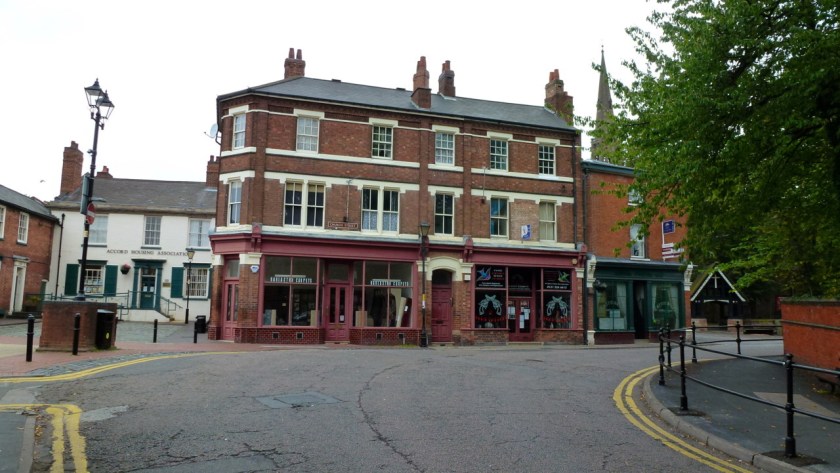
August 17th – The architecture of Darlaston – as I mentioned a couple of posts ago – is surprising and beautiful. There are some really grand, ambitious, but dignified buildings in the centre of town, yet who outside of Darlaston knows? Have you ever seen such a lovely post office or cop shop? Welcome to the real Black Country. It has a habit of taking your breath away.