January 25th – It perhaps hasn’t become apparent yet to most folk, but to cyclists and those bound to the outdoors, this has been quite a grim winter. 

We’ve had far more frosts this year than last, and consequently, there’s been a lot more salt on the roads. The damp but not terribly rainy conditions have led to a corrosive, goopy, sticky road grime that coats the bike and is taking a steady toll, particularly on the wheels and brakes. 

Investigating a rub tonight, I noticed the corrosion on the disc pads, and the badly grooved disc. Aluminium parts are developing a familiar white bloom. There is surface rust on the exposed bare steel surfaces of pedals and bottom bracket.

When the weather clears, all this will need attending to. 

September 20th – Spotted in a customer’s cycle shed, two bikes side by side that illustrate something that annoys me.

Shimano, the Japanese industrial giant that revolutionised cycling are not what many people imagine them to be. They are essentially production engineering experts, probably more than they are bicycle technology or fishing equipment manufacturers.

Shimano make loads and loads of great, well thought out products that I love. their work to refine the derailleur gear system in the 80s and 90s, their clipless pedal systems and electronic gear technology have changed cycling for the better immensely. But something more than these innovations has had a massive influence.

Shimano sell innovative kit to bike manufacturers. That means they also sell and produce the tooling to manufacture bikes en masse. Shimano often market products to manufacturers because they’re cheaper or easier to assemble on a production line, but sometimes of little discernible end-user benefit.

Shimano pioneered the external bottom bracket, a frankly piss-poor idea that is hated by lots of cyclists for it’s increased wear and susceptibility to corrosion. Shimano invented it to make assembly of bikes from one side far easier. It shifted to producers in large numbers and is now, sadly, ubiquitous.

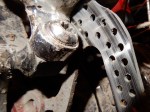
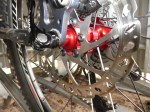
Similarly, for years, bicycle disk brakes – which I love as a technology – had their rotors attached to the wheel hubs by six M5 screws, like the bike in the top picture. This ‘6 bolt’ design has been a standard for more than a decade, and works well. You can feel if there’s a securing issue without the loose disc being dangerous, and the rotors are light and easy to replace with standard workshop tools – usually an Allen or Torx driver.

Shimano recognised that a big cost in disc brake adoption to mainstream bikes was assembly of the disc onto the wheel – six screws require either a complex, mutispindle head or an operator repeating the same action 12 times per product. So they invented Centerlock(sic).

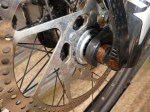
The lower picture shows a bike with a Centerlock rotor.

Centerlock uses a splined male dog on the hub, and a special brake disc with a mating female recess. The rotor slides onto the splines, and is held in place by the same type, thread and tooled ring that holds the gear cassette on a rear wheel, thus requiring one tool to fit the cassette and two brake rotors, a huge cost saving in production.

Centerlock rotors are heavier, and you need a special tool to fit or remove them. If the ring comes loose, there’s nothing else to hold it.They limit consumer choice of aftermarket replacements.

There’s a whole industry sprung up around centre lock to 6 bolt adaptors.

This change in technology was introduced purely for the benefit of bike manufactures, arguably to the detriment of consumers and to me, is inferior.

Rant over.

August 1st – A mechanical mystery. Three month old Shimano hydraulic brake pads, which suddenly lost grip and appeared to be glazed or contaminated. The pads are the sintered metal type and are genuine manufacturer parts.

Sometimes, long periods of braking can ‘glaze’ pads. causing them to become highly polished and shiny, meaning they don’t work well. The common treatment for this is to file the surface of the pad and pop them back in. 

These I have degreased, cleaned, filed and even surface ground, but whatever I do they quickly glaze again. New pads of the same type were just fine.

Anyone got any idea what’s going on here? I’m wondering if overheating has caused the pad material to harden…

March 11th – A nasty graunching from the rear brake on the way home was severe enough to have me check it out as soon as I got home. Much to my shock, I found the stock, soft resin-organic brake pads in my rear calliper were just a bit worn.

Ahem.

The new sintered metal ones are at the rear, the ones I took out in front. That’s bad. Should have spotted it sooner – luckily I don’t seem to have damaged the disc.

Never take your eyes of those essential maintenance tasks, people!

April 9th – Whoops. The bike I’ve been riding over the past few days has been having an issue with the front brake pats just lightly touching the disc. The noise was irritating me, so before I set out today, I got down to realigning the caliber, and then noticed the pads were a bit worn. Having spares on the bench, I whipped the old ones out.

Oh dear. The bad set, for those not in the know, are on the left, the replacements on the right. The pad on the one side is so worn, it’s to the metal, and the spring is mashed, too.

I also had an issue with the piston sticking. Hopefully that’s sorted.

Hydraulic brakes wear pads quicker. I must remember that. 

August 19th – I’m fussy about brakes. Very fussy indeed. Urban cycling – particularly in heavy traffic – demands the ability to control speed and stop with certainty and dependability in all conditions.

Since I discovered disc brakes a few years ago now, I’d never have a bike fitted with anything else. After using cable controlled versions – the excellent Avid BB7 – these days, I use hydraulic brakes by Avid (part of what used to be Sachs for old timers reading out there) and by Shimano.

They are both excellent kit. Being hydraulic, however, they absolutely devour pads.

Modern cycle disc brakes started on mountain bikes, where braking is usually short, or at relatively low speed. With similar units on commuting and road bikes, engineering questions of heat dissipation, wear and glaze on the pads are critical.

Discs and callipers get fearsomely hot very quickly. It’s not unusual to see my discs steaming on wet rides. Prolonged use can cause the surface of the brake pad to become shiny and lose grip, ‘glazing over’, and the wear is constant. 

There are two general types of brake pad; sintered metal and resin (AKA ‘organic’) – sintered last a long time, are great in the wet but can howl in use and wear discs heavily. Resin pads wear quickly, are silent, and generally offer softer control and better ‘modulation’.

I’ve been very, very pleased with the Shimano brakes, which have been on the bike for about 4-5 months now, but the resin pads they came with haven’t impressed me. The pads for these units come on a heatsinking vaned plate, and are very easy to change, which is a blessing as the rear set were never the same after I cleaned the bike using normal bike cleaner. The front ones glazed out a few days ago.

I went to sintered on the back when they became poor, and was shocked at the huge difference made, and the fact that so far they’ve been silent, so today, I popped some in the front, too. (The new sintered pad is on the left; the knackered resin on the right).

Braking harmony restored.

I must say, recent experience is leading me away from resin or organic pads.

October 21st – Time for a techy bit. Disc brakes are my favourite kind of bicycle brake – resilient, reliable and good in the wet, they need care if they’re to maintain performance. The brakes on the current commuting bike are hydraulic, and very powerful; they eat brake pads, especially in wet weather. In the wet, the grit from roadwash and grindings from the pads and disc combine to make an abrasive paste that makes the brakes noisy in use and causes wear to all braking surfaces. After a wet ride, wherever possible, I flush the discs in clean water to clear any residue off. If this is ignored, larger particles become embedded in the pads and score the disc surface, impeding performance and causing high-pitched noise.

I’ve also noticed with these appreciable wear on the discs. These were changed 3,000 miles ago and I can feel now feel quite a step between the surface and unworn part of the disc.

If your bike has disc brakes, look after them, and they’ll be there when you need them. It’s especially important in weather like this. 

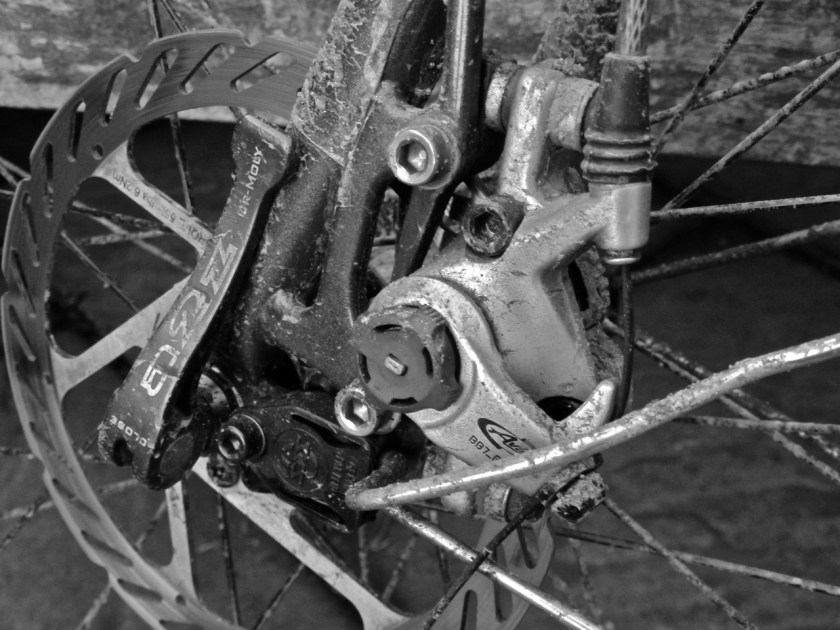
January 28th – I’ve not mentioned much about the bike technology on this blog, which is a bit odd, really, because without it, I wouldn’t be able to ride like I do. One of my favourite innovations of the last ten years or so is the road disc brake. This model – the Avid BB7 – is designed to work with road, rather than mountain bike setups and levers. It is cable operated and stops you on a sixpence, wet or dry. There’s no rim wear, no rubbing, and the pads last for ages. Maybe not quite as good as a top-end set of hydraulic discs, but not far off in my opinion. All my bikes have disc brakes, fantastic things.