March 14th – Brooks Saddles. Made and broken in the Midlands.

I love a Brooks leather saddle – made in Smethwick for a century or more from real leather, they’re a marmite thing amongst cyclists – you ether love them or hate them. I adore them; I’ve ridden on a Brooks for tens of thousands of miles and I’ve never found anything that fits my ample arse better. 

However, some aspects of them are not great. the ‘Brooks creak’, where at an indeterminate point after breaking in, the thing squeaks noisily for 400 miles or so no matter what you do to relieve it; the sometimes middling build quality can be disappointing; but both of these pale compared to the real annoyance – poor quality tension pins.

The two metal objects above should be one piece. This bolt sits in a yoke from the saddle rails to the nose, the nut adjusting the tension of the whole thing. It rarely needs adjusting, but it takes the entire weight of my resplendent girth.

Until it fatigue-snaps on the way home. 

They are a bugger to replace, and cost a fiver a time. To snap like this (and it’s a common, longstanding moan with Brooks customers) the component is poor quality. It would be easier to fit were it threaded to the boss. The whole thing is weak and shoddy. That’s very poor for a £60 saddle.

It left me with an uncomfortable, rattly ride home and a horrid workshop job to do. 

But I still wouldn’t entrust my posterior to any other brand. 

Brooks you muppets, sort it the hell out. Please.

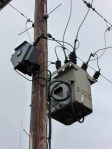
December 18th – Geekout time again. I nipped in to Shenstone in the morning to beat the storm and pick up a Christmas present. On my way, the wind blew me down Bullmoor Lane to Chesterfield, near Wall. On the bend near Raikes, there’s been an electricity pole for years that’s fascinated me. It has a really complicated arrangement of equipment mounted upon it, and it’s effectively in the middle of nowhere. I’ve always been interested in it’s purpose, so I resolved to find out.

After a fair bit of googling, it’s an ‘automatic recloser’, and a really high-tech piece of equipment with a simple purpose; it’s an 11,000V breaker, performing the same kind of job as the ones you get in a modern domestic fusebox.

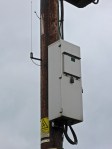
It consists of the unit that switches on and off the supply – the big box at the top, which breaks the three phase supply voltage present on the lines above, and an electronic control unit called an ADVC, which detects when there’s a fault, such as overcurrent in the load. A small transformer sits high up to supply the ADVC.

The ADVC reads the signals in the line, like voltage and current, and should it detect a problem, it disconnects or ‘opens’ the recloser, breaking the supply. Since most faults with overhead lines like this clear themselves quickly (they may be weather, vegetation or vermin related, for instance), the ADVC monitors the disconnected line and automatically recloses – reconnecting the supply – automatically.

The system is monitored by complex electronics with a computerised controller, and can communicate by radio telemetry, hence the antenna; it even has batteries so it can keep working if it’s own supply is interrupted.

I’ve been meaning to find that out for years… you can read more here.

This project takes me to some strange places, sometimes…