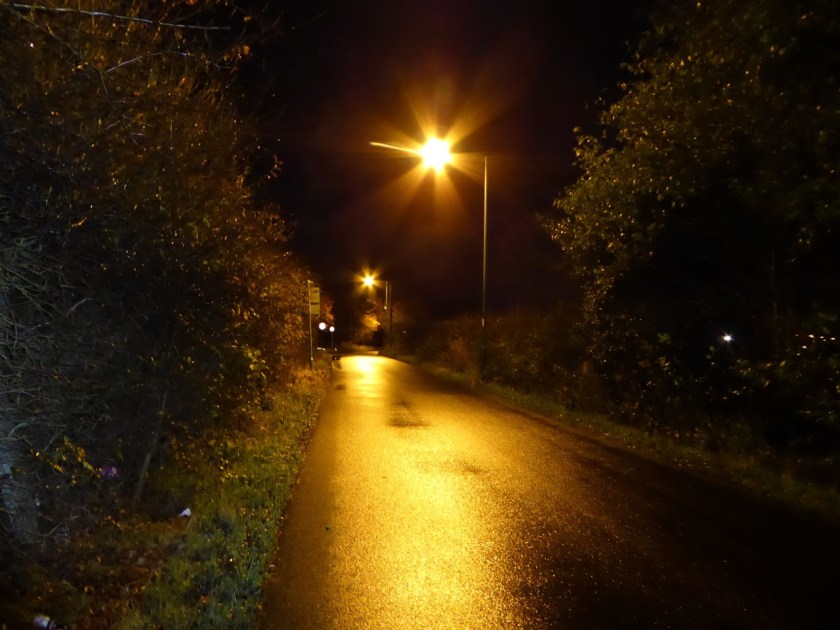
December 8th – A grim day in which everything went wrong, including leaving home with a flat camera. At work, I recharged it, but I left for home in steady rain and got as far as High Heath before I felt motivated to use it.

Today, the ride in had been dogged by wind and a mechanical issue, work itself had been a succession of protracted difficulties and conflicts, and the ride home was wet and I was without waterproofs. I stopped in a deserted, wet Green Lane, this desolate view is exactly how I felt.

Tomorrow will be better. It has to be.

November 25th – Another good one for Bob’s big book of bizarre mechanical failures. A few weeks ago I bought new cycling shoes and fitted new SPD cleats – the small pieces of metal that lock into the pedals for better engagement in place of toe clips – as is normal. I nipped up the screws, and gradually adjusted them for best cleat position.

Riding to work this morning, it felt like my left side cleat was clogged with mud or debris, and I had difficulty engaging and disengaging. As I went on it became more and more tricky. Arriving, I inspected the leat and found it had come loose and was rattling freely.

I have never had this happen before and am very surprised.Potentially very dangerous, I’m glad I found it trying to clip in and not out.

If you use lipless pedals, check your cleats for tightness today.

November 11th – As bike gear gets cheaper and the drive to reduce weight continues, lots of stuff is getting crappier. I’ve always liked Sigma bike computers – cheap and well engineered. However, the last one has a particularly loose twist-lock mount. Today, it spun from the holder on the bars in traffic, and before I had chance to recover it, it went under the wheel of a car. This is the result.

From lights to GPS units to bike computers, bike mounts are getting crappier. Can we stop weight shaving and cost cutting please?

June 17th – So help me god, I’ve been asked how you know if your bottom bracket needs replacing (see last entry, 16th June) – so I made a quick video. The old part is held in a vice over white paper for clarity. I’m wobbling the other end, out of shot. There should be no wobble at all.

Hope that helps!

April 25th – The void in the canal embankment on the bend between Pier Street and Catshill Junction is worsening. It’s been growing for two years as the brickwork collapses, and the Canal & River Trust don’t seem to be in any hurry to fix it. They are undertaking repairs further down to sections of embankment that don’t seem as badly affected. Hopefully, they’re working up in this direction.

To me, this is a serious hazard that could trap a walkers foot or bicycle wheel. Like the cover to the sluice up at Clayhanger Bridge, it seems just like the kind of hazard they should be on top of.

The Canal & River Trust have been informed of both issues repeatedly.

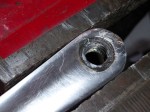
April 25th – A recovery day, mainly resting and pottering around attending to mechanical issues with the bikes. Long-term readers will remember my bizarre crank failure last spring, and at the time I suggested I’d never see it again: well, I was wrong. 

This is an identical Lasco crank from my other bike. There are clear cracks growing either side of the pedal mount bore. Thankfully, I had a spare so changed it over on discovery, hopefully forestalling an unexpected failure.

I‘m not sure if this is a poor design, manufacturing failure or a sign that I should lose some weight…

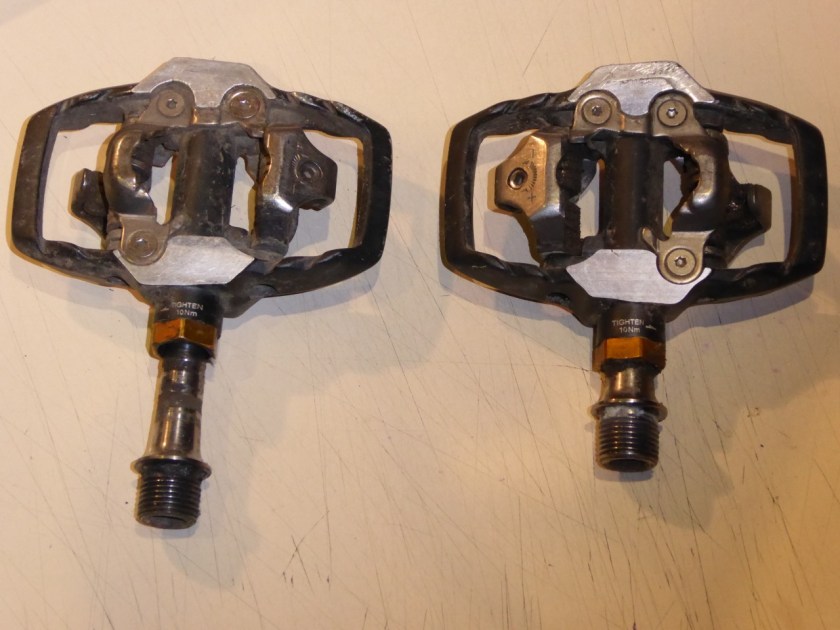
January 21st – another one for Bob’s big book of bicycle breakdowns. These are a pair of Shimano SPD XTR clipless pedals – the mechanism on them engages with a metal piece on the bottom of special shoes that means I ‘click in’ to them and can pull the pedals up as well as push down. 

These are considered a fairly high-end pedal, and have a platform – the black grooved frame – around them for additional foot support. They cost about £70 a pair, I guess and are generally good quality. This pair had done about 10,000 miles.

They are built around a cylindrical bearing held together internally by two nuts – an adjuster and a locknut, and this keeps everything adjusted and spinning without play.

Except when the threaded part snaps from fatigue, the bearing falls apart and the pedal tries to come off the spindle. The one on the right is normal, the one on the left, fatally broken.

Thankfully, it wasn’t far from home and was still ridable with care. That’s an unwanted expense in January…

November 7th – This is annoying. Just about every bike wheel has spokes of some sort, and their job is critical and load-bearing. As you ride, the spokes on the bottom of the wheel are in compression, and the ones at the top in tension, and as the wheel spins, the spokes are alternately pushed and pulled.

The do a lot of work considering they’re just 2mm diameter bits of stainless steel wire.

I carry lots of weight on my commuting bike – anything up to 20 kilos, and together with my resplendent girth, the wheels come under some stress, particularly on the pothole-strewn backroads of Walsall.

On Thursday, the bike felt odd on the back end. An inspection showed me that three spokes had broken, which need to be replaced. That’s a pig of a job, especially as they have broken at the rim end, which means removing the tyre and rim tape and replacing the nipples.

Today, I procured replacements and hoped to do the job when I got in – but it was far too wet and miserable.

I don’t know why the spokes failed; probably just excess weight and fatigue. But I’ve now lost trust in that wheel and wonder what else it has in store for me…

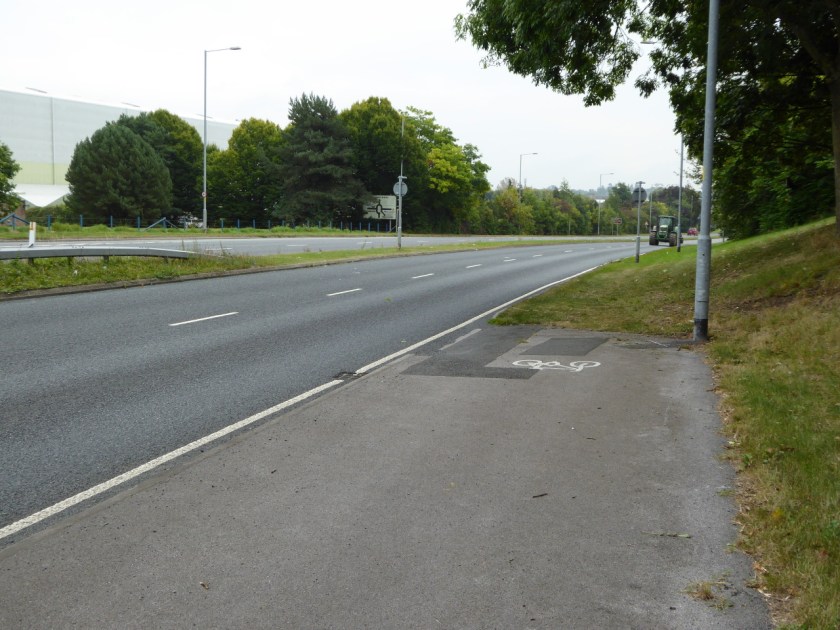
September 15th – I spent the afternoon in Droitwich. This piece of woeful, inexplicable cycling ‘infrastructure’ is precisely why we’ll never have nice things.

Do you think the designer gave any thought to cyclists going in the other direction?

(No, there isn’t a lane on the other side of the road; there isn’t even a pavement.)

July 23rd – Riding back home this evening, something shiny in the road caught my eye – lying on the edge of Green Lane in Shelfield, the debris from something that really shouldn’t happen. It’s a shattered bicycle sprocket.

This would have been part of the cassette, or rear group of cogs an the back wheel  of a cheap bike. It’s been used, as the teeth are worn, and the chrome coating ground through. Decent sprockets are made from high-grade alloys or steel, with some flexibility. Generally, they’re pressed or forged. 

This one is low grade steel, and has been made from cast material, making it inflexible and weak. It’s a fair assumption that under load, it’s cracked, and at some point catastrophic failure has occurred, and other debris in the road suggested as much.

Cheap supermarket or discount store bikes are often fitted with this kind of cheap componentry and fail in this kind of manner. Deprending on when it failed, this kind of breakdown could be very serious, and cause the rider to be injured – imagine if this had happened when cycling up a steep hill, like Black Cock Bridge, further on?

If you need a decent bike, and haven’t got much cash, a better option is to look out for a decent secondhand steed. You’d be surprised what you can get from Gumtree or the small ads for the same money.

A very, very cheap bike really isn’t worth the risk or hassle. They’re cheap because they’re made out of cheese, bus tickets and spit…