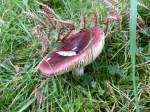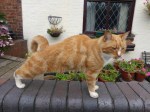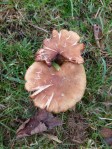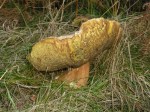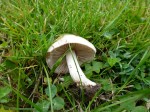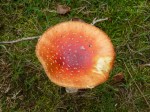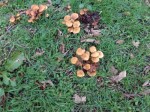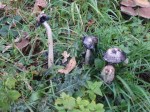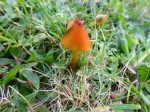
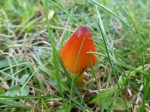
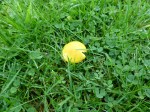
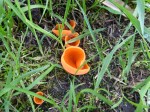
October 15th – Victoria Park, Darlaston is an embarrassment of fungal riches at the moment. I spun through on a misty, wet morning where the only colour I’d seen was the red of brake lights, and noticed several brightly coloured types of fungi in the freshly mown grass. The orange curly one I’ve never seen the like of before, and I love the little yellow button. There was a plentiful supply of shaggy manes, too, which the grass cutters had clearly mown round when attending to the rest of the park. I liked that – a nice touch.

Such welcome colour on a dull morning commute.

October 5th – I went up on the Chase for a short, late afternoon blast. I was keeping an eye out for interesting fungus, as that’s one of my favourite things about the season. I was trying to find decent fly agaric in particular, but all the examples I found were either old, badly damaged by slugs or very young. Other than those, there was disappointingly little. Perhaps I should have tried a less well-used part of the Chase…

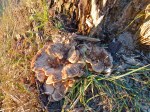
September 1st – A dull, unremarkable autumn day, with a steady, draining wind. I headed out to Middleton and back along the canal through Tamworth to Hopwas. At Camp Road, I spotted a massive bracket polypore fungus growing at the foot of a huge oak tree. This fungi was the biggest I’ve ever seen. It must have been 20 inches wide, and seemed to be supporting a variety of bug life all of it’s own.
Near Bassetts Pole, hops growing wild in the hedgerow.

The view of Middleton over the fields is still gorgeous, and the cat at the lock cottage in Bodymoor Heath was an affectionate, sociable chap.

The day finished with the most remarkable sunset I’ve ever seen. But more of that later…

August 25th – One good thing about the coming autumn is it’s the fungi season. I love all manner of the mycology – toadstools, puffballs, mildews, moulds, brackets and more. I love the fact that what you’re seeing isn’t the organism itself, just the flower and that the parent life form can be huge and underground, with maybe dainty little caps showing. I also love the lifecycle, speed of change and development.

These examples were at Penkridge Bank, on Cannock Chase. Bring it on.

November 4th – With all the rotten tree stumps left in Chasewater’s dam after the felling operation as part of the restoration, there’s now an impressive crop of assorted fungi in evidence. The rusula and glistening ink caps pictured here are amongst several species evidently thriving there. I haven’t seen much fungi about this year, it doesn’t seem to have been a very good season. 

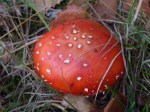
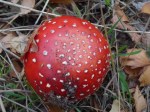
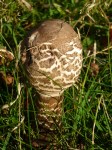
October 14th – The fungi seems to be doing well, too. This is possibly the most perfect specimen of fly agaric I’ve ever seen. This is the classic, spotty toadstool of fairy tales, and is considered toxic, and possibly hallucinogenic. This proud fellow was growing beneath silver birches, as they often do, in a front garden in Hilton, near Wall. The second one is a mystery to me: I know not what it is, but it’s massive. A foot in diameter, the stalk is thicker than my forearm. It’s clearly quite aged, and seems to be host to several sorts of insect. It was growing on a verge in Summerhill. I don’t think I’ve ever seen such a large toadstool.

October 5th – One of the best things about autumn is the sudden and prolific emergence of the mycology.  Yesterday, there was nothing of note on this twenty-metre long, 1 meter wide grass edge in Telford. Today, after a cold, damp night, two different types of puffballs, tricholoma,, field mushrooms and tough-shanks variously peppered the damp grass. What isn’t often appreciated about these curious fungi is that they aren’t separate organisms; the surface growth is merely a bloom for a surface, or subsurface organism. How cool is that?

November 26th – The unseasonably warm weather is providing some unexpected surprises, one of the most visible of which is the profusion of fungi still appearing on a daily basis. The fly agaric by the canal at Newtown, in Brownhills, are still in fine fettle and throwing up new caps daily, while the blumells near Shenstone Park look fresh and tasty. Alonside these are a whole host of others – polypores, brackets, puffballs, ceps and caps. I don’t think I’ve ever seen such a good year for the mycology.

October 8th – It seems to be a good year for fly agaric, the classic fairytale toadstool. They grow near birches and I’m usually lucky to see a handful or so – this year they’re all over the place. These excellent specimens were spotted on the heathland near the spillway at Chasewater, between the canal and the dam road. Considered toxic, and used as a hallucinogen in some cultures, these bright fungi have an otherworldly aurra, even odder when you consider that the white spots drop off as they age. Nature: always doing stuff just to get attention.

September 29th – A gorgeous indian summer day. I escaped to the Chase for the third time in a week, and explored again the area around Brocton and into the Sherbrook Valley. I made a half-hearted attempt to find Freda’s Grave, which is near there, but I didn’t have it marked on my map and was ultimately unsuccessful, but I’ll return another day. Freda was an army mascot for a regiment stationed on the chase, and a commemorative stone was laid in her honour. 

What I did find, however, was an astounding array of fungi sprouting up. Blumels, puffballs, chicken of the woods. This most peculiar autumn is well into it’s stride, but I think the sun has yet to get the message, thankfully.