#365daysofbiking Approaching equity

March 14th – One of the nice but pointlessly geeky things about riding with a GPS bike computer is the ability to see sunrise and sunset times change every day.

That’s not so great when nights are closing in, but when they’re opening out, it’s lovely to watch; and one of the things that always makes me happy is the spring equinox.

The science of the equinox/equilux is basically beyond me but the equinox is when the length of day is equal to the length of night, and the difference between sunset and sunrise is 12 hours. I always find it intriguing that thins’t smack bang at 6pm and 6pm, which would be neat, but usually around 6:15.

Every year this gets me, and every year I’m as delighted and inspired by it.

Find out more about the science of the equinox here.

This journal is moving home. Find out more by clicking here

from Tumblr https://ift.tt/2wsZu7U
via IFTTT

September 26th – Interested and fascinated to note that the restored windmill at Longdon that I photographed a week ago actually has a sailed that rotates with the wind as required – note the sails are on a different side of the building this week.

That mill has to be a tour de force of mechanical geekery… I love it.

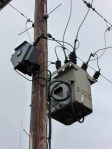
December 18th – Geekout time again. I nipped in to Shenstone in the morning to beat the storm and pick up a Christmas present. On my way, the wind blew me down Bullmoor Lane to Chesterfield, near Wall. On the bend near Raikes, there’s been an electricity pole for years that’s fascinated me. It has a really complicated arrangement of equipment mounted upon it, and it’s effectively in the middle of nowhere. I’ve always been interested in it’s purpose, so I resolved to find out.

After a fair bit of googling, it’s an ‘automatic recloser’, and a really high-tech piece of equipment with a simple purpose; it’s an 11,000V breaker, performing the same kind of job as the ones you get in a modern domestic fusebox.

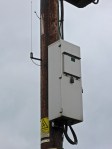
It consists of the unit that switches on and off the supply – the big box at the top, which breaks the three phase supply voltage present on the lines above, and an electronic control unit called an ADVC, which detects when there’s a fault, such as overcurrent in the load. A small transformer sits high up to supply the ADVC.

The ADVC reads the signals in the line, like voltage and current, and should it detect a problem, it disconnects or ‘opens’ the recloser, breaking the supply. Since most faults with overhead lines like this clear themselves quickly (they may be weather, vegetation or vermin related, for instance), the ADVC monitors the disconnected line and automatically recloses – reconnecting the supply – automatically.

The system is monitored by complex electronics with a computerised controller, and can communicate by radio telemetry, hence the antenna; it even has batteries so it can keep working if it’s own supply is interrupted.

I’ve been meaning to find that out for years… you can read more here.

This project takes me to some strange places, sometimes…

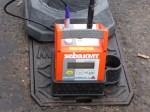
November 28th – Oh my, this is a geeky thing. I spotted on the pavement near the Warwick Road near Sparkbrook. It’s a small, orange box with a radio antenna, and some kind of display. From it, there’s a signal cable popped through the access cover of a fire hydrant. There was nobody in sight and it just sat there, protected by a road cone.

This is actually part of a very clever water leak detection system made by SebaKMT, a measurement technology company. This rechargeable device is one of two recorders placed near a suspected water leak. An audio sensor is attached to the pipe beneath the cover from each recorder, and both units ‘listen’ to the noise made by the escaping water transmitted up the pipework.

The data from each is broadcast wirelessly to a third device, held by a technician, and that calculates the exact distance of the leak down the pipe from the sensors, by time lag in the audio signals recorded.

By taking several measurements, it can pinpoint within centimeters the place where engineers should dig to fix a leak that may not e evident on the surface. Such devices can save a huge amount of time and money to utility companies.