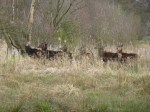
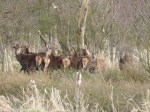
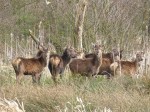
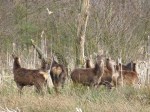
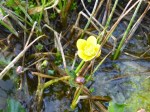
April 19th – I hadn’t wandered over Jockey Meadows for years – I must do it again. Leaving the bike in the hedge, I waded through the water meadow towards the deer. The land here is saturated, and appears very fertile. Globeflowers are in bloom, and frog, toad and newt spawn are evident in the shallow water (frog spawn is in clumps, toad in ribbons. Newt spawn is laid in small pockets on the stems of underwater plants or in the curls of leaves and fronds). There is a healthy greenness here. I can see why the deer love it. This is a Site of Special Scientific Interest, and I can see why.

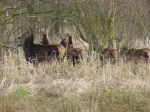
April 19th – I saw them fleetingly in the distance, and thought they were horses. Stopping to take a better look, I realised there was a group of at least 4 red deer in the middle of Jockey Meadows, between Green Lane and Lichfield Road, Walsall Wood. Crossing the wetland to get a better shot, it was very, very boggy, but I discovered there was quite a large, mixed group; largest I’ve ever seen here. Half the group disappeared from view as I approached, I’d say the total was maybe 20-25 animals. I can see why they like it here; open watermeadows for browsing with low scrub for cover when eeded. So wet, they get little disturbance (I was wading through marsh 6-10 inches deep), no dogs and plenty of fresh sedges and other greens.

I love the deer. They’ve probably come up from Brownhills Common, scared off by the noise of all the anti-heathland protestors…

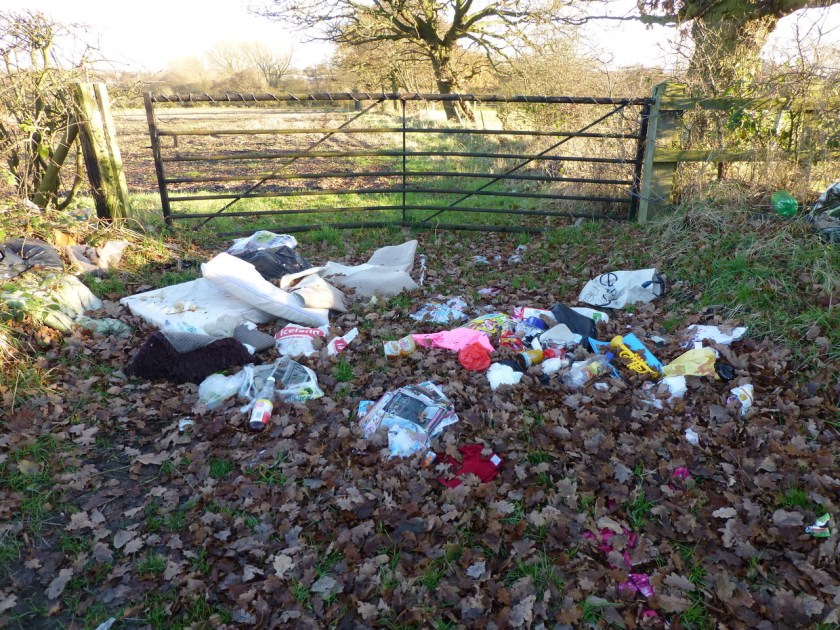
March 7th – Meanwhile, on the Walsall Wood-Shelfield border, Green Lane is currently in a sorry state. There is flytipping in various spots, and the litter is building up, too. My contempt for the scum that do this is immeasurable. However, the first undealt-with dumbing begets more; and so it has been. At the entrance to the Sewage Works, the main barrier, which put an end to regular violations of the driveway, has been stolen, and the tipping problem returned there, too.

The whole lane needs a good clean up and the selfish bastards who dump rubbish and drop litter need stringing up by their toes…

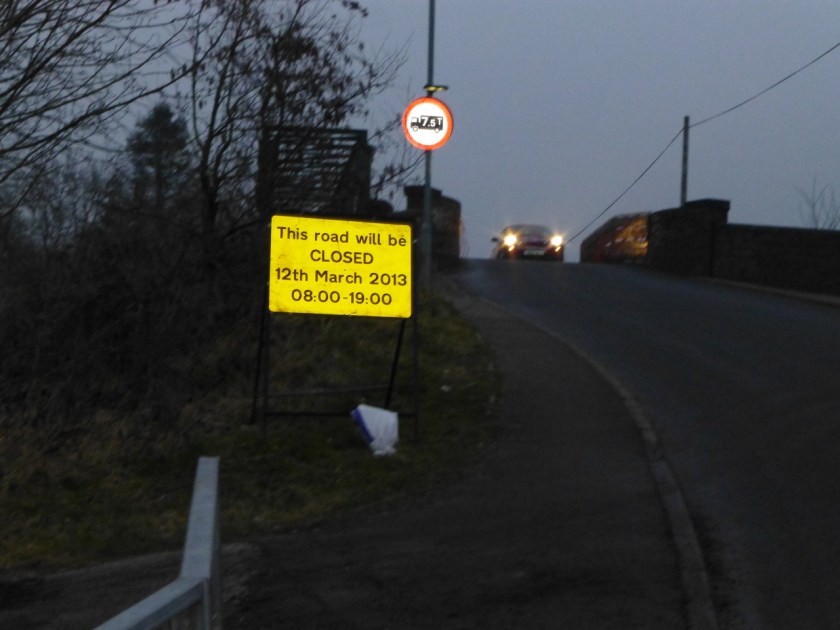
March 6th – The guard rails on the Black Cock Bridge in Walsall Wood have been missing awhile. The bridge itself is ageing badly, perilously steep and in poor condition. Following a temporary bodge – cable tying mesh over the missing rails which kept snapping off – locals complained and now, next Tuesday, 12th March 2013, the road will be closed while they are properly repaired. That in itself will be no mean feat, as the supports of heavy angle iron have rusted to dust.

It’s good to see repairs being made, but I can’t help thinking this particular canal crossing can’t be far from the end of it’s useful life.  The problem is, it would be so difficult to engineer a solution complying with modern standards, that I can’t ever see it being sorted, to be honest.

January 23rd – The little camera seems to really struggle with light on snowy nights. I’m not enough of a photographer to make it work quite the way I want. But these two shots show something. When I was banging on about gritting a couple of days ago, I was unaware of what a wide and generally welcome reception the piece would get. A good demonstration of my point – that road salt isn’t the magic solution folk think it is – is illustrated in the upper photo, taken at Shelfield lights. I’d been passed by gritters here several times the previous week. With the lack of rain, the brine strength on the road surface must be very high, yet the triangle of slush in the foreground remains. The reason is because the salt isn’t ground in that part by passing traffic, so although it’s been coated in salt numerous times, because there’s no meltwater, the ice remains. There’s a similar band of virgin snow on the centre of the Chester Road that’s been there since last Friday. it must get coated in grit nearly every day.

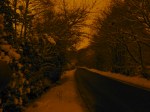
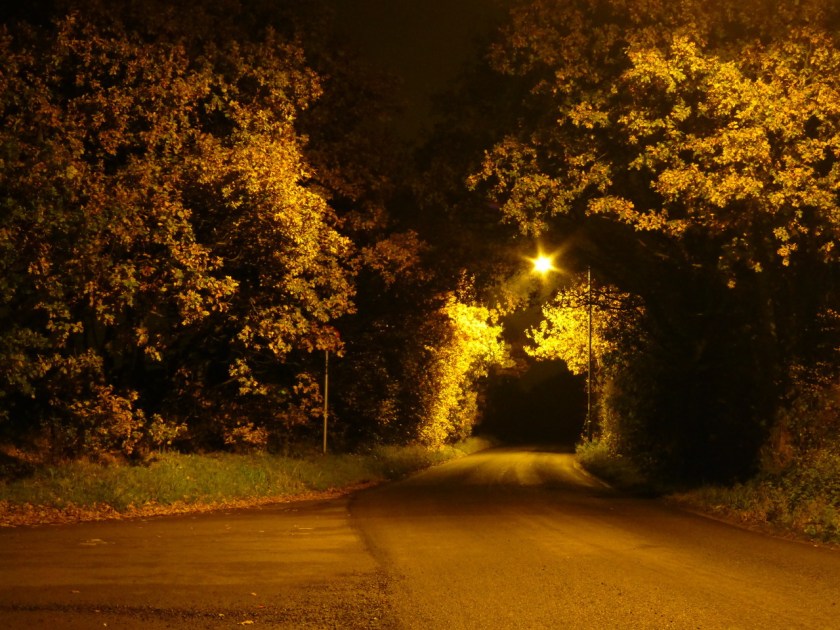
Returning via Green Lane, I was interested in how the snow lit up the normally dark, wooded road. This road was very clear, and as I came through, a grittier came past in a shower of sharp crystals. In some respects, this road was clearer that the Lichfield Road, and I struggled to understand why. Then I realised – this is a low point. What meltwater does exist, gathers in this lowland. That lane must be like a brine bath.

Must remember to regrease the wheel bearings when the weather warms up… the bike will need to be washed well, too. All this salt will be eating the metalwork…
December 1st – I notice that Green Lane on the Walsall Wood/Shelfield border is seeing an increase flytipping again. As  usual, this is just domestic refuse, and would have fitted in a wheelie bin or public littler bin. I just can’t work out how the scumbags who do this think. It must take more effort to flytip in many cases than it would do to dispose of the stuff considerately.

November 14th – Further on, I stopped to take a photo and ponder. I’m a grown bloke, and nothing much scares me. Heavy traffic? No problem. Speed? Not at all. Heights? Maybe a little. Darkness? Not at all, love cycling in the dark, especially in rural places. Green Lane, between Shelfield and Walsall Wood at night? Hell yeah. I’ve no idea why, it’s the only place I ever feel nervous out at night, and I’ve cycled in some grim places. Something about the darkness, the woods and the traffic combine to really make me feel queasy down here after dark. 

I think it’s to do with finding a car accident down here a few years back. The imagery of that stays with me.

I must be turning into a right wuss in my old age.

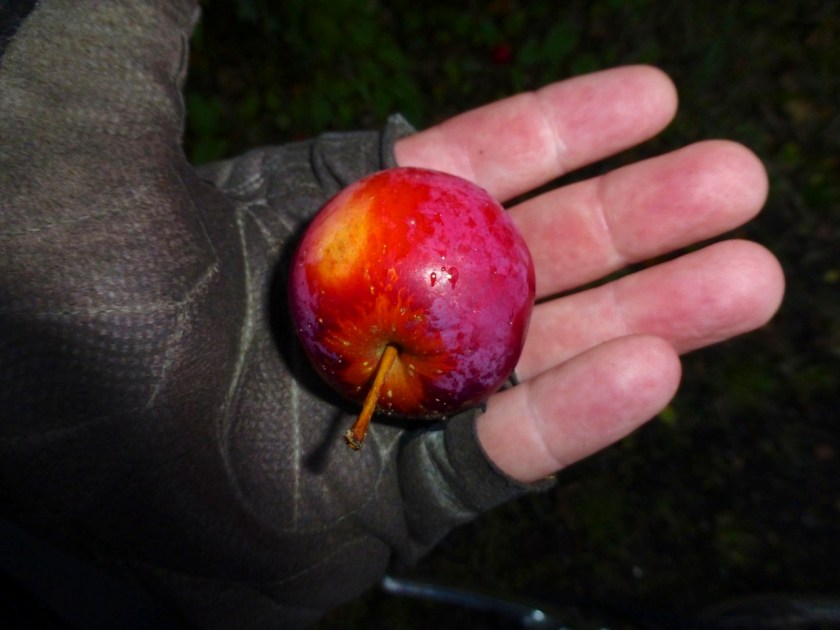
October 15th – Returning along Green Lane, Walsall Wood at dusk, something caught my eye on the verge near Shelfield School. I stopped to take a look at what seemed to be small peaches, and found they were actually really nice, perfect little crab apples. These would probably make a decent wine or jam – whilst too acid for conventional culinary purposes, these tiny apples are highly prized amongst jam-makers and home brewers. I’m surprised nobody has picked up the windfalls, to be honest…

October 3rd – The mystery of the bean field is solved. As I cycled past this evening, the farmer was harvesting the crop of beans I considered last week to be lost. I’d been musing on exactly how they were harvested for a while, and it seems the technique is identical to how much local maize is harvested: the whole plant is mown off at about six inches above ground, then chopped into rough chunks by the machinery, where presumably, it’s loaded into a trailer. I’d assume the beans a therefore used as fodder.

That’s a very big machine. Impressive stuff, and a mystery no more.

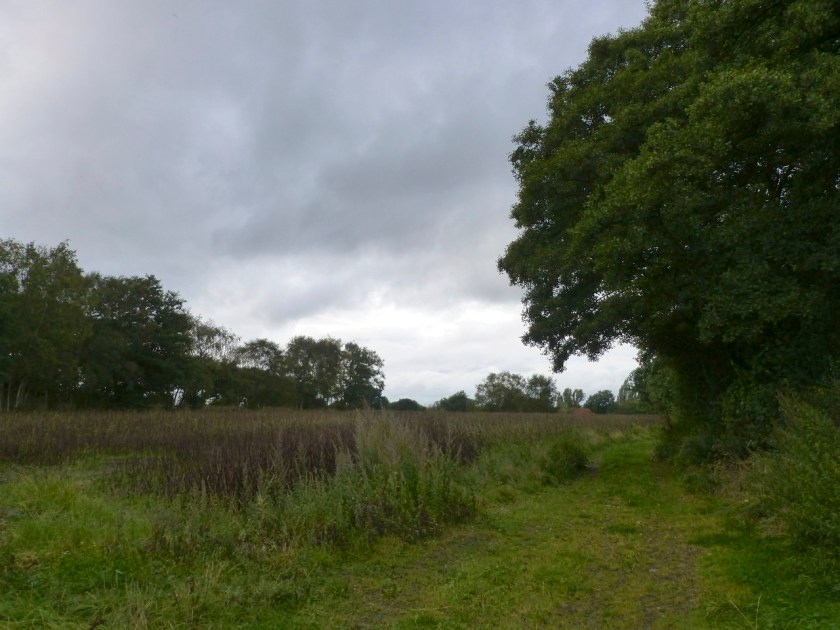
September 25th – The mystery of the bean field continues. The commute home was grey and made grim by late trains, but at least it was dry. Coming back along green Lane to Walsall Wood, I noted that the fields of beans here – unlike the ones in Lynn, near Stonnall, hadn’t been harvested. They’re just rotting in the fields. Whether that’s the plan, and it’s just a crop rotation technique, or whether the lousy summer ruined the crop, I have no idea, but I’m hoping someone can explain…