#365daysofbiking Ah, there you are:

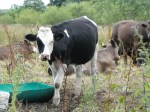
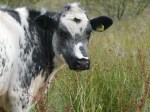
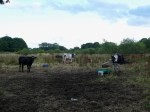
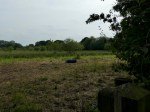
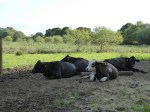
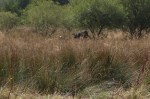
September 3rd – I finally spotted them – 2 coos way off in the scrub of Jockey Meadows, Walsall Wood.

These young bulls are released to graze this Site of Special Scientific Interest periodically to maintain the meadow by eating the fast growing species and giving the slower, lower plants a chance. Their hooves chew up the soft ground and encourage new growth, and there is of course the fertilising power of the cowpat love they spread with abandon.

So far, I can see just two, far off in the tall grass and reeds. I look forward to meeting them at the gate soon.

August 20th – The coos of Jockey Meadows have clearly been here again. But there is no sign of them now.

I’ve been wondering if they’d be here this summer, as the meadow is lush and  full of stuff they’d love to eat – but up to now, no sign of them.

But the feeding troughs are out, the grass is trampled down. But where are they?

I love to see them. I hope they come back soon.

August 8th – I passed the Jockey Meadows coos in poor light and soft rain as I cycled home. They were near mostly near the gate having a project meeting and I felt sad for them in the wet, although that was utterly daft, as they don’t appear to care about, or even notice the weather.

They are doing a good job and the meadow is visible freer of scrub and tall grass now, and I guess soon the lads will move on.

Although one must always treat cattle with respect, I do love these gentle, inquisitive and sociable animals. 

July 27th – After a good couple of weeks trying to catch them at the gate, the Jockey Meadows coos were finally not too busy to meet me this evening. 

They’ve been released here much later than usual this year, and the meadow is clearly full of tasty stuff as whilst I’ve seen the odd bovine rump above the scrub, they’ve not been loafing much hear the road at all, and have seemed very busy in their work: that of maintaining the meadow by eating the fast growing plants, churning the soil and improving it’s fertility.

I love cows and tonight, they seemed to be convening a union meeting. There are more of them this year, I counted 12 I think, whereas they normally number around 8. It was notable, however, that whilst I was interesting enough to stare at quizzically, I wasn’t interesting enough to expend any effort in walking over to investigate.

It’s good to see these lads back and I look forward to meting them again soon…

June 11th – I had to pop into work late afternoon, and as sun tried to break through the generally overcast day, I stopped to look for my mates the coos at Jockey Meadows. 

At first, I thought they’d gone again, but I could smell them. The muddy field was freshly churned after the rain. I looked carefully.

The workforce was busy. Deep in the scrub or the water meadow, they were here and there, doing what they do best. 

Grazing, steadily. Getting the job done.

July 21st – The lads are still working hard in a field further up Green Lane. The small herd of cattle continue to live in the watermeadow, which is looking noticeably more cropped than it was. The cows themselves are all looking in fine fettle – but I do have a soft spot for the brown and white one.

Is it me, or does he seem to be smiling?

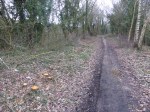
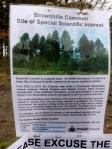
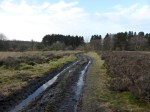
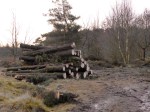
February 23rd – I was grey and very, very windy when I headed to Chasewater, but it still felt springlike as it was very warm for the time of year. Chasewater was very choppy and largely deserted, but heading back over a drying-out Brownhills Common I noted the paths and tracks were already beginning to self-heal from the felling activity here a few weeks before. I also noted some great information signs, the most interesting point on which was that the felled wood was being used locally. 

This whole project has been beset by poor communications, and had some of this information been available at the outset, much of the hysterical reaction to the works could have surely been prevented.

Hopping on the cycleway at Engine Lane, I noticed someone has been hard at work there, cutting down the undergrowth and overhanging bushes and opened the whole track out – nice one. 

Wonder who was responsible for that? Whoever it was, I salute them.

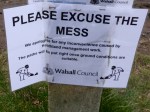
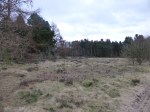
January 26th – Reader Jeepboy contacted me this morning, noting that the heathland restoration work had begun on Brownhills Common and things were a bit lumpy. My curiosity piqued, I took a ride over the common west of The Parade to have a look. True enough, the conditions up there are muddy and wet – take wellies if you’re walking. But it’s interesting to see the landscape open out a bit.

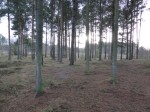
Nothing much grows under the conifer plantations, which have spread widely. This threatens the historic and biodiverse heath, and the wildlife that thrives upon it – everything from red deer, who munch on the sedges and lounge in the low cover to the birds that feed from the berries and seeds of the broad-leafed trees here.

Whilst the clearance looks shocking, only selected batches of coniferous woodland are being cleared, and deciduous trees left to thrive. It’s interesting to see the landscape re-emerge here. Come some decent weather, the mud will soon dry out and conditions will improve – however, it may be some time before access from the A5 drains sufficiently… it’s the closest Brownhills has had to a lido for some time.

I know this work has been and will continue to be controversial, but I honestly think it’s for the best. It’s sad that the situation was allowed to get so out of hand that dramatic steps were necessary.
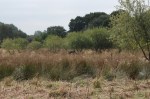
August 9th – Some months ago there was a brouhaha locally about plans to manage this section of Brownhills Common by removing the conifers, which are not natural here and are damaging the biodiversity of the heath.

Many locals didn’t see what the problem was. Here its is, this afternoon, in a nutshell.

Here we have open heather heath, host to a myriad of insects, small mammals, and passing deer. The heather, grasses and small, deciduous saplings are being choked by fast-growing spruce. 

What chance does that oak sapling stand against the larger conifer shading it? If left unchecked, how diverse will this spot be in five years?

This is why management is necessary. Because if we’re not careful, the heath here will be lost, together with all the species it contains.