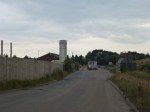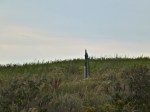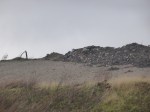
February 10th – I came home in the early afternoon, just as the rain was clearing. I’d had to call in at Aldridge, so found myself in the hinterlands between Walsall Wood, Leighswood and Stubbers Green. This is a very scarred landscape, mainly from brick marl extraction. The geology of the former quarries here is perfect for landfill, and for decades, as a site is abandoned by the brickmakers, it is adopted by the refuse industry.

Now at the capping and landscaping stage, Vigo Utopia was a massive hole in the ground when I was a child, but now stands high above the surrounding area. Bulkheads tap off the methane and pipe it to a generator plant. Eventually, this mound will be a public open space, but that’s some way off yet.

Of course, the brickworks are still busy, and there’s still marl to be extracted, and there will therefore be further space for landfill. A vicious cycle of blight and nuisance, it renders this landscape hostile, ugly and barren, particularly on a dark, wet and blustery February Monday afternoon.

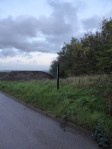
October 22nd – I noted on my way to work the other day that ownership of the former Shire Oak Quarry – now a landfill for dry construction waste – has passed from Tarmac to JPE. I’m not sure why Tarmac sold it, but it was mothballed for a while after the slump in construction after 2008, to be reopened a couple of years later. 

I also noted that dust monitoring equipment has been installed, too. Wonder if that’s in response to local issues or a general requirement these days?

April 18th – The landfill at Highfields South, just over the Lichfield Road from Jockey Meadows, is notable for a number of reasons. It’s pretty well managed, and is being filled in a very controlled way. It’s now generating electricity from the landfill gasses it produces, and it has a very diverse selection of gulls, and attracts birdspotters from far and wide.

I noticed as I passed tonight that the bulkheads bored into the mound were now all connected. Like the former Vigo Utopia landfill a mile away, this one will generate electricity by burning the methane it produces for some years to come.

Don’t kid yourself that this is green, however; it’s still burning fuel, it’s not renewable and merely utilises gas that would otherwise be lost. But it’s still a neat use of an unusual resource.

October 28th – Today, British Summertime ended, and darkness fell an hour earlier. Why we continue this silly ritual of clock changing, I do not know; but from now until the end of March, there will be lots of night shots. This always leaves me feeling down. Still, it’s only seven and a half weeks until the shortest day, and it’s opening out from there.

The weather was atrocious. Rain, wind and a keen nip in the air meant only a short ride was in order to bag some shopping and check a few things out around Brownhills.

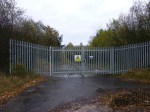
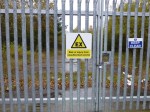
Travelling up Coppice Side, I noted the fence and gates to the landfill that operated here for much of the 80s had been renewed. Problematic, both in operation and reclamation, the site isn’t secure and folk walk their dogs and explore the landscaped mound here. What few realise is the meaning of the warning sign on the gate – it indicates an explosion risk. The former tip still vents gas. For years, technicians came on a regular basis and ignited a flare to burn the methane off, but that practice seems to have stopped. Not the best place to enjoy a Park Drive while walking the dog, I’d tenure…

August 17th – It was very grey and spotting with rain as the heavy wind blew me back up Shire Oak Hill later in the day. Oddly, the gates to Shire Oak Landfill – the former quarry at Sandhills – had been left open, and I took the opportunity to have a play with the zoom mode on the camera. The view from this spot is always great, although hard to capture in photos, but despite the grey murk of the day, the images weren’t too bad. Springhill, Hammerwich, Wall and Lichfield were all clearly visible. 

June 27th – A few people have remarked to me lately about the landfill site at Highfields South, behind Baron’s Court in Walsall Wood. The operators – Cory Environmental – are actually working to a defined plan here. At the moment, only half the void is full of waste, piled to some height, as you can see. this mound will be monitored, tapped for gas for use in a generator set, and with the weight on top, gradually settle to an agreed level. While this is taking place, waste is dumped in the to he half of the void, and the same process occurs. When the hole is full, the whole lot will be sealed with a layer of marl and topsoil, and parkland planted. The same kind of plan is in operation at the Vigo Landfill, on the other side of the canal. That one is now full, constantly generating electricity from landfill gas, and settling. In a couple of years that too, will be landscaped in public open space.

This is big business. There’s nothing so valuable as  a hole in the ground.

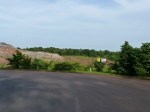
May 2nd – Heading off the canal at Leighswood Bridge there’s a footpath that somehow, against huge odds, has managed to stay open despite wending a precarious way between Europe’s largest inland toxic waste facility and an immense marlpit.

The red marls that have been opencast here for centuries made the area of Aldridge and Stubbers Green famous for it’s brickworks and tileries, producing high-quality engineering bricks and building materials that an entire industrial revolution was built out of.

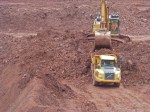
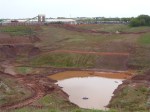
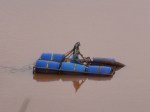
These days, marl is excavated in an almost robotic process. An excavator works down the face in terraces, and four huge trucks are filled in a constant relay, each carrying three excavator bucketfuls to the Wienerberger brickworks up top. At the base of the excavation, there’s a pool of drainage water. This is returned to a settling lagoon on the surface by a pump, floating on a raft, cleverly made out of empty drums. Note that the marl itself is quite dry, and not the clay-like material one would expect. Impervious to water, it makes an ideal void into which landfill of most grades can be dumped when the opencast is exhausted. This area is surrounded by landfill sites utilising former marl pits, and under it all, millions upon millions of gallons of toxic slurry dumped in the deep coal workings that also riddled the landscape. 

There’s nothing so valuable as a hole in the ground.

In many countries, this would be considered environmental destruction. Here in the UK, we call it industry.

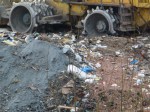
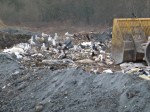
February 26th – Since we’re on a bit of a refuse theme today, as I trundled up the canal to Aldridge, I stopped to look at the gulls, crows and jackdaws scavenging on the Highfields South Landfill, just behind Barons Court in Walsall Wood. This is the reality of our waste problem, and Walsall Wood and Brownhills have plenty of landfill sites. A hole has been dug – in this case, for brick marl – leaving a large, watertight void. Ideal for dumping our rubbish. Highfields is filling at an alarming rate – what’s under that vehicle looks like a combination of domestic and industrial general waste with what appears to be incinerator ash. Carrion birds are picking over the food waste. It stinks. And we can’t keep doing this. We have to cut the waste we generate. Nobody wants to live near a landfill – and the space within them is reducing, week by week. Yet mention bin regulation or recycling and we’re up in arms. It’s as if we can’t see the connection. I find it utterly depressing.

15th July The landfill operation at the former Vigo Utopia marlpit, in Coppice Lane, Walsall Wood, is nearly complete, which must be a relief for nearby residents who’ve endured two decades of smell and nuisance. What many people don’t know is that this site generates 2MW of electricity and feeds it back into the national grid. That’s enough to power nearly 4,000 homes. Bores are drilled into the decaying landfill content, lined, and the gas of decomposition is pumped out and employed to power two gas engines driving generators. The gas would otherwise be wasted. 

When I passed the site at 5:30pm on a Friday, the plant was humming away. I believe a similar operation is planned for Highfields South landfill, opposite Jockey Meadows.