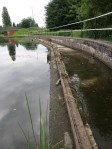
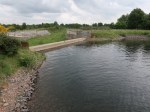
July 19th – Following the canal breach a few weeks ago, that saw the local canals lose nearly a foot in level following a breach into a culvert beneath the waterway at Little Bloxwich, the repair has been effected and levels are back up to a healthy level now.

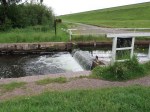
At Clayhanger, the low end of the overflow is now running well and it’s a fine sight and sound once more.

June 12th – Following isolation of the leak at Little Bloxwich, the canal level has continued to rise and is now about 20-25mm off maximum (ie. the weir bar at Clayhanger overflow), so more or less back to normal.

It took a while, with problems at Chasewater and with balancing pumps having to be installed at the leak site, but thankfully, apart from the fact that there’s a large repair required in Little Bloxwhich which will prevent passage from Brownhills to Wolverhampton and vice versa by boat for a bit, it’s good to see the waterway back to normal health.

This could have been so much worse.

June 2nd – Heading out on a dull but warm afternoon, the eventual aim was Draycott in the Clay steam fair at Klondyke Mill, but fate had other ideas. On the way, I called in at Chasewater to see if it was filling the canal. It was, the valves were open.

There has been a leak in the canal near Little Bloxwich that has lost a huge amount of water into a culvert beneath the canal, and the Canal and River Trust had said initially the drop in level was due to Chasewater’s supply being cut off by Staffordshire County Council, which was clearly arrant nonsense.

The Trust finally released an emergency stoppage notice and began damming off the leak that very afternoon.

You can read more here.

Chasewater is still very full, and when called upon will need to fill the five inches or more lost from the canal. An interesting situation to watch.

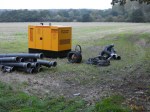
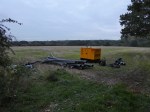
October 24th – Passing Jockey Meadows on the way home, the clean up from the recent sewer problems near Bullings Heath is still ongoing, with tankers pumping our sumps and groundwater in series during the day. I noted as I passed a diesel standby pump dropped in a field, and pipeline equipment. It’s either for flushing, or pumping water out of the brook into the sewers for a while.

The work here has been protracted and involved, and the efforts taken to avoid damaging the local ecology with raw sewage have been dedicated and impressive.

Let’s hope all the issues are resolved shortly.

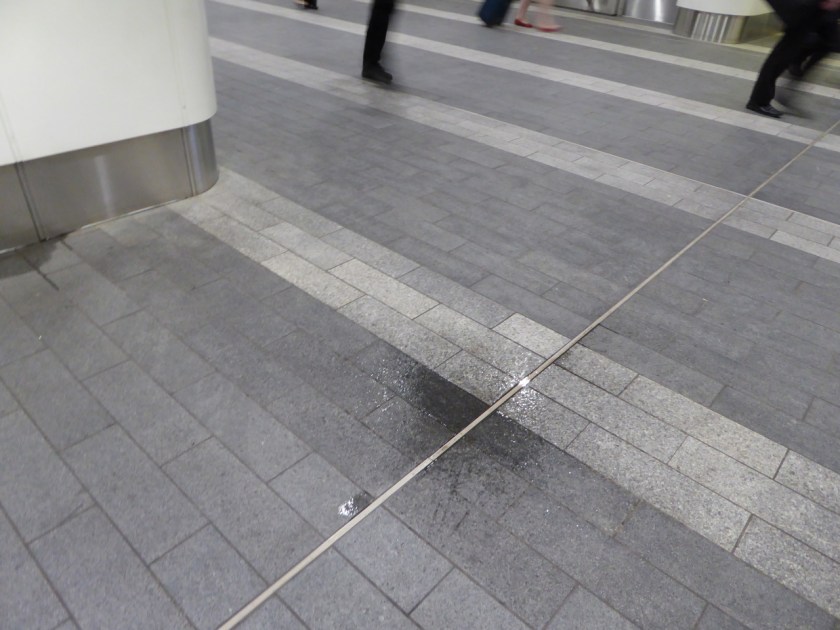
February 26th – Mind you, I say Birmingham is getting better at change, but… this is the real face of the ‘New’ New Street and the preposterously named ‘Grand Central’ project. This place constantly has leaks. Often when it hasn’t rained for days. To walk through the station now is to squelch through wet patches on concourses, platforms and passageways.

This cannot, in any shape or form, be a good sign.

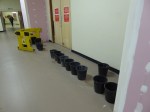
July 7th – New Street, New… wet feet. 8am on a Monday morning, and water trickles through the ceiling and onto the floor of the new concourse. For a supposedly refurbished building, there aren’t half a lot of faults with the new New Street Station. The seems to be a permanent array of leaks, this one at the top of the escalator to Platform 7. Several others were in evidence.

What’s most worrying is that it hasn’t rained for a couple of days…

I wouldn’t pay ‘em in tap washers.

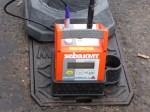
November 28th – Oh my, this is a geeky thing. I spotted on the pavement near the Warwick Road near Sparkbrook. It’s a small, orange box with a radio antenna, and some kind of display. From it, there’s a signal cable popped through the access cover of a fire hydrant. There was nobody in sight and it just sat there, protected by a road cone.

This is actually part of a very clever water leak detection system made by SebaKMT, a measurement technology company. This rechargeable device is one of two recorders placed near a suspected water leak. An audio sensor is attached to the pipe beneath the cover from each recorder, and both units ‘listen’ to the noise made by the escaping water transmitted up the pipework.

The data from each is broadcast wirelessly to a third device, held by a technician, and that calculates the exact distance of the leak down the pipe from the sensors, by time lag in the audio signals recorded.

By taking several measurements, it can pinpoint within centimeters the place where engineers should dig to fix a leak that may not e evident on the surface. Such devices can save a huge amount of time and money to utility companies.

March 13th – Anyone know the number of a good plumber? On the southeastern side of Tyseley Station, there’s a train wash, where trains from the nearby depot are cleaned after daily service. When I passed this morning, there appeared to be something of a malfunction. Water (I assume it was water) was issuing from a pipe joint on the control cabin right onto the track.

Looks like a split pipe. I wonder how long it had been going on? It was fixed by my return, 7 hours later.