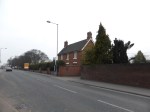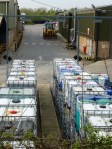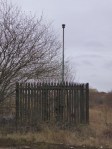
February 27th – I had to pop into Aldridge on my way home and had ridden up Coppice Lane; not far from the gas turbine and leechate plant, another sign of a dirty underground secret from the past. This square compound on wind and mud-blasted wasteland, just off the rear entrance to the Ibstock Brick plant, is a breather for the mines underneath the area that were used as a dumping receptacle for millions of gallons of industrial toxic waste a couple of decades ago.

Inside this well-locked square palisade fence, a bulkhead is fitted to a borehole that goes hundreds of feet underground and allows gasses to vent to the atmosphere from the sludge within. The breather itself is from a tall pipe, well above human head height, up where the wind can quickly disperse anything nasty.

It’s sobering, and a bit chilling; and indicator that beneath this area there is an unknown quantity still requiring monitoring and care. But the ground it is in is surrounded in clay and favourable, and as time passes, the content should settle.

There are several of these installations in the local area – finding them is an interesting, if slightly unnerving challenge.
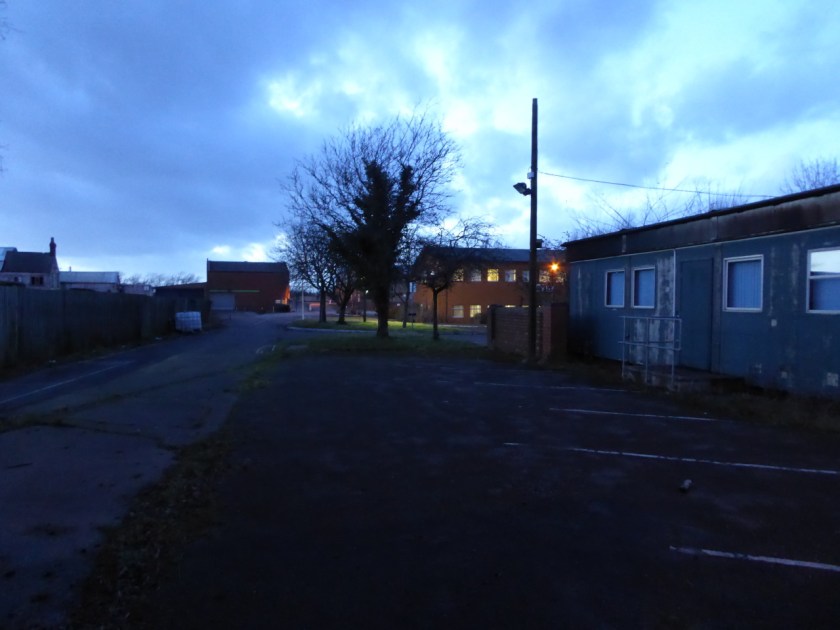
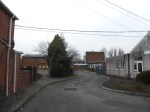
January 15th – also seemingly decaying unloved is the old Veolia plant on the Lindon Road on the border between Walsall Wood and Brownhills. Once a chemical waste disposal site, it started life as Effluent Disposal, and went through a number of incarnations before being purchased by Veolia, who’ve since built a new HQ at Cannock, leaving this place vacant.

It appears to have resident security on site, as one would expect.

There was talk of this place being converted into a food processing factory, which seemed bizarre, given the history. The site was up for sale for ages. It’s hard to think of what it could be next, really.

I imagine any estate agent has a challenge on their hands shifting this.

April 10th – I notice it’s still for sale, the old Veolia site in Lindon Road on the Walsall Wood/Brownhills border. This chemical waste disposal facility, an old pit shaft, was filled with industrial effluent in the 70s and 80s. When it was full,  the company kept their labs and offices here and moved the site to a different pit system at Stubbers Green, in Aldridge.

The company names operating this facility changed regularly; Effluent Disposal, Leigh Environmental, Sarp, Veolia.

The site is large, mostly empty, including the Victorian house out front used as offices for some years. There are only a skeleton staff here, as administration moved to shiny new offices up in Cannock a year or so ago, leaving this site mostly deserted. 

Whoever buys this will get a lot of land. But as a former mine, the land is contaminated from the colliery, let alone later uses. Any buyer will have to deal with the shaft itself, down which the poison was poured.

Don’t think about entering this place; the security is full on and tight, and there are still people here. I wonder what will become of this site, and the secrets it keeps.

May 2nd – On the other side of the precarious footpath mentioned in the last post is this chemical waste facility, now operated by Veolia, a huge international waste disposal company. These days, it’s a modern, well kept and operated plant, but it wasn’t always thus. Under the tower is a borehole to the former mine workings below, and into this void were pumped millions of gallons of toxic waste. Contained by marls, it is thought to be safe; yet other surface waste dumps nearby, operated by former operators like Polymeric Treatments, were not so successful. Claiming to have invented a system of mixing highly poisonous materials with concrete, the ‘Sealosafe’ process was widely considered to be a failure. 

Operations here were controversial through the late seventies until the nineties, with smell, nuisance and just plain fear all being factors. At one stage, operators had a surface lagoon full of slurry which became the subject of a standoff between the local council and the company concerned, which ultimately led to regulation of an entire industry.

These days, the tankers slide in and out of here largely unnoticed, and the controversy has abated. The laws governing these kinds of operations are probably now the tightest in Europe, and rightly so. We still get the occasional smell, but on the whole, there’s little to show of the ferocious political and activist battleground this once was.

WE have to accept, I guess, that if we want to live in a world with shiny metal goods, wonderful kitchen cleaners, beautiful plastics that all manner of complex chemical processes are required. These generate massive quantities of very, very nasty stuff. Whilst the commercial operation of sites like this is not ideal, we need to accept their necessity, and in technical terms, our area is highly suited to this kind of disposal in terms of geology.

A complex history, largely misunderstood and forgotten.