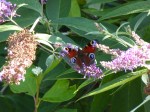
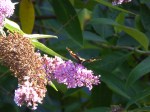
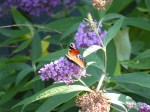
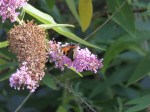
June 9th – I have no idea about Lepidoptera, but spotted this lovely moth (I think) in the flowers near the new pond in Clayhanger. It was beautiful and very active – and along with the bees and a whole host of other bugs, shows why margins and scrubs left to run wild are so very important for biodiversity.
Tag: Lepidoptera
July 22nd – The Mad Old Baggage noted the other day that buddleia was known as the ‘butterfly bush’ – and she’s right. By a busy roadside in Walsall, the purple, masonry-destroying shrub is quietly reclaiming the built, and using it to nurture the lepidoptera.
It may be a plant of the margins, scrubs and wastes, but buddleia is a bright, beautiful shrub that clearly supports a whole host of bugs – which can’t be bad.
A fantastic sight.
June 27th – This post was inspired by top Pelsall geezer Matt Drew, who spotted a different clump of these fellows and posted a pic on Facebook last week, inspiring me to look out for them.
These delightfully spiky caterpillars are the larvae of the beautiful peacock butterfly. They really are rather impressively hostile-looking, but cute at the same time – I spotted them in a nettle bed at the top of Shire Oak Hill, near the old quarry there.
In summer, the adult female peacock will lay between 200 and 500 eggs at the very top of a stinging nettle in direct sunlight. 10 days later they’ll hatch, and the emerging caterpillars will spin a communal web-tent out of silk (see the top picture) which they’ll live in until large enough to leave; they live and grow in clumps at the top of nettles, and as they grow, they may move from nettle to nettle in a patch together as a group, before pupating separately.
They’re easy to spot as a dark infestation at the tops of the tallest nettles in a nettle bed.
Male peacock butterflies are very territorial, and can often be seen attempting to chase away birds that may be coming near their selected nettle patch.
I’m glad I found some – and thanks again to Matt for the inspiration to look.
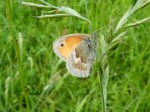
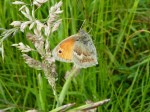
August 25th – Small tortoiseshell butterfly, caught out of the corner of my eye, resting on the trail at Cannock Chase. Such a beautiful little thing.
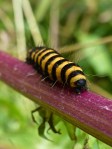
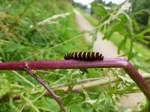
August 31st – I know bugger all about Lepidoptera. That’s not to say that caterpillars, butterflies and moths don’t fascinate me, because they do, but I never found time to read much about them. They’re very curious things. Take this fellow, for instance. 30mm long, clearly a Wolves fan, I spotted him whilst travelling at some speed down a canal towpath in Aldridge. I pulled the bike to a halt, and went back to examinee what I thought I saw crawling along a himalayan balsam stalk. How does that even work? I spotted him really easily, presumably so can his predators. How does that work on an evolutionary level? He’s certainly striking, hairy and caprivating. Anyone recognise what it is?
Edit: he appears to be a future cinnabar moth. Wonderful, black and red moths… and also rather late, it seems.