November 27th – Been a while since I discussed brakes here, but the glazing issue of the rear pads I had – I think I’ve cracked it. And built Frankenbrake as a result.
I, like many utility and commuter cyclists, like to ride a bike that’s essentially a tourer. I like the bars, the variety of positions, and I like that Shimano finally made hydraulic brakes for road and cyclocross bikes with the same bars.
The trouble with tourers for years has been that they’re mongrels. No one groupset (ie. drivetrain with brakes and controls) is wholly suitable. Tourers carry load, don’t mind a heavier bike as it’s sturdy and stable. They like a wide gear range – preferably a triple front ring. And solid wheels with damn good brakes.
So a good tourer may have utlegra, SLX, XT and 105 series parts all working together.
Brake options have traditionally been anything you want as long as it’s canti, but since road discs and suitable frames appeared – first cable, then hydraulic – our braking options have improved.
My rear brake – A Shimano R785 lever with a BR785 calliper – has been eating pads. They appear to glaze, loose all friction, and no matter how well cleaned, filed or surface ground, never regain bite. Pads are not cheap. I thought I’d cracked it using Uberbike pads – but the last two sets have gone really quickly.
The last set went a week after fitting, and without the same happening on the front, I decided to solve the issue. I’ve been using a primitive parking brake on trains – I use a rubber loop to keep the back brake on to stop the bike rolling about. It turns out that the brakes aren’t designed for continual operation like that, and the vibration from rocking was weeping fluid out of the piston seals, on to the back of the pad plate, and dropping the odd drip of fluid onto the rotors.
I’ll stop using the band. But that left me with a possibly faulty rear calliper, which has never been quite as snappy as I’d like. And Shimano are transferring to flat mount – a format incompatible with my frame – for their 785 replacements.
I knew the 785 was a variant of the XT mountain bike, 2 piston brake with slight design changes in shape. Reading about, I found people who’d put Shimano 4 piston callipers on XT levers for mountain bike use, so I figured a 4 piston Saint calliper should therefore work with a 785 road lever, as the same oil volume was being moved as the XT model, if you see what I mean. They all use the same hoses and fluid, a light mineral oil.
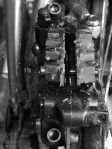
So I ordered a saint calliper, got the bleed kit out, and got oily. The result is that the Saint calliper works really well, has a much bigger pad friction area, and is nice and firm, yet progressive. It’s a bit more fiddly to set up as the piston stroke isn’t as large, but it’s working well with patience.
To any home mechanic who’s thinking about this, it’s an excellent upgrade – but as with any brake fluid operation, remove pads and keep well away from the disc as you will spill oil everywhere.
Meanwhile, a slow handclap for Halfords. When on the off chance I called in for a bottle of Shimano mineral oil brake fluid, the twit behind the counter said ‘Use Dot 4 – it’s all the same stuff.’ – it so isn’t. Dot 4 is Glycol, not oil, and will swell and perish Shimano seals and cause premature failure. Urrrghh.
Now, let’s see how well these pads last…




 BrownhillsBob's #365daysofbiking