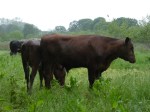
May 31st – A bright spot in an atrocious, wet commute home was spotting that the coos have returned to Jockey Meadow in Walsall Wood – and by the look of the lush meadow there, they have their work cut out. 

Not that it seems hard work, browsing the bog for the juiciest grasses and shoots, and generally looking handsome. 

I love these guys. So nosey, so proud. Good to have my friends back.

March 26th – There’s times when you just have to give in. For several reasons I’ve recently converted from 28mm Schwalbe Marathon Plus tyres to 25mm. the ostensibly small, 3mm change has made a big difference to fitting the tyres, which has led to a couple of tubes being pinched on reassembly – notoriously during my ride around the Roaches a couple of weeks ago.

I’ve been looking for solutions. These tyres won’t be fitted by hand, the combination of Mavic rims and Schwalbe rubber is notoriously tough, so I’ve opted to try a new tool – this plastic hook device made by BBB and costing about £7 pivots like scissors, and you rest one arm on the opposite rim, and hook the tyre on with the other.

I’ve not tried it yet, but it has to be worth a shot. Never known tyres this tight before.

March 14th – Brooks Saddles. Made and broken in the Midlands.

I love a Brooks leather saddle – made in Smethwick for a century or more from real leather, they’re a marmite thing amongst cyclists – you ether love them or hate them. I adore them; I’ve ridden on a Brooks for tens of thousands of miles and I’ve never found anything that fits my ample arse better. 

However, some aspects of them are not great. the ‘Brooks creak’, where at an indeterminate point after breaking in, the thing squeaks noisily for 400 miles or so no matter what you do to relieve it; the sometimes middling build quality can be disappointing; but both of these pale compared to the real annoyance – poor quality tension pins.

The two metal objects above should be one piece. This bolt sits in a yoke from the saddle rails to the nose, the nut adjusting the tension of the whole thing. It rarely needs adjusting, but it takes the entire weight of my resplendent girth.

Until it fatigue-snaps on the way home. 

They are a bugger to replace, and cost a fiver a time. To snap like this (and it’s a common, longstanding moan with Brooks customers) the component is poor quality. It would be easier to fit were it threaded to the boss. The whole thing is weak and shoddy. That’s very poor for a £60 saddle.

It left me with an uncomfortable, rattly ride home and a horrid workshop job to do. 

But I still wouldn’t entrust my posterior to any other brand. 

Brooks you muppets, sort it the hell out. Please.

January 25th – There’s been a bit of a running debate lately amongst friends and family about just how much one should clean a bike in winter. I must admit, I’m from the ‘Only clean when the crud is ~25% of the total weight of the bike’ school, but others differ.

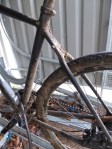
Visiting a client this afternoon, I checked out the bikes parked in their bike rack. This clearly well-used semi-hybrid has a fairly clean, well-lubed chain, but oh – the caked mud on that front mech is crossing a line.

That thing really needs some mudguards – all the mud from the back wheel that isn’t doing a skunk-strip on the rider’s jacket is being dumped on the chain and front mech.

June 17th – So help me god, I’ve been asked how you know if your bottom bracket needs replacing (see last entry, 16th June) – so I made a quick video. The old part is held in a vice over white paper for clarity. I’m wobbling the other end, out of shot. There should be no wobble at all.

Hope that helps!

June 16th – Bottom brackets are a pain in the arse. I can’t believe that after more than a century of cycling technological innovation, they’re still so rubbish.

The bottom bracket is the spindle that the cranks mount on through the bottom of the frame, which spins freely allowing your pedals to rotate. As a mechanical component, the bottom bracket experiences the worst abuse – epicentric, unbalanced point loading, muck, water and corrosion. My bottom brackets take my full weight, plus that of the bike and load. They work hard.

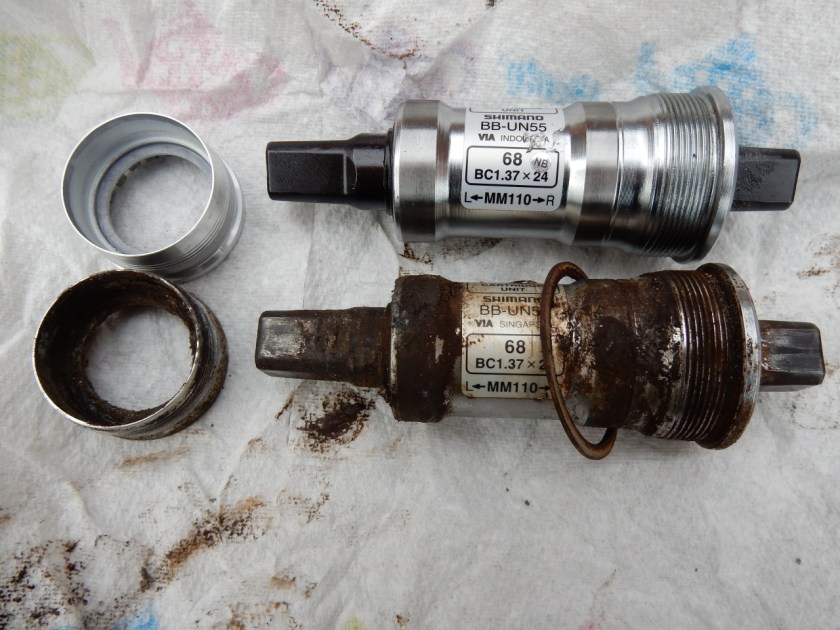
Several solutions exist for bottom brackets – the component axle and loose bearings – the old way and fiddly to adjust and maintain; the ‘sealed cartridge’ (above) – a disposable insert designed for easy changing; the external – a frankly daft idea that’s gained traction in the last five years; the thoroughly insane press fit, preferred by the weekend Wigginses with plastic bikes.

All are rubbish, really.

On Sunday, I noticed the cranks on my bike had alarming play within the frame. The non-drive side bearing had collapsed in the cartridge. It’s done about 20,000 miles. Removing it is easy if you have the right tools and the person who fitted the last one did it properly. 

Cranks are removed with a special extractor, and the cartridge is removed with a special socket tool from the DRIVE SIDE. It is a left hand thread, meaning the unit is turned clockwise to unscrew it. That fact escapes many, and has led to loads of skinned knuckles and damaged frames.

The cartridge is left hand threaded to prevent it loosening in use due to precession.

There is a support bush on the other side that unscrews normally using the same tool. The threads are cleaned with a small wire brush and degreaser, dried, greased with anti-seize paste and the new one fitted. Half an hour tops.

If the threads are not greased, the unit will be very, very hard to remove in future.

A replacement is about £15-£20. I’ve tried expensive alternatives – they make no difference.

See you again in another 15-20,000 miles.

May 7th – I notice that on Jockey Meadows, the pasture field that’s genuinely a water meadow is now staffed by a heard of beef cattle again. About 10 or 12 large animals are browsing the scrub in an effort to maintain it – the cows eat the fast growing plants, and give the slow-growers chance. They also spread the fertile love in the form of cowpats.

Every time I passed them this week, the coos have been far over the other side. Only did I notice when I’d zoomed in that a passing heron was doing his bit too.

April 9th – Whoops. The bike I’ve been riding over the past few days has been having an issue with the front brake pats just lightly touching the disc. The noise was irritating me, so before I set out today, I got down to realigning the caliber, and then noticed the pads were a bit worn. Having spares on the bench, I whipped the old ones out.

Oh dear. The bad set, for those not in the know, are on the left, the replacements on the right. The pad on the one side is so worn, it’s to the metal, and the spring is mashed, too.

I also had an issue with the piston sticking. Hopefully that’s sorted.

Hydraulic brakes wear pads quicker. I must remember that. 

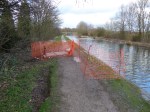
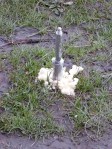
March 31st – At Clayhanger Bridge on the canal near Brownhills, there’s a sluice that allows the waterway to be drained into local sewers if necessary. I noticed today that it had temporary fencing around it, and that micropiles – stainless steel rods inside sleeve tubes and packed out with expanding foam – had been fitted around the sluice and along the adjoining canal bank.

This is clearly a stabilisation job, and I’m intrigued as there’s not real outward sign of such a thing being necessary – except for the fact that I suspect the bank and culvert may be subject to destructive erosion if used, which these piles may relieve.

The tops currently stood proud will be chopped off at ground level later.

Meanwhile, closer to Catshill Junction, the embankment has been falling away into the canal for over a year, and nothing has been done despite drawing it to the attention of the Canal & River Trust.

Most peculiar.