#365daysofbiking Making a deposit

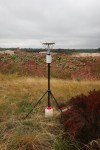
August 29th – I travelled home through Aldridge early in the afternoon after visiting the bank, and I had stuff to wait in for. On the way past the brickworks at Stubbers Green, just where the marlpit fence runs near the towpath, I noticed this curious instrument.

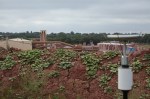
It’s a temporary placement, for gathering data about but deposition from the quarry and brickworks. It’s called – I kid you not – A frisbee deposition gauge, and it collects dust from the air and rain, which it collects in the vessel at the bottom of the tripod. There’s thin crosswires to stop birds landing on it, and a course foam pad to stop large debris like litter and leaves clogging it up.

Several of these instruments appear to be positioned around the site, presumably to test compliance with relevant pollution law.

It’s a fascinating area of environmental science and engineering and interesting to see it in use locally.
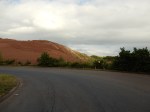
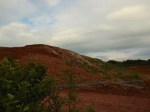
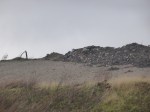
June19th – I must admit, I’m fascinated by the landfill at Highfields South, between Walsall Wood and Shelfield on the Lichfield Road. It looks and seems haphazard, but is being operated in an engineered manner. At the moment, the eastern side of the void is filled, now to about 6-8 metres above ground level with a marl cap on top. Gas bulkheads sit atop harvesting tubes inserted deep into the mound. As the pile sinks under it’s own weight and that of the cap, it evolves gas, which is harvested and powers a generating set, feeding energy into the National Grid.

Meanwhile, to the west of the void, the hole is being prepared for the next stack of waste. Systematic. Methodical.

The void existed due to marl quarrying for bricks, and the landscape is favourable for this type of thing. It may not be pleasant, and we should reduce our waste as a society, but the process is very interesting.

January 23rd – on a grey, murky afternoon I cycled down the canal from Aldridge. I’d headed for the canal as I often do to escape the traffic, which seemed overly aggressive as I’d hit it during the school run.

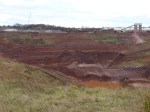
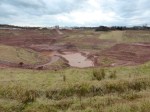
Passing the Weinerburger Brick marl pit at Stubbers Green, I took a look into the void through the fence. It doesn’t get deeper, but it grows steadily, by gradual removal, dumper after dumper of red marl heading to the moulds and then the kilns.

That’s a lot of bricks come out of there. And what a huge scar on the landscape. But the one ever-present thing here – the familiar, warm smell of bricks being fired – is, like Burntwood’s permanent smell of vinegar – one of the ways I know I’m near home.

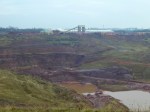
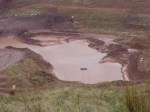
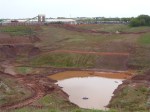
February 24th – The huge marlpit at Stubbers Green that feeds the Weinerberger brick plant with raw clay is impressive. These extraction processes are not as simple as just digging a hole. The pit is dug in a pattern decided by engineers to ensure safety and drainage. In an impervious material like marl, accumulated water from the elements and surrounding environment is an issue to contend with. Here, a floating pump on a bouyancy raft made of empty drums returns water to a surface lagoon. Roadways and access tracks crisscross the site.

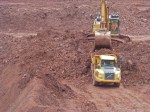
Extraction didn’t seem to be in progress when I passed today, but excavators load huge trucks with the red, surprisingly dry material, which is conveyed to the plant on the far side in an endless chain. The factory was running, however, as I could smell the distinctive note of baking clay in the air.

Although ugly, and many consider it a blight, this is a factory and facility that provides much employment to the local area, and the bricks produced are good quality. I find it fascinating in scale and procedure, and could look into that void for hours.

One of the fascinating aspects is looking at the rear face, and seeing the subtle colour changes in the clay as the geology yielded its secrets.

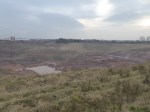
February 10th – I came home in the early afternoon, just as the rain was clearing. I’d had to call in at Aldridge, so found myself in the hinterlands between Walsall Wood, Leighswood and Stubbers Green. This is a very scarred landscape, mainly from brick marl extraction. The geology of the former quarries here is perfect for landfill, and for decades, as a site is abandoned by the brickmakers, it is adopted by the refuse industry.

Now at the capping and landscaping stage, Vigo Utopia was a massive hole in the ground when I was a child, but now stands high above the surrounding area. Bulkheads tap off the methane and pipe it to a generator plant. Eventually, this mound will be a public open space, but that’s some way off yet.

Of course, the brickworks are still busy, and there’s still marl to be extracted, and there will therefore be further space for landfill. A vicious cycle of blight and nuisance, it renders this landscape hostile, ugly and barren, particularly on a dark, wet and blustery February Monday afternoon.

May 2nd – Heading off the canal at Leighswood Bridge there’s a footpath that somehow, against huge odds, has managed to stay open despite wending a precarious way between Europe’s largest inland toxic waste facility and an immense marlpit.

The red marls that have been opencast here for centuries made the area of Aldridge and Stubbers Green famous for it’s brickworks and tileries, producing high-quality engineering bricks and building materials that an entire industrial revolution was built out of.

These days, marl is excavated in an almost robotic process. An excavator works down the face in terraces, and four huge trucks are filled in a constant relay, each carrying three excavator bucketfuls to the Wienerberger brickworks up top. At the base of the excavation, there’s a pool of drainage water. This is returned to a settling lagoon on the surface by a pump, floating on a raft, cleverly made out of empty drums. Note that the marl itself is quite dry, and not the clay-like material one would expect. Impervious to water, it makes an ideal void into which landfill of most grades can be dumped when the opencast is exhausted. This area is surrounded by landfill sites utilising former marl pits, and under it all, millions upon millions of gallons of toxic slurry dumped in the deep coal workings that also riddled the landscape. 

There’s nothing so valuable as a hole in the ground.

In many countries, this would be considered environmental destruction. Here in the UK, we call it industry.