March 18th – A bit of a tip for the Brooks saddle owners with a sheared tension bolt, as I suffered last week.

If your saddle hasn’t stretched much, it can be particularly hard to get the replacement bolt in – in the factory, the saddles are stretched on a hydraulic jig, so fitting a replacement can be a struggle to the home mechanic.

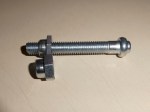
The problem is made worse because the pin isn’t threaded all the way up – and an extra 2mm of thread could make all the difference, and did on my saddle.

To make fitting a replacement easier, I took the adjusting nut from the new pin, and turned 2mm off the head on the lathe at work. It’s a steel nut, so there’s plenty of material left, and that 2mm allows the nut to be wound back clear enough to fit the pin with minimum leverage.

If you have this problem and don’t have access to a lathe, just find a handy local engineering company where someone will probably do this very quick task for a pint.

It could make the difference between doing the job yourself and having to return the saddle to Brooks.
June 16th – Bottom brackets are a pain in the arse. I can’t believe that after more than a century of cycling technological innovation, they’re still so rubbish.

The bottom bracket is the spindle that the cranks mount on through the bottom of the frame, which spins freely allowing your pedals to rotate. As a mechanical component, the bottom bracket experiences the worst abuse – epicentric, unbalanced point loading, muck, water and corrosion. My bottom brackets take my full weight, plus that of the bike and load. They work hard.

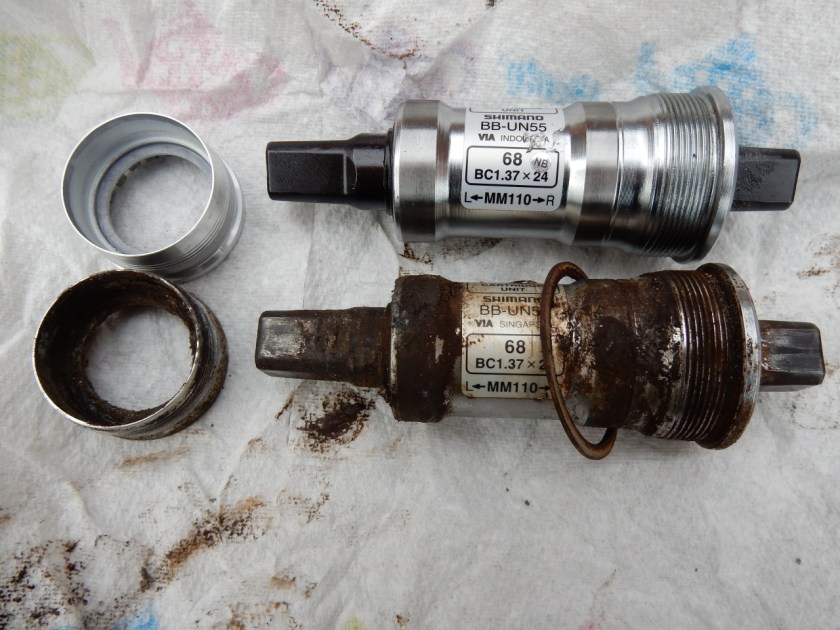
Several solutions exist for bottom brackets – the component axle and loose bearings – the old way and fiddly to adjust and maintain; the ‘sealed cartridge’ (above) – a disposable insert designed for easy changing; the external – a frankly daft idea that’s gained traction in the last five years; the thoroughly insane press fit, preferred by the weekend Wigginses with plastic bikes.

All are rubbish, really.

On Sunday, I noticed the cranks on my bike had alarming play within the frame. The non-drive side bearing had collapsed in the cartridge. It’s done about 20,000 miles. Removing it is easy if you have the right tools and the person who fitted the last one did it properly. 

Cranks are removed with a special extractor, and the cartridge is removed with a special socket tool from the DRIVE SIDE. It is a left hand thread, meaning the unit is turned clockwise to unscrew it. That fact escapes many, and has led to loads of skinned knuckles and damaged frames.

The cartridge is left hand threaded to prevent it loosening in use due to precession.

There is a support bush on the other side that unscrews normally using the same tool. The threads are cleaned with a small wire brush and degreaser, dried, greased with anti-seize paste and the new one fitted. Half an hour tops.

If the threads are not greased, the unit will be very, very hard to remove in future.

A replacement is about £15-£20. I’ve tried expensive alternatives – they make no difference.

See you again in another 15-20,000 miles.

April 9th – Whoops. The bike I’ve been riding over the past few days has been having an issue with the front brake pats just lightly touching the disc. The noise was irritating me, so before I set out today, I got down to realigning the caliber, and then noticed the pads were a bit worn. Having spares on the bench, I whipped the old ones out.

Oh dear. The bad set, for those not in the know, are on the left, the replacements on the right. The pad on the one side is so worn, it’s to the metal, and the spring is mashed, too.

I also had an issue with the piston sticking. Hopefully that’s sorted.

Hydraulic brakes wear pads quicker. I must remember that. 

May 21st – There’s a crucial bit of biking equipment I couldn’t live without – clipless pedals. Pedalling long distances on flat pedals is horrid, and your feet can slip in traffic. The old fashioned alternative was toe clips and straps, which were OK, but nasty if you had to get free quickly. In the 1980s, as a solution, Shimano developed the SPD clipless system.

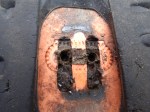
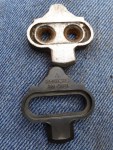
I have sevral pairs of SPD compatible shoes, which have screw mountings on the sole under the ball of the foot. There is a metal plate embedded above which floats for adjustment. On to the plate is screwed a ‘cleat’ – a metal key block that engages smoothly with a spring-latched mechanism in the pedal. This provides a positive, hassle-free engagement which is predictable, adjustable and secure, yet twists free instantly when required. They ensure your feet are always in the best, comfiest position, and the pedals are double-sided, so you never have to think about clipping in. You just do it without looking.

Clipless allow you to ‘pull up’ with one foot while pushing down with the other, and even pedal one-legged while scooting through traffic. This small, drop-forged block of steel – about half the size and thickness of a small box of matches – transmits all your pedalling force in an absolutely tiny contact area, yet fits flush in your shoes in such a way that you can walk all day in a pair of SPD shoes and never feel the cleat.

The intense concentration of force in one small component and two 5mm screws is so great that it wears quite quickly. Tonight, my cleats had developed such a sloppy fit, I couldn’t put up with them anymore. After 5,000 miles, it was time for a change.

It’s easy to do; cleats come with pedals, or can be brought separately. You usually have to drill out one or two of the old screws due to the heads being fouled, but once you get them out, the cleat leaves an impression in the shoe that the new one locates in. A blob of grease on the screw threads, and crank them up. 

The fit is so good, it’s like riding a new bike.

My compliments to the inventors – these really are a great invention.

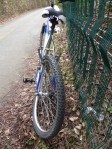
April 4th – On the cycleway from Telford station, this sad sight. It’s a BSO, or bike-shaped object and is the kind of bike one might buy from a supermarket, discount store or catalogue for a low price. BSOs are usually made from the heaviest depleted uranium, bad weld and cheese. They feature the cheapest, most poor quality components, as they’re generally sold to folk who won’t ride them much. 

They are bought by retailers in bulk for between £12-£20 each.

This machine – clearly abandoned on the way to work (it had gone by the time of my return) – had failed in a way common to such bikes; the wheels, built by machines with no human involvement at all – are usually very badly tensioned, and can collapse, or ‘pringle’ (think of the shape…) unexpectedly. This one was sudden and catastrophic, ripping the rear brake apart.

Never buy a cheap bike like this, even if you’re flat broke. Look for something better, secondhand. Some real bargains can be had with patience. Riding a piece of crap like this will put you off for life.

Hope the rider got to work OK.