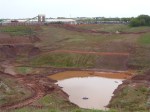
February 24th – The huge marlpit at Stubbers Green that feeds the Weinerberger brick plant with raw clay is impressive. These extraction processes are not as simple as just digging a hole. The pit is dug in a pattern decided by engineers to ensure safety and drainage. In an impervious material like marl, accumulated water from the elements and surrounding environment is an issue to contend with. Here, a floating pump on a bouyancy raft made of empty drums returns water to a surface lagoon. Roadways and access tracks crisscross the site.

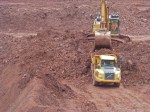
Extraction didn’t seem to be in progress when I passed today, but excavators load huge trucks with the red, surprisingly dry material, which is conveyed to the plant on the far side in an endless chain. The factory was running, however, as I could smell the distinctive note of baking clay in the air.

Although ugly, and many consider it a blight, this is a factory and facility that provides much employment to the local area, and the bricks produced are good quality. I find it fascinating in scale and procedure, and could look into that void for hours.

One of the fascinating aspects is looking at the rear face, and seeing the subtle colour changes in the clay as the geology yielded its secrets.
May 2nd – Heading off the canal at Leighswood Bridge there’s a footpath that somehow, against huge odds, has managed to stay open despite wending a precarious way between Europe’s largest inland toxic waste facility and an immense marlpit.

The red marls that have been opencast here for centuries made the area of Aldridge and Stubbers Green famous for it’s brickworks and tileries, producing high-quality engineering bricks and building materials that an entire industrial revolution was built out of.

These days, marl is excavated in an almost robotic process. An excavator works down the face in terraces, and four huge trucks are filled in a constant relay, each carrying three excavator bucketfuls to the Wienerberger brickworks up top. At the base of the excavation, there’s a pool of drainage water. This is returned to a settling lagoon on the surface by a pump, floating on a raft, cleverly made out of empty drums. Note that the marl itself is quite dry, and not the clay-like material one would expect. Impervious to water, it makes an ideal void into which landfill of most grades can be dumped when the opencast is exhausted. This area is surrounded by landfill sites utilising former marl pits, and under it all, millions upon millions of gallons of toxic slurry dumped in the deep coal workings that also riddled the landscape. 

There’s nothing so valuable as a hole in the ground.

In many countries, this would be considered environmental destruction. Here in the UK, we call it industry.

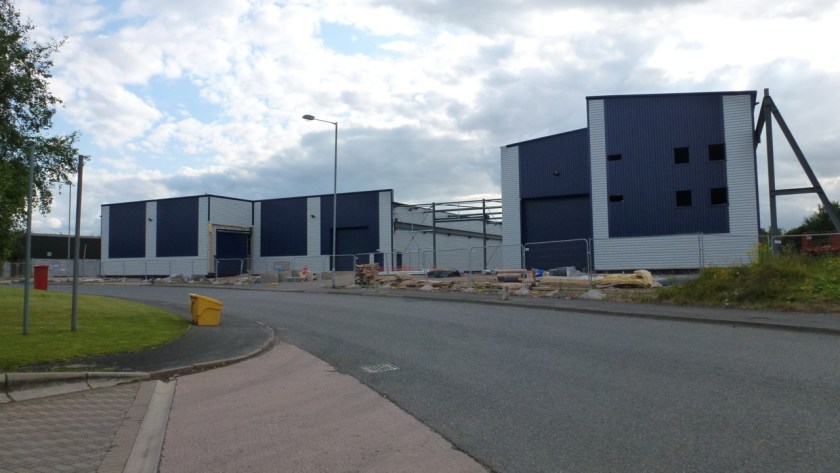
June 23rd – swinging down Maybrook Road on a wet afternoon commute, I took a look at the new factory being built there on the former site of the Walsall Wood Pit spoil heaps.Unusually, it’s a new engineering facility, which is a rarity these days. Sadly, it looks rather hideous, but it’s jobs I guess, and you can’t have everything. This land has been idle for decades and it’s good to see it now being used.