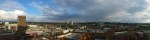
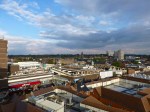
October 13th – My town, for better or worse.

I have a strange relationship with Walsall these days. Pass through it regularly, love almost all of it, but bits I used to know like the back of my hand are now alien to me. Certainly, shopping there is a grim experience these days. I was in town anyway, and wanted to see the Damien Hirst exhibition at the New Art Gallery. I like Hirst a lot, but the exhibition left me cold – I really wanted to see stuff like Mother and Child Divided again, yet what was here seemed to be the odds and ends of the artist’s work. The way it had been mixed in with the Garman Ryan collection was clever, though, and I did admire the guile of the people responsible for doing that, particularly the placement of the wallpaper.

I hadn’t been in the Gallery for a long while, and not on the roof terrace since the building opened a decade before, as when I’d visited, it had always been shut. Today, it was open, and I took photographs of my town – the place I once haunted like a skinny, music-obsessed ghost. I knew every shop, every bar, every alleyway, every cafe. Yet getting older dragged me away, and Walsall befell the same fate as other such post-industrial towns; ravaged by the inexorable rise of out-of-town and fringe retail developments, atrocious town planning and the encroachment of internet shopping,  it now holds little for me. The independent shops have gone, replaced by nail-bars, hairdressers, pound shops and money lenders. Many of the heritage buildings I could see from this view ten years ago are gone, lost to the arsonists that seem intent on depriving us of a cultural past. The bad planning goes on, the retail sheds obscuring or wrecking formerly decent vistas.

I still love this place with all my heart – as Bill Caddick put it, ‘Sore abused, but not yet dead’, but I fear I’m losing it forever. What’s gone, cannot be put pack, and there just doesn’t seem to be the breadth of vision, or cast of hand to build something new. Stuck in a kind of decay-limbo. I could cry.

I did what I always do at times when Walsall, and my past, makes me feel like this: I got back on my bike, cycled up to Caldmore, and reminded myself what community was about.

That’s my Walsall, right there.
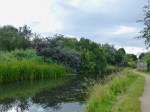
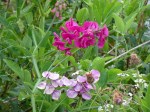
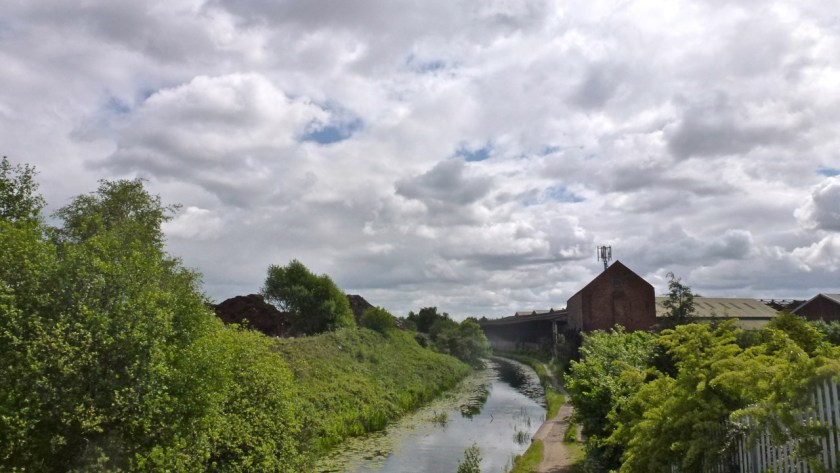
August 4th – I pottered up the canal to Chasewater, the end destination being Morrisons to get some shopping in. On the way the weather was temperate, and pleasant, but generally dull. Passing through Anglesey Wharf, we stopped to admire the flowers, which all seem to be showing in late summer purples now. Willowherbs, buddleiaheathers, even some kind of sweat pea (I think) as Alice Walker said ’…just trying to get noticed..’. I reflected on what the old familiars of this place, the coal-loaders, miners and boatmen would make of this scene now; the peace and quiet, rabbits lazing on the heath and grasses and shrubs dotting the former wharf. Once this was a humming, filthy coal depot. Some things are decidedly changes for the better.

January 18th – One of my predominate emotions regarding the Black Country, and Darlaston in particular, is that of loss. Looking from the Walsall Canal at the James Bridge aqueduct, right on the Walsall/Wednesbury/Darlaston border, the much improved but still grimy Tame picks its way through abandoned brownfield sites and wasteland, past the gas storage depot and into the hinterlands of Bescot and the shadow of the motorway. Once, it wound its slimy way around huge factories, refineries and metal mills. IMI, Rubery Owen, FH Lloyd, GKN. Between this wind-blasted canal bank and those proud twin churches, hundreds of thousands of men, women and children worked. In vile conditions, often uneducated. The noise would have been deafening, unlike the gentle lap of canal water and wind rush I hear today. Sometimes, it’s as if their improved standard of living killed the place. They destroyed us for wanting better.

It doesn’t matter anymore.

You can’t put it back, as an old mate used to say.

August 18th – It’s arguable that the most powerful economic force in the development of modern Darlastion was GKN, or Guest, Keene & Nettlefolds, a fastener manufacturing company that, until the 1980’s, loomed large in the Black Country industrial psyche. GKN had massive factories in Eastern Darlaston along Station Street, and companies that supplied them and competed were attracted nearby by the availability of skilled labour – Companies like Charles Richards, Kinnings Marlow and Deltight. GKN, of course, are still a massive powerhouse in British engineering, yet in the 1981, decided to end fastener production in the UK. Tens of thousands in Darlaston and Smethwick were made redundant. These were not just factories, but communities, that had their own doctors, carpenters and decorators on site. The National Blood Service used to come here for days on end, and blood donation was seen as an easy break by many of the workers who donated blood.

Here at Station Street, the GKN buildings remain, now housing ZF Lemforder and Caparo, both shadows of the manufacturer that abandoned Darlaston to the Wolves. GKN’s footprints are all over this town, and ingrained into the social history of this proud place.

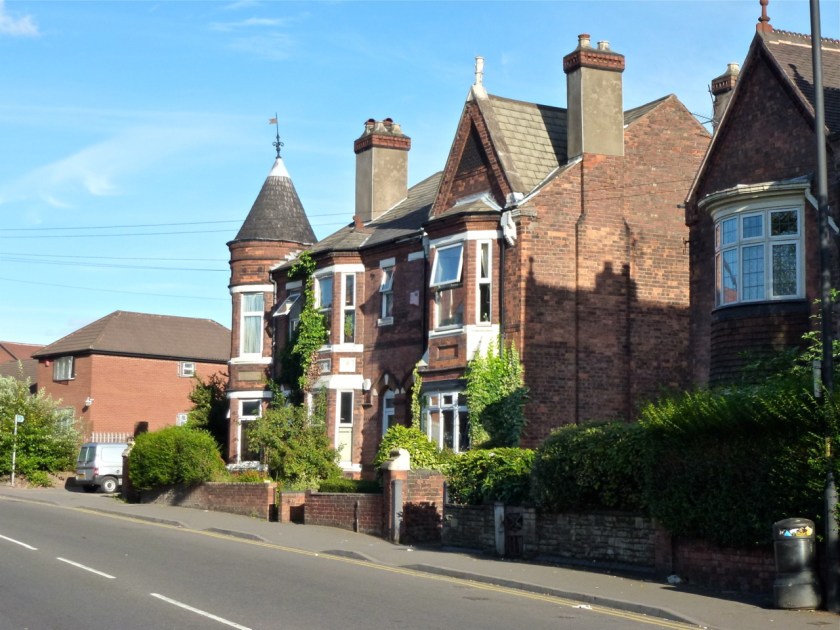
August 16th – Darlaston has some fantastic architecture. This industrial town between Wednesbury, Willenhall and Walsall was built in the heat of the industrial revolution on it’s drop forging and fastener trades. Both have now all but gone, with huge swathes of wasteland left behind, but hidden in nondescript rows of terraces and in quiet suburban streets are examples of buildings so wonderful they’d grace the likes of Cheltenham. This fine example is on the Walsall Road, just outside the town centre. I just love the circular tower and complex roofline. The ornamentation in the stonework is also gorgeous.

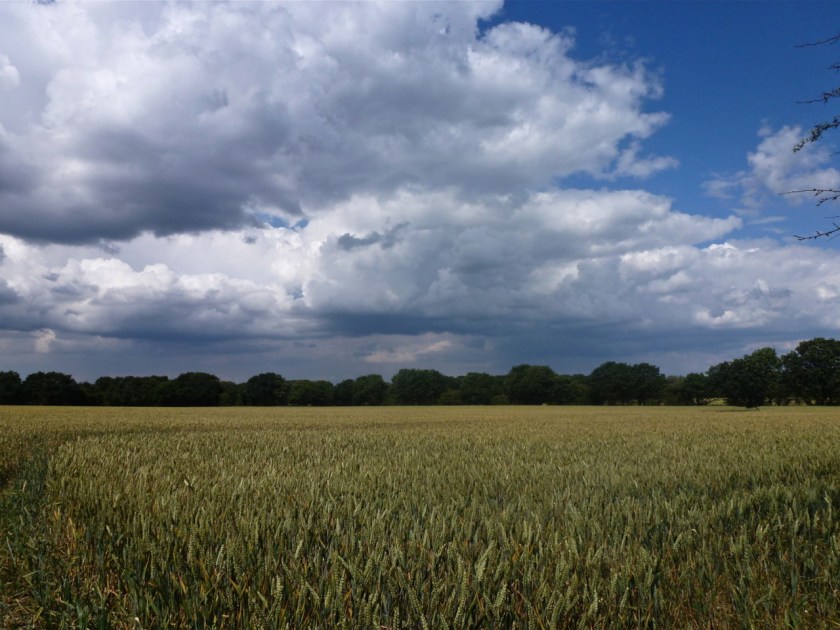
July 9th – researching the latest post on the Black Cock Bridge subsidence mystery, my path inevitably wandered toward lunch in Pelsall. Coming back through High Heath, I spotted this lovely, ripening field of wheat on the corner of Green Lane and Mob Lane. I reflected as I cycled down Mob Lane that since I was going downhill toward the old Bullings Heath, High Heath was suitable named.

Funny how you only notice these things peripherally – and who would have thought such a beautiful sight were possible in such a post-indurtial place?