#365daysofbiking Too low for comfort

Monday, September 21st 2020 – The fascination with other people’s bikes continues, as does the bafflement with some modern bike technical fashions.

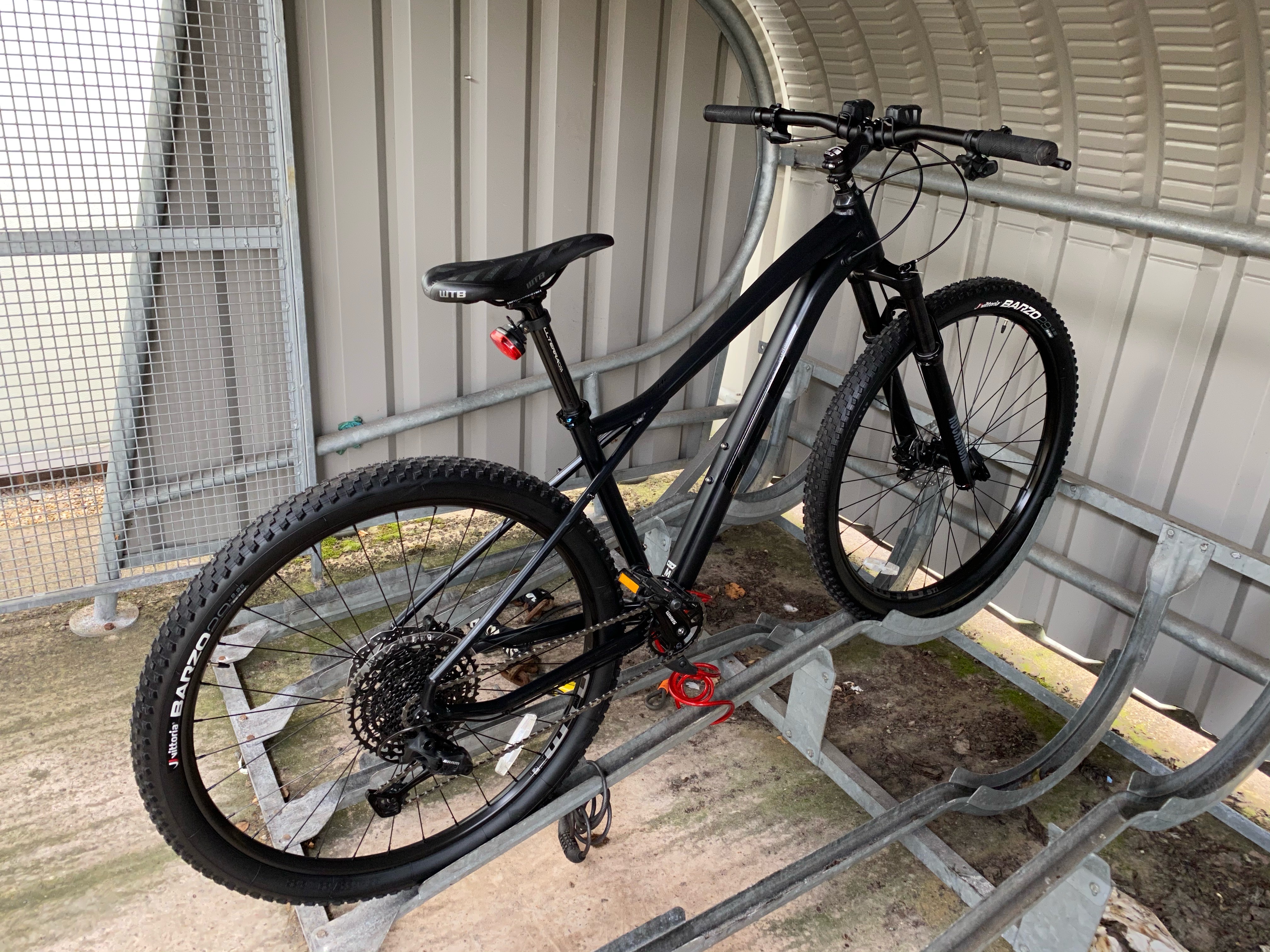
In a familiar customer bike shed, a new bike I think might be a Marin is locked with a Poundland cheese string bike lock (but thankfully this shed has a very securely locked door). It’s a nice, fairly high-end equipped bike, with SRAM (that’s Sachs for the oldies) gears. It’s what I would class a ‘forest bike’ – it’s not really a full MTB but not a hybrid. It would be at home on Cannock Chase’s midway trails or rough canal towpaths.

The bike has remarkable gearing arrangement, that’s sadly fashionable – a single front ring, which is tiny and an eyewateringly wide rear sprocket range.

I note it’s been left in the lowest of gears.

Why?

The gearing is utterly rubbish for road use.

I was talking to a pal about this the other day. I’m tying to build a decent derailleur setup at the moment, but there’s no longer the crossover between road and MTB gear sets where you can get a massive range for excellent touring use by mixing and matching. It’s either this stupidity, which necessitates a huge rear mech just waiting to get smashed off by a stump, or the low range and boredom of road group sets.

I know it’s fashion, like the frankly ludicrous fat bike fad, and we’ll swing back to doubles and triples when the spinning kids want to go a bit faster than15mph downhill. But I wish it would pass.

It comes to something when a basic hub gear offers 25% wider range than most mountain group sets.

Rant over. For now.

from Tumblr https://ift.tt/2ZYwJeY
via IFTTT
September 20th – Spotted in a customer’s cycle shed, two bikes side by side that illustrate something that annoys me.

Shimano, the Japanese industrial giant that revolutionised cycling are not what many people imagine them to be. They are essentially production engineering experts, probably more than they are bicycle technology or fishing equipment manufacturers.

Shimano make loads and loads of great, well thought out products that I love. their work to refine the derailleur gear system in the 80s and 90s, their clipless pedal systems and electronic gear technology have changed cycling for the better immensely. But something more than these innovations has had a massive influence.

Shimano sell innovative kit to bike manufacturers. That means they also sell and produce the tooling to manufacture bikes en masse. Shimano often market products to manufacturers because they’re cheaper or easier to assemble on a production line, but sometimes of little discernible end-user benefit.

Shimano pioneered the external bottom bracket, a frankly piss-poor idea that is hated by lots of cyclists for it’s increased wear and susceptibility to corrosion. Shimano invented it to make assembly of bikes from one side far easier. It shifted to producers in large numbers and is now, sadly, ubiquitous.

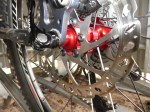
Similarly, for years, bicycle disk brakes – which I love as a technology – had their rotors attached to the wheel hubs by six M5 screws, like the bike in the top picture. This ‘6 bolt’ design has been a standard for more than a decade, and works well. You can feel if there’s a securing issue without the loose disc being dangerous, and the rotors are light and easy to replace with standard workshop tools – usually an Allen or Torx driver.

Shimano recognised that a big cost in disc brake adoption to mainstream bikes was assembly of the disc onto the wheel – six screws require either a complex, mutispindle head or an operator repeating the same action 12 times per product. So they invented Centerlock(sic).

The lower picture shows a bike with a Centerlock rotor.

Centerlock uses a splined male dog on the hub, and a special brake disc with a mating female recess. The rotor slides onto the splines, and is held in place by the same type, thread and tooled ring that holds the gear cassette on a rear wheel, thus requiring one tool to fit the cassette and two brake rotors, a huge cost saving in production.

Centerlock rotors are heavier, and you need a special tool to fit or remove them. If the ring comes loose, there’s nothing else to hold it.They limit consumer choice of aftermarket replacements.

There’s a whole industry sprung up around centre lock to 6 bolt adaptors.

This change in technology was introduced purely for the benefit of bike manufactures, arguably to the detriment of consumers and to me, is inferior.

Rant over.

March 14th – Where do you leave a pair of bikes when you’re exploring a lost Mall? Well, loads of railings and street furniture nearby…

Cue rant.

Birmingham is a lousy city to cycle around at street level. For decades, the City Council have paid lip service to cycling, with a road system that routinely ignores the needs of more vulnerable road users, like Moor Street Queensway. They were given millions in cycle funding, which they used to resurface miles of perfectly good canal towpath.

And then, there’s aresehattery of this calibre. No cyclist would ever have managed this. I guaran-damn-tee the person responsible for this act of civic idiocy last rode a bike in school.

What am I upset about?

Cyclehoops are the round fittings bolted to these railings. They are great items of cheap street furniture designed to be fixed to existing street furniture to provide anchor points for bike parking. We have some in Walsall on lampposts. They’re brilliant because they stop your steed flopping around the post, and provide a secure lock rail that’s hard to remove.

Oddly enough, railings already provide that feature.

Birmingham City Council bought a bunch of Cyclehoops and instead of fitting them in places where they would be useful, bolted them to railings that already perform the purpose Cyclehoops fulfil.

You normally have to make an appointment for this kind of idiocy.

Stick a fork in the Council’s backside and turn it over, it’s done.

July 6th – Sustrans, the cycling charity who created and ostensibly look after the National Cycle Network are really annoying me locally.

A few weeks ago, I pointed out the baffling signage south of Chasewater on the canal, which appeared to prohibit a good cycling route. Here I noticed similar confusion at the level crossing by Chasewater Heaths station. Face north, and the signage correctly leads you over the crossing, onto the cycleway past the Sportway. Come in the opposite direction, and it shows you’re on Route Five. Or you’re not. 

What the hell?

Get your act together, people; you’re supposed to be promoting cycling, not preventing it.