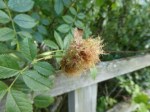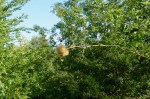
July 30th – Nipping out of work in the earl m morning on a cafe run, passing a familiar patch of waste ground, I finally found something I’ve been looking for for a few weeks without luck; a robin’s pincushion gall.

This hairy mass on dog and wild roses is, like the knopper and marble galls on oaks, an insect gall; a tiny wasp lays eggs by injecting them into a leaf-bud surrounded by DNA corrupting chemicals that cause this odd growth to form rather than a leaf.

Beneath the bristles, there’s a solid ball of plant matter with cavities within which the larva grow and develop in safety; when ready, like other galls, they eat their way to freedom and adulthood.

The gall doesn’t harm the plant at all. It’s a remarkable thing.

August 1st – Also ripening well are the rosehips, the seed fruit of the various types of wild and feral rose that grow so beautifully by the towpaths and edge lands all over urban Britain. Sweet and juicy, they are sought after by birds, mammals and foragers alike.

Less common and indeed, quite a find, is the odd, hairy wasp gall growing on the same bush. This is the wonderfully named robins pincushion gall, or sometimes just moss gall.

Like oak galls, this curious mutation forms from a leaf bud on the rose stem injected with eggs and a DNA corrupting chemical by a tiny wasp. The chemical causes the leaf bud to mutate into this odd growth instead, and at the heart of the woolly mass is a solid core, in which the eggs hatch, and the larvae eat their way out when ready.

the gall doesn’t harm the rose particularly and is just another fascinating example of the ingenuity of evolution, with host and parasite developing together for thousands of years.