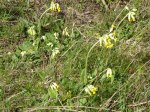
April 11th – A short trip to Chasewater on an unpleasantly windy day was rewarded with the realisation that I’d had a guerrilla-planting success: last autumn, I scattered a load of wild cowslip seeds at Anglesey Basin: this year, a pleasant patch of my favourite flowers.

If we enjoy these things, help them out by spreading the love. I collect seed heads in little bags and spread them on wasteland and verges, then enjoy the results.

Wild flower power!

July 13th – A vitally important mission begins.

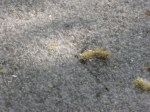
These are the seed heads of my favourite flowers, cowslips, and the wee dots the seeds themselves. For the next few weeks, I’ll potter around anywhere I saw cowslips in spring, looking for the seeding plant. I’ll gently collect a little pot of seeds, and then spread them on land where it would be nice to see some in spring (praying I don’t get pulled by the coppers in the meantime).

It’s how most of the cowslips got on Clayhanger Common in the first place. I’m rather proud of that.

Guerilla planting is a random act of natural kindness. Do it now.

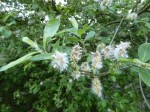
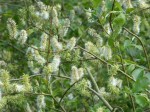
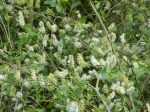
May 18th – I like it when things here resolve themselves and intertwine. Way back on April 28th, I spotted an unusual, willow-like tree growing by the canal I’d not noticed before. What snagged my attention were the curious, spiky, flower-like growths, and I asked at the time what the tree might be, and were the ‘blooms’ flower or seed?

The wonderful fellow cyclist Wilymouse kindly pointed out on the original post that the tree was Grey Sallow (or Grey Willow). I learned from a link supplied that what I had seen was the female flower of this tree; the male being the familiar pussy willows.

Check out Grey Sallow here, and the images down the right hand side of the page.

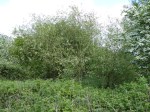
Moving on, Rose Maria Burnell sent me some photos this weekend of seed fluff blowing around Chasewater. Rose assumed it was from dandelions, and I think a lot of it is… but also, it’s coming in huge amounts from grey sallow trees – the spiny flowers I photographed have seeded and are shedding wind-born material into the air, and coating everything with fluff. 

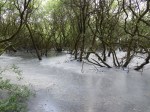
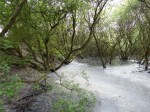
The trees seem particularly dense around Fly Creek and the dam, although they’re all over Chasewater, and the atmosphere is thick with little seeds. At the creek by the boardwalk crossing, the water is white with seed fluff. It’s really quite eerie.

So, mystery solved – thanks to Wilymouse and Rose for the input!

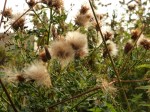
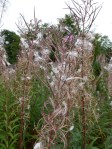
August 27th – I noted recently that rosebay willow herb is called ‘old man’s beard’ due to the white, fluffy, wind-borne seeds it spawns at this time of year. Another prolific source of the familiar ‘fairies’ that float on the breeze are thistles, also plants of the margins and hinterlands. Gorgeous at the moment in their downy decadence, they are a food source for small birds like finches, and also for any passing donkeys, who love thistles with a passion.

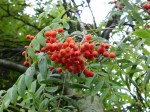
August 23rd – Spinning out through the countryside, I noticed how many plants and trees are fruiting – rowan, oak and many I don’t recognise. The willow herb is seeding, too, and it’s easy to see why it has the colloquial name ‘old man’s beard’. It’s very hard to escape the fact that autumn is now on my heels. A sobering thought.