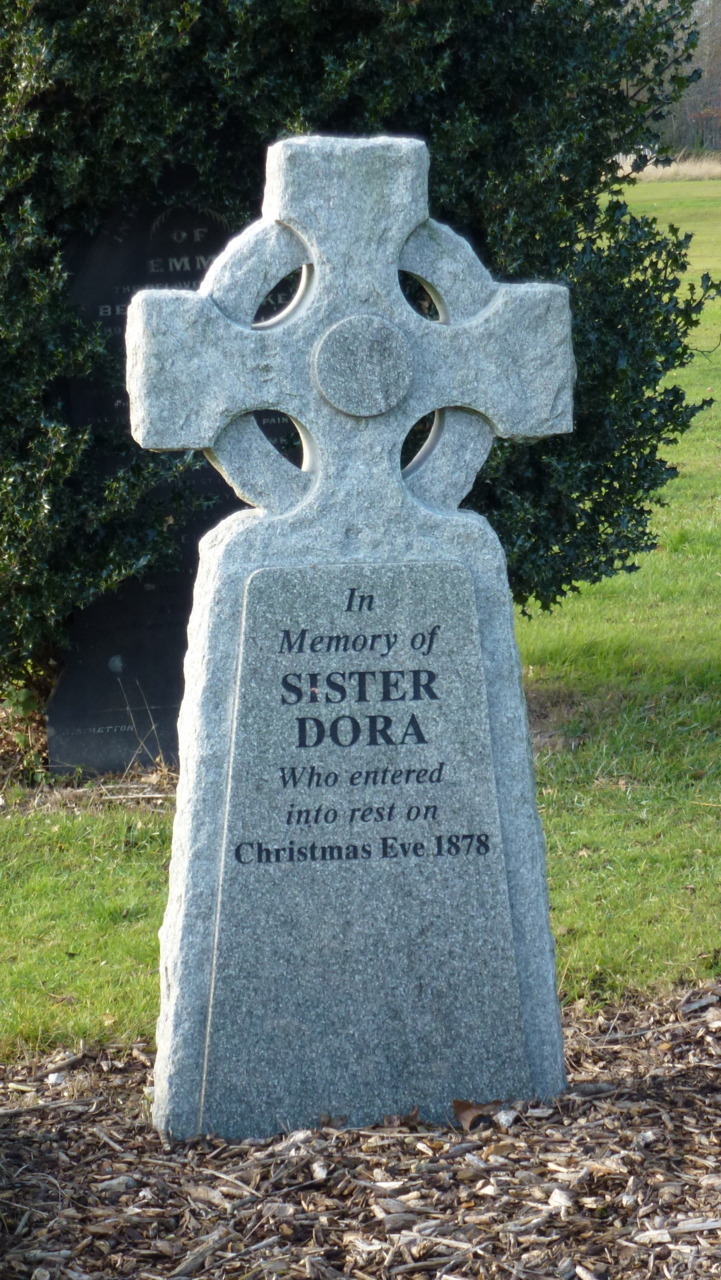
December 15th – Of all Walsall’s notable folk, I think perhaps the most loved is Sister Dora. Dorothy Pattison was one of the first nurses in the town, and she worked tirelessly to heal the sick and injured from industrial accidents and smallpox. She was well respected in her lifetime, and her reputation remains to this day. She’s buried at the sadly dilapidated Queen Street Cemetery in Walsall, in a very low key grave. Her statue stands proudly on The Bridge in Walsall, and as well as giving her name to streets and buildings locally, Dora also gave her name to the town’s mental hospital.
Wikipedia has this to say about the great nurse:
She was the second-youngest child of the Rev. Mark James Pattison, and sister of the scholar Mark Pattison Jnr. From 1861–1864, she ran the village school at Little Woolstone,Buckinghamshire.
In the autumn of 1864, she joined the Sisterhood of the Good Samaritans at Coatham, Middlesbrough and devoted her life to nursing. She was sent to work at Walsall’s hospital in Bridge Street and arrived in Walsall on 8 January 1865. The rest of her life was spent in Walsall and it was there that in local eyes she became to be compared with Florence Nightingale.
Later she worked at the Cottage Hospital at The Mount.
In 1875, when Walsall was hit by smallpox, Sister Dora worked for six months at an epidemic hospital being set up in Deadman’s Lane (now Hospital Street). During 1876, Sister Dora attended more than 12,000 patients.
The last two years of her life, Sister Dora worked at the hospital in Bridgeman Street, overlooking the South Staffordshire Railway (later the London and North Western Railway). It was there that she developed a special bond of friendship with railway workers who often sufferen in industrial accidents. The railwaymen gave her a pony and a carriage and even raised the sum of £50 from their own wages to enable Sister Dora to visit housebound patients more easily.
In 1877 Sister Dora contracted breast cancer, and died on Christmas Eve in 1878. At her funeral on 28 December the town of Walsall turned out to see her off to Queen Street Cemetery, borne by eighteen railwaymen, engine drivers, porters and guards, all in working uniform. On her death Florence Nightingale paid the following tribute, ‘May every nurse, though not gifted with Sister Dora’s genius, grow in training and care of her patients, that none but may be better for her care, whether for life or death’. Her epitaph read, ‘Quietly I came among you and quietly let me go’.



 BrownhillsBob's #365daysofbiking