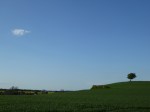
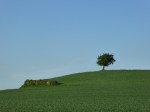
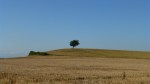
May 14th – Grove Hill, near Stonnall, remains a muse to local photographers and historians alike. The hill topped with a lone tree is well known as a landmark to people passing on the Chester Road.

Myth and legend has it that a noble man is buried here, hence the tree, although the reason for its placement is probably more esoteric. Like the groinal hedge to its side, the tree is probably preventing soil erosion.

This year, the hill appears to have a crop of fine-looking wheat growing lush and green all around.

It’s a lovely spot.

November 26th – Heading off to work on a less than inspiring morning. I’m glad to say I’m used to the chill again now, but the greyness is still a bind. As I sped down through Stonnall, I passed Grove Hill. Last time I looked up there, it was a field of oilseed rape, and the tree, now barren, was in full leaf.

There’s a winter crop grown in the surrounding field now, which was young and vivid green, perhaps the only splash of natural colour on an otherwise dismal grey morning.

That hedge still demonstrates soil erosion beautifully, mind. The folks that planted that knew exactly what they were doing.

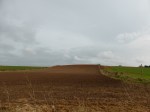
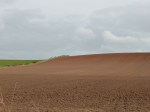
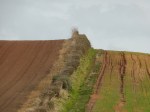
April 15th  – the gorgeous sandy soil of the north east side of Shire Oak’s bunter sandstone ridge gives Stonnall its charm and character. This light, thin and variably fertile soil shows off it’s characteristics best when ploughed and harrowed, as this field has been south of Mill Lane. The colour – somewhere between chocolate and ochre, varies across the contours. Last week, there was snow lying in the lee of that spinal hedgerow. Now it’s spring.

What this does demonstrate well is that the old boys who planted these hedgerows – miles of which were grubbed up hereabouts in the post war decades – really knew their stuff. Note the step from one field to the next; that’s caused by centuries of wind erosion. The hedges – by virtue of clutching roots and obstructive foliage – break the wind, and act like groynes. This effect can also be seen on Grove Hill and many local ridge boundaries.

The landscape reads like a great book, sometimes.

July 24th – Grove Hill is a local landmark that’s very visible from the Chester Road. The subject of huge mythology, there’s really very little known about it. Presumably, but not necessarily a burial mound, the lone tree on top makes a lovely viewpoint and a distinctly notable feature. I noticed a recent conversation on Facebook where it was asserted that the hill was called Gallows Hill, and was once the site of a military encampment. Sadly, I think the physical geography has a simpler explanation.

I believe the tree still exists – and I doubt it’s original – to keep the soil on top of the hill. It’s windy up there, and soil erosion is a problem. The root system will work to contain the earth, giving the reason why the farmer never removed it and put up with ploughing round it year after year. Note the short ridge hedgerow to the left – it’s on the generally windward side of the hill. The difference in soil height is caused by the hedge doing it’s job, which is also to prevent erosion by the wind.

It’s a lovely spot, with some fascinating folklore. However, like most fantastical tales, I suspect the actuality is somewhat mundane.