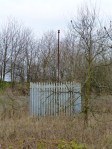
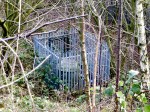
February 23rd – Evidence of subterranean systems of an altogether more sinister nature can be found dotted around the borderlands of Walsall Wood, Shelfield and Aldridge. These odd enclosures – one in the fall towards the marl pit by the Brickyard Road canal bridge at Stubbers Green, and the other, on scrub near the end of Dumblederry Lane in Aldridge, are grim reminders of what lies beneath. They are access boreholes to the mine workings beneath, filled with millions and millions of gallons of toxic waste, dumped there after the mines closed. The dumping, over the course of a couple of decades, was freeform and barely regulated. The current operators of the site from which this dump is accessed manage it carefully. The boreholes, of which there are a number, are fenced and secured for obvious reasons. The one at Dumblederry lane has a breather valve fitted, to vent gas safely into the atmosphere.

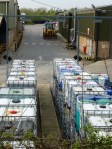
May 2nd – On the other side of the precarious footpath mentioned in the last post is this chemical waste facility, now operated by Veolia, a huge international waste disposal company. These days, it’s a modern, well kept and operated plant, but it wasn’t always thus. Under the tower is a borehole to the former mine workings below, and into this void were pumped millions of gallons of toxic waste. Contained by marls, it is thought to be safe; yet other surface waste dumps nearby, operated by former operators like Polymeric Treatments, were not so successful. Claiming to have invented a system of mixing highly poisonous materials with concrete, the ‘Sealosafe’ process was widely considered to be a failure. 

Operations here were controversial through the late seventies until the nineties, with smell, nuisance and just plain fear all being factors. At one stage, operators had a surface lagoon full of slurry which became the subject of a standoff between the local council and the company concerned, which ultimately led to regulation of an entire industry.

These days, the tankers slide in and out of here largely unnoticed, and the controversy has abated. The laws governing these kinds of operations are probably now the tightest in Europe, and rightly so. We still get the occasional smell, but on the whole, there’s little to show of the ferocious political and activist battleground this once was.

WE have to accept, I guess, that if we want to live in a world with shiny metal goods, wonderful kitchen cleaners, beautiful plastics that all manner of complex chemical processes are required. These generate massive quantities of very, very nasty stuff. Whilst the commercial operation of sites like this is not ideal, we need to accept their necessity, and in technical terms, our area is highly suited to this kind of disposal in terms of geology.

A complex history, largely misunderstood and forgotten.

May 2nd – Heading off the canal at Leighswood Bridge there’s a footpath that somehow, against huge odds, has managed to stay open despite wending a precarious way between Europe’s largest inland toxic waste facility and an immense marlpit.

The red marls that have been opencast here for centuries made the area of Aldridge and Stubbers Green famous for it’s brickworks and tileries, producing high-quality engineering bricks and building materials that an entire industrial revolution was built out of.

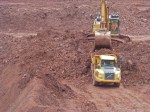
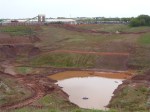
These days, marl is excavated in an almost robotic process. An excavator works down the face in terraces, and four huge trucks are filled in a constant relay, each carrying three excavator bucketfuls to the Wienerberger brickworks up top. At the base of the excavation, there’s a pool of drainage water. This is returned to a settling lagoon on the surface by a pump, floating on a raft, cleverly made out of empty drums. Note that the marl itself is quite dry, and not the clay-like material one would expect. Impervious to water, it makes an ideal void into which landfill of most grades can be dumped when the opencast is exhausted. This area is surrounded by landfill sites utilising former marl pits, and under it all, millions upon millions of gallons of toxic slurry dumped in the deep coal workings that also riddled the landscape. 

There’s nothing so valuable as a hole in the ground.

In many countries, this would be considered environmental destruction. Here in the UK, we call it industry.