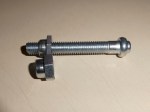
March 18th – A bit of a tip for the Brooks saddle owners with a sheared tension bolt, as I suffered last week.

If your saddle hasn’t stretched much, it can be particularly hard to get the replacement bolt in – in the factory, the saddles are stretched on a hydraulic jig, so fitting a replacement can be a struggle to the home mechanic.

The problem is made worse because the pin isn’t threaded all the way up – and an extra 2mm of thread could make all the difference, and did on my saddle.

To make fitting a replacement easier, I took the adjusting nut from the new pin, and turned 2mm off the head on the lathe at work. It’s a steel nut, so there’s plenty of material left, and that 2mm allows the nut to be wound back clear enough to fit the pin with minimum leverage.

If you have this problem and don’t have access to a lathe, just find a handy local engineering company where someone will probably do this very quick task for a pint.

It could make the difference between doing the job yourself and having to return the saddle to Brooks.
June 17th – So help me god, I’ve been asked how you know if your bottom bracket needs replacing (see last entry, 16th June) – so I made a quick video. The old part is held in a vice over white paper for clarity. I’m wobbling the other end, out of shot. There should be no wobble at all.

Hope that helps!

January 18th – Cycling in the snow presents its own unique pitfalls, hazards and skills, and over the years, I’ve learned the best tricks I can. For cyclists out there considering cycling in the snow, there’s some stuff to watch out for. Beware speed humps, potholes and the edges of roads, which hide beneath the snow and take you by surprise. Watch out for the large lumps of compacted snow and ice that litter the busier roads; they drop off vehicles, and look soft and slushy, yet are usually rock hard. Try and ride in the centre of lanes where possible, and note that virgin snow is often easier to cycle through than mobile compacted ice in vehicle tracks. Beware of large chunks of solid ice that sweep from HGVs and vans – vehicles with tarpaulins are a particular hazard for that. Keep changing gear frequently, to prevent your cable from seizing, and use brakes as little as possible. Relax, and go where the bike takes you.

Since urine contains urea, a natural deicer, peeing on a gear mechanism or brake can free it and get you home.

Take it easy. Ice doesn’t forgive speed.

Riding in this weather is fun, but take care, and it’ll be really enjoyable.