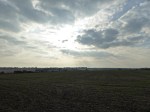
September 23rd – The overcast days seem to be well upon us now, and when I left work this evening, the light was grey, indistinct and the air quality once more very poor. I had to nip over to Stonnall to pick something up, so I ploughed on with grim determination. 

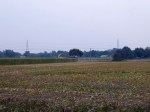
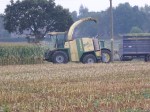
Just off Lynn Lane, on my return, I noted that the last arable crop of the season was being harvested. Maize (a close relative of sweetcorn) which had grown tall and green in the end days of summer was now being shorn off at ground level by a special piece of machinery, which chops the whole plant – leaves, stalk, seed and cob – into chips for use as bulk in animal feed and the like.
I watched from afar with a heavy heart. The smell was remarkable, and with it, the summer passed the final baton to autumn. The closing-in is well underway today, coincidentally also that of the Autumnal Equinox.

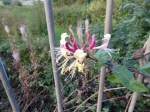
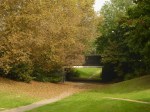
September 22nd – Further on from the flytipped mattress, my dark mood was lifted by a splash of colour as I winched myself up the Black Cock Bridge. Remarkably, the honeysuckle thicket growing there is still flowering, and in seeming good health.

Think about that. We’re 8 days off October, and the honeysuckle is still gorgeous.

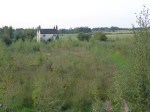
Looking beyond the railings, I noted the field in from of the old farmhouse had been planted with young, deciduous saplings, which are coming along rather well. An excellent thing, and great colours right now, too.

September 21st – A horrid, horrid day. Laden with a cold, the sun was out but I was in. Feeling cranky, miserable and ill, I battled technology and social media at home, and finally left for a restorative ride at 5pm. 

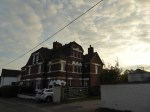
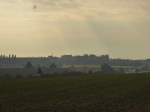
The air was still poor, but it caught the sun beautifully. Looking from Hammerwich over the fields to Brownhills, I was fascinated by the glow of the Lichfield Road as it rose to cross the Anglesey Branch. Riding over to Wall and back through the lanes around Chesterfield, the villages and old building looked beautiful, as did the odd flower of the evergreen, growing in the hedgerows at Wall.

It may have been a terrible, terrible day, but the golden hour was just what I needed.

September 20th – Must have passed this garden backing onto the canal at Anchor Bridge hundreds of times – but never once noticed the apple tree, which this autumn has a fine crop of apples. The owner doesn’t seem to have noticed, though, as the windfalls are plentiful on the ground.

A lovely sight. Wonder if they’re eaters or cookers?

September 20th – Things were still grey and the air quality still dreadful, but a very, very fine rain had settled on the town as I cycled to Chasewater. 

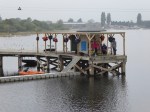
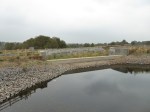
It’s good to see the old place busy now, and I love the way the Wakeline people have taken over and repurposed the old pier. Boats were speeding around, despite the murk, but I also noted the low water level – lower now than it has been for a couple of years. The valves are still open, so one assumes there’s a good reason.

Cycling back along the canal, it felt more like November than September, apart from the unseasonal warmth. Or maybe it was just a cold kicking in – at least that would explain the congestion.

September 19th – After a languid Indian summer, the sudden dull, overcast weather was a shock, but other stuff was bothering me. The air quality seems lousy at the moment, and it was irritating my sinuses making me unusually reliant on decongestant. Visibility wasn’t great either, but the air wasn’t really damp. This is an odd season, to be sure.

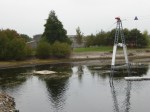
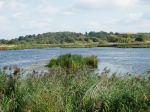
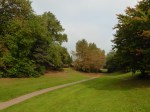
The autumn is in full swing, and the colours turning from dusty, tired greens to oranges and golds. Around Clayhanger Common and the new pond, the beautiful, deciduous copses and thickets are a wonder to behold, yet I think few every really study them or note the diversity of species they contain.

If only for a bit more sun to make these colours sing!

September 18th – From the Indian, back to the Indian summer. Darlaston, in and around Victoria Park. The leaves are turning and falling, and the park as clean and perfect as usual. Surrounded by beautiful houses, I will not cease banging on about this jewel of a place until everyone gets it.

I was intrigued by the scarlet berries on the holly-like evergreen; copious and beautiful, they seem to be holly, but the leaves don’t look much like holly leaves; more like a cross between laurel and holly. A curious thing.

Anyone know what it is?

September 18th – Ah, Walsall. In how many ways do I love thee?

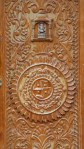
I spotted this a few weeks ago. At first glance, to the uninitiated, it’s quite shocking; an ornate front door to an everyday house bearing a carved swastika.

The swastika, though, has a millennia-old peaceful history before it was stolen by the National Socialists; it is a symbol recurrent in Sanskrit (where the name originates) and one of peace and good fortune to Hindus, Jains and Buddhists. Still in common use in defiance of the Nazi corruption of it’s peaceful meaning, the Hindu culture in particular is trying to reclaim it from being associated with evil.

This beautifully carved front door is laden with Hindu symbolism, including a representation of Ganesha, the elephant-like god of good fortune and artistic wisdom. The Swastika is used often in the front doors of Hindu houses to invite in Lakshmi, the god of love, prosperity and beauty.

Note also the front gate contains the legend Patel, a common Hindu surname. 

Walsall is a melting pot of cultures, peoples and trades. On a dull moring in Pleck, a beautiful thing blends into an otherwise unremarkable urban tapestry.

That’s why I love this place.

September 17th – Recently on Facebook there was some concern over a swan that was found dead in Pelsall. The bird had been decapitated, and many were accusing vandals. The truth is less controversial, but sadly a little more gory.

The swan was, in all probability, killed by a fox. Anyone who’s seen the aftermath of a fox in a henhouse will know that Reynard goes for the neck.

At this time of year, this year’s cubs are driven out of the den by their parents to seek their own territories – that’s why we often see foxes sleeping on roofs and in quiet but open spots in late summer. Quite frankly, these canines are homeless.

The young, inexperienced adolescents are forced to fend for themselves – that includes finding food – and many will attempt kills that are well above them. So it probably was with the Pelsall swan.

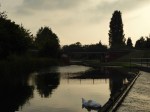
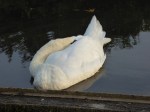
Swans are not bright birds. As I came home along the canal, I spotted this usually aggressive lone bird fast asleep, drifting on the water. It had floated into the bank around the overflow, at Clayhanger Bridge, and the thicket nearby is usually host to a den of Brer Fox.

It would be fairly trivial for the fox to sneak up to the bird unseen, and go straight for the neck, which is about the only bit the fox can attack without the risk of being ferociously pecked. The kill, to an experienced fox, would be fast and efficient and lead to food for a week or more.

The fox that attacked the Pelsall bird was probably scared off, or attacked by other swans roused by the commotion, leaving their kill behind.

I couldn’t knowingly leave this swan to a similar fate, so after taking a few pictures, I gently woke it by speaking. I was greeted by wing-flapping, honking and hissing, and the white bird swam away from me.

Job done.