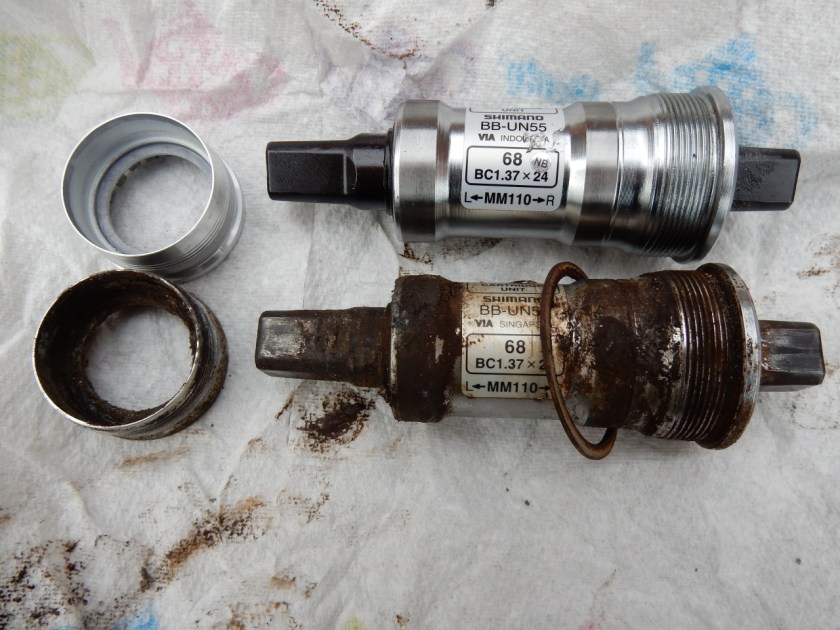
June 16th – Bottom brackets are a pain in the arse. I can’t believe that after more than a century of cycling technological innovation, they’re still so rubbish.
The bottom bracket is the spindle that the cranks mount on through the bottom of the frame, which spins freely allowing your pedals to rotate. As a mechanical component, the bottom bracket experiences the worst abuse – epicentric, unbalanced point loading, muck, water and corrosion. My bottom brackets take my full weight, plus that of the bike and load. They work hard.
Several solutions exist for bottom brackets – the component axle and loose bearings – the old way and fiddly to adjust and maintain; the ‘sealed cartridge’ (above) – a disposable insert designed for easy changing; the external – a frankly daft idea that’s gained traction in the last five years; the thoroughly insane press fit, preferred by the weekend Wigginses with plastic bikes.
All are rubbish, really.
On Sunday, I noticed the cranks on my bike had alarming play within the frame. The non-drive side bearing had collapsed in the cartridge. It’s done about 20,000 miles. Removing it is easy if you have the right tools and the person who fitted the last one did it properly.
Cranks are removed with a special extractor, and the cartridge is removed with a special socket tool from the DRIVE SIDE. It is a left hand thread, meaning the unit is turned clockwise to unscrew it. That fact escapes many, and has led to loads of skinned knuckles and damaged frames.
The cartridge is left hand threaded to prevent it loosening in use due to precession.
There is a support bush on the other side that unscrews normally using the same tool. The threads are cleaned with a small wire brush and degreaser, dried, greased with anti-seize paste and the new one fitted. Half an hour tops.
If the threads are not greased, the unit will be very, very hard to remove in future.
A replacement is about £15-£20. I’ve tried expensive alternatives – they make no difference.
See you again in another 15-20,000 miles.



 BrownhillsBob's #365daysofbiking