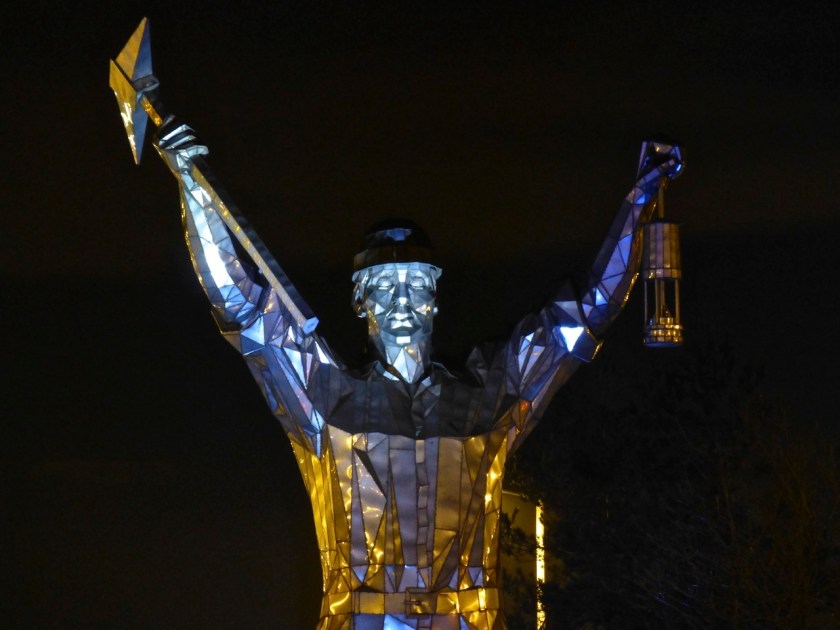
November 10th – I have an odd relationship with Morris, the Brownhills Miner. I like the sculpture,  he’s well-loved, and I really appreciate the work that’s gone into making him. But when it comes down to it, it’s a 10 metre stainless steel miner, lit by blue LED lights. Pretty, but also pretty ineffective. Morris didn’t bring regeneration, or prosperity. He doesn’t symbolise a rebirth or recovery. He just stands, back to the town, holding a lamp out to see if anything better is coming, all the while reminding us of what was lost.

That’s the thing about civic pride, statuary and economics. It’s best done when you’ve fixed the other stuff. It’s not a cure all.
November 10th – I didn’t get out until nightfall. It was cold, and clear, and I was all set. Then I discovered my camera had not charged from the night before. I carried on with my ride, then returned home, got a fresh cell, and nipped out to Brownhills. It was around 7pm, and the High Street was quiet. I looked in Ravens Court, the battered, all but derelict shopping precinct. A typical design of the period, it was further bastardised by a hideous facelift in the 1990s. It’s now down to a couple of tenants, and stands, unloved, steadily decaying. Tesco were to demolish this and build a new superstore, but they got cold feet and have left the community in limbo. this desolation is our gift from the retail behemoth that destroyed our town. At night it’s grim, desolate and forbidding.

In daytime, it’s worse.

Further towards home, I traversed the Black Path, the cycleway and footpath that heads up through Holland Park to the A5 and Newtown. That too was dark and hostile. I don’t know what it is about Brownhills at night these days, but the quality of darkness seems to be getting more malevolent. Perhaps it’s just the mood I’m in…

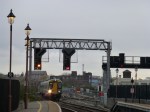
November 9th – The day was very grey indeed, and the train service lousy. Bad weather had been predicted for the evening commute, and with cancellations and slow running all round, I left work half an hour early. We’re in the days now of the nascent winter; grey, smoggy air, partial drizzle and heavy cloud makes for a greasy, unreal, not-quite-daylight feel. This is the worst bit of winter for me; not cold enough to be dramatic, or photogenic, or even challenging to ride in, but just headache-grey mundanity, rumbling from day to day. Stuff this, bring on some real winter, please. Snow, or crisp frosty mornings with bright air that hurts your forehead and clutches your chest when you breathe in. 

The only thing that looks good in the is murk is the light of the railway. Steady, bright, control.

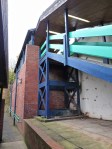
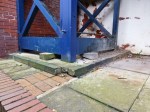
November 9th – I’m fascinated by this bit of structural joinery at Blake Street Station. It’s nothing more than the wooden frame supporting the access steps to the Birmingham bound platform, but the way they’re erected is a work of art. At the base, they’re chocked level with two pairs  of perfectly cut reverse acting wedges. You don’t see that very often these days. I’d be interested to know how old this assembly is – had it been crated today, it would be a steel framework with jacking bolts, so it must be at least 2 or 3 decades old. The precision of the wedges makes me smile every time I see them. That was a joiner who understood his art.

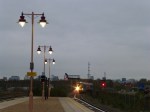
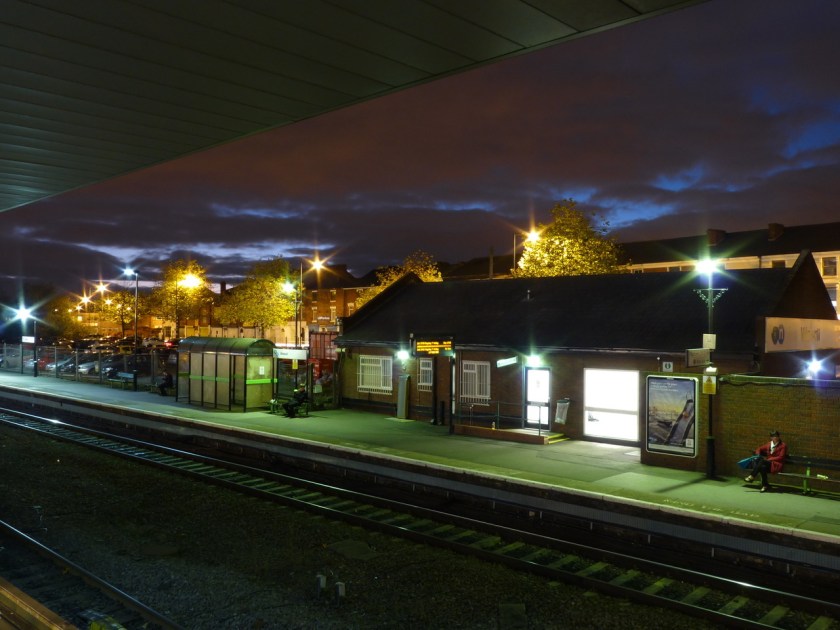
November 8th – Walsall Station at night has an odd, other-worldly atmosphere. The view from the ramp has always been great at night, but sadly diminished since the BOAK building in Station Street was lost to arson. It’s a horrid place to wait at – particularly for those on platform one, here waiting for the Rugeley train, as usual delayed by ten minutes.  London Midland, the embattled operator of the station, have talked about removing the staff here and leaving the station unstaffed at night. If they did, I think the service would see much less use – I, personally, would not feel safe. Good old London Midland.

November 8th – Urban design. This really irritates me – so much so, one day I’m going to twist the sign out  of the way. When on the stop line at the front of the queue leaving Birmingham New Street Station, a sign on a nearby lighting column obscures the view of the lights unless you’re in just the right position. Usually, you’re surrounded by traffic, or in bright sunlight, obscuring the other signals. 

I’ve been through here in a van and it’s no better, really. I wish people would think about this stuff – it really is time for less clutter signage at junctions.

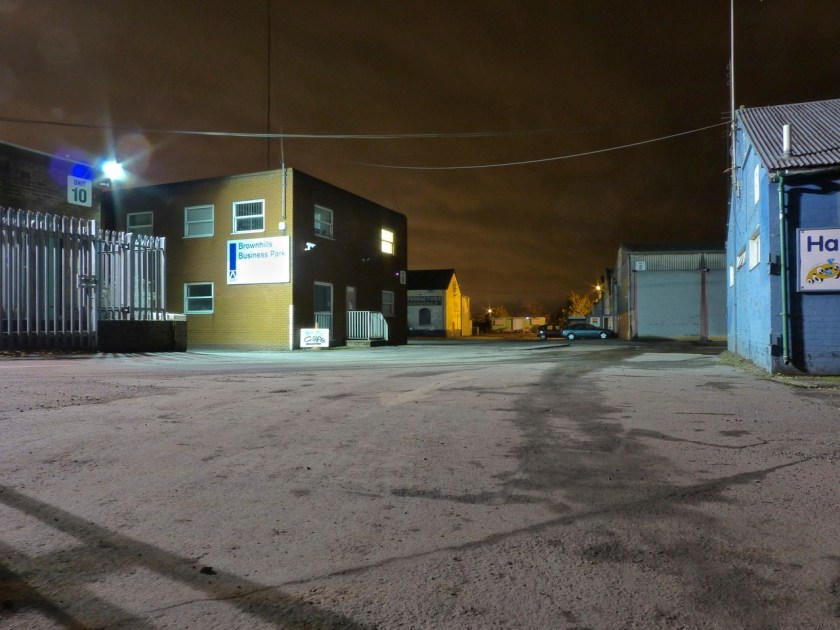
November 7th – Hard to imagine that this industrial yard was once the top yard of Walsall Wood Colliery. Brownhills Business Park is now an industrial estate, host to lots of small companies in it’s cheap units, mostlyd converted from the old pit buildings. A hive of industry in the daytime, it looks quite deserted in the evening. Recently, this site was saved from clearance for housing. The importance of such sites to the local economy is huge and should not be underestimated.

I often try and imagine the place, busy with miners, coal-trucks and clanking wagons. It’s impossible, now, but the ghosts linger, I’m sure.

November 7th – I’m really getting into Acocks Green in Birmingham. I love the suburban, Metroland architecture, broad tree-lined streets and air of urban dignity. What’s really interesting me, particularly now I’ve spotted Hay Hall, is that there are clearly buildings of an earlier period dotted throughout the district. Some are quite well hidden, but this suggests a long history. This is fascinating and I must read up.

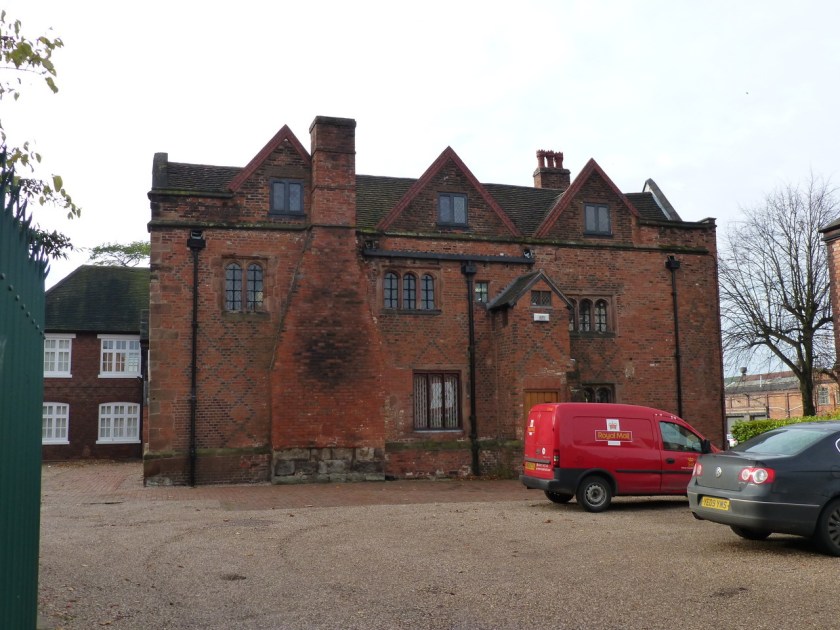
November 6th – I came upon this remarkable building yesterday, completely by accident. Taking a wrong turn in the industrial backstreets of Tyseley, Birmingham, I found Hay Hall,  one of the few remnants of Medieval architecture in the city. It’s got excellent chimney pots, too. Wikipedia has this to say:

A moated house or manor was first founded at the site in about 1260 by the De La Haye family. Hay Hall passed on to the Este family in 1423, when the heiress Marian De La Haye, married Thomas Este. They are commemorated in St. Edburgha’s Church atYardleyby a wall sculpture depicting them. The Este family owned and occupied Hay Hall until the late seventeenth century after which the property changed hands frequently. In 1917, when thePatented Butted Tube Company purchased Hay Hall and a surrounding 13 acres of land. The estate was developed into new tube works and factories but fortunately Hay Hall was saved from demolition.

The last person to actually reside at Hay Hall was apparently a Mrs Shelley who was employed as a housekeeper by the then rebranded Tube Investments Company, and was known to be living in the Hall up until 1939. In 1948 the building was fully restored and is currently in use as private offices for the Reynolds Tube Company Limited

I’m not sure if Reynolds still own it – the sign outside says ‘Air Link’, but it’s very hard to convey just how industrial the area around it is. Utterly incongruous, and rather lovely.