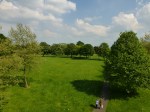
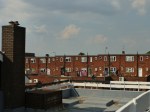
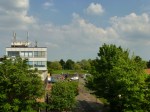
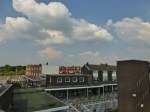
May 28th – Oddly, I found myself in Aldridge this afternoon. I’m not a huge fan of ‘the village’ myself; the Shopping Centre is soulless, and I find the place a tad unfocussed and a bit up itself, to be honest. However, it’s very green, and whilst cycling up the croft, I had an idea. I cycled up the car park ramp and took a look at Aldridge from on high. What did I find? Lots of trees. Lots of dull, utilitarian architecture. An almost unknown row of modern tenements. A place of contrasts, and an interesting way to see it.

May 14th – It’s been eight months now since I recorded the closure of the Mango Tree restaurant on the Chester Road in Aldridge. Soon after that, it was reported the building had been bought, and a new venue was to open there. Well, when I cycled past at 4pm today, it seemed that Voujon is now ready to reopen, if it hasn’t done so already. Looking smart, and totally refurbished, it’s nice to see the building back in use again. There’s a long history of eating establishments of this site – from transport cafes to a Little Chef. I wish the new proprietors well in their venture.

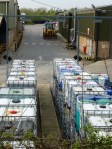
May 2nd – On the other side of the precarious footpath mentioned in the last post is this chemical waste facility, now operated by Veolia, a huge international waste disposal company. These days, it’s a modern, well kept and operated plant, but it wasn’t always thus. Under the tower is a borehole to the former mine workings below, and into this void were pumped millions of gallons of toxic waste. Contained by marls, it is thought to be safe; yet other surface waste dumps nearby, operated by former operators like Polymeric Treatments, were not so successful. Claiming to have invented a system of mixing highly poisonous materials with concrete, the ‘Sealosafe’ process was widely considered to be a failure. 

Operations here were controversial through the late seventies until the nineties, with smell, nuisance and just plain fear all being factors. At one stage, operators had a surface lagoon full of slurry which became the subject of a standoff between the local council and the company concerned, which ultimately led to regulation of an entire industry.

These days, the tankers slide in and out of here largely unnoticed, and the controversy has abated. The laws governing these kinds of operations are probably now the tightest in Europe, and rightly so. We still get the occasional smell, but on the whole, there’s little to show of the ferocious political and activist battleground this once was.

WE have to accept, I guess, that if we want to live in a world with shiny metal goods, wonderful kitchen cleaners, beautiful plastics that all manner of complex chemical processes are required. These generate massive quantities of very, very nasty stuff. Whilst the commercial operation of sites like this is not ideal, we need to accept their necessity, and in technical terms, our area is highly suited to this kind of disposal in terms of geology.

A complex history, largely misunderstood and forgotten.

May 2nd – Heading off the canal at Leighswood Bridge there’s a footpath that somehow, against huge odds, has managed to stay open despite wending a precarious way between Europe’s largest inland toxic waste facility and an immense marlpit.

The red marls that have been opencast here for centuries made the area of Aldridge and Stubbers Green famous for it’s brickworks and tileries, producing high-quality engineering bricks and building materials that an entire industrial revolution was built out of.

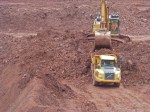
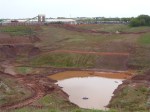
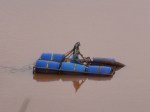
These days, marl is excavated in an almost robotic process. An excavator works down the face in terraces, and four huge trucks are filled in a constant relay, each carrying three excavator bucketfuls to the Wienerberger brickworks up top. At the base of the excavation, there’s a pool of drainage water. This is returned to a settling lagoon on the surface by a pump, floating on a raft, cleverly made out of empty drums. Note that the marl itself is quite dry, and not the clay-like material one would expect. Impervious to water, it makes an ideal void into which landfill of most grades can be dumped when the opencast is exhausted. This area is surrounded by landfill sites utilising former marl pits, and under it all, millions upon millions of gallons of toxic slurry dumped in the deep coal workings that also riddled the landscape. 

There’s nothing so valuable as a hole in the ground.

In many countries, this would be considered environmental destruction. Here in the UK, we call it industry.

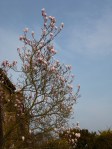
March 22nd – Nature is well awake now. Spring has come too far to turn back. The days are warming up, lengthening out and feeling better all the time. The most important thing, though, is that the flowers have appeared. All over our area, early oilseed rape crops have smatterings of yellow bloom, magnolias are reaching for the sky and daffs dance in the breeze. All around nature is just crying out for your attention…

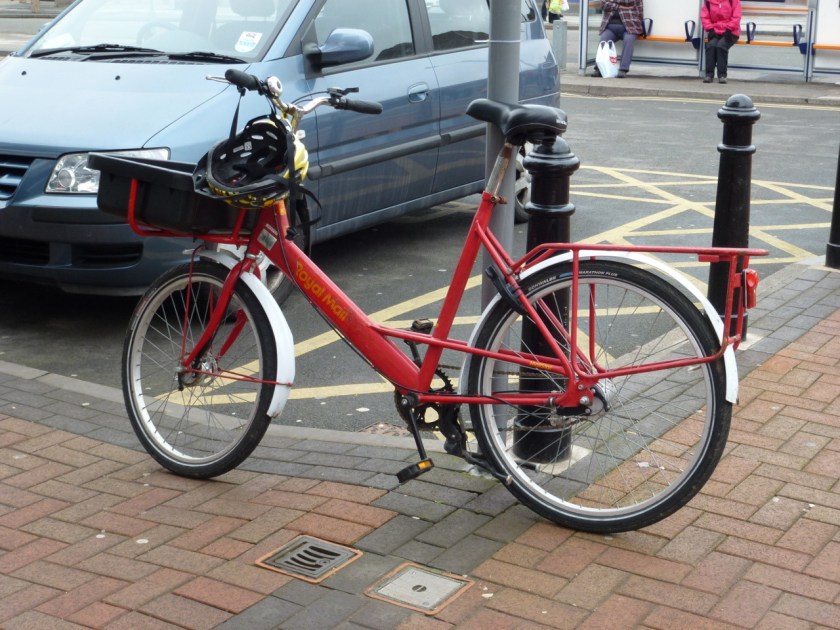
February 28th – Unusually, I passed through Aldridge on my way to work today. While popping into the shopping centre, I noticed a Royal Mail bike parked up near Anchor Road. These are a longstanding design, manufactured by Pashley in the UK. They weigh a ton, but have lots of solid, dependable tech – hub brakes and gears by Sturmey Archer, step through frame, Scwalbe marathon plus puncture resistant tyres, and dutch-style wheel lock on the rear, as well as the all important sturdy rack and front tray. Sadly, these bikes could be a passing tradition, as the wonks at the Royal Mail are apparently considering discontinuing the use of bicycles. Idiots.

February 11th – A bitterly cold day, and one for a rest. I had some stuff to do at sundown, so headed up over Lazy Hill to catch what was quite a decent sunset. It’s always been a bit of a disappointment to me that the best views of the countryside below from this spot can only be accessed by trespassing. As with Lanes Farm at Sandhills, most of the ancient rights of way seem to have been removed by more modern landowners. This picture of Castlefort Hill – the hamlet of upmarket houses once known as Castle Gate after the accent earthwork atop the hill – was taken from the fields on the brow of the ridge, after hopping over a field gate. Most access points are blocked by barbed wire.

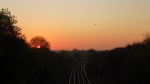
October 14th – Another stretch of canal, 70 minutes later. Had to nip out to Walsall, so swung home on the canal from Sutton Road to Leighswood. The sunset was remarkable, but sadly, no herons today. I didn’t see a soul, and as the sun sank over Walsall, the familiar chill of autumn returned to the air. A gorgeous end to the day. 30 miles in two hours punctuated by the most gorgeous scenes and views. It doesn’t get much better than this…

5th October – This one is far more serious. Recently, the Whitehouse junction in Aldridge was resurfaced an re designed. It’s now horrid to cycle across, and encourages the type of driver behaviour demonstrated above. The guy cuts me up, then stops his car, opens the door and shouts something abusive at me (I couldn’t hear what, due to the wind). I notice he didn’t seem to want to hang around and discuss the issue. All I did was shake my head and mutter.

EY52ANE – you’re dangerous. Please consider your behaviour and it’s effect on others, before you kill somebody.

September 16th – Pottering along the canal near Stubbers Green, I stopped to study the remains of the railway bridge that used to carry the spur line into Leighswood Colliery, later the site of Duckham’s Lubricants. It’s an interesting remnant, and several bridges crossed this canal in the space of a mile or so, all carrying railways into coal yards for loading. If one looks carefully, large sandstone capstones can be found in canal side undergrowth. I was intrigued to note that this bridge had a similar wooden plank insert under the deck as the Black Cock Bridge. They look of similar construction and age. The wood must have been as a cushion, I guess.