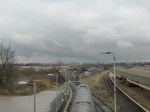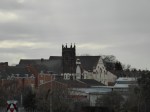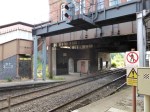
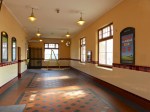
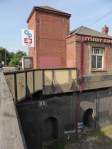
July 16th – I noticed something today that’s puzzling me. I doubt many others have ever registered it, and even fewer probably care, but it appeals to my sense of lost history. I noticed today that Tyseley Station once had a lift, or at least, the evidence points to it.

I noticed some time ago there was a tower attached to the station building, contemporary with the rest of the structure, that had no apparent door or way in. It’s a few metres taller than the main building, and is about the size of a lift shaft, but there’s no evidence of it in the booking hall, where the tiles and fittings look original and undisturbed from new.

Down at track level on platforms 1 & 2, there is a low, bricked up doorway with a modern door built in. The platform island ramps down to it. It’s the only access to the tower I can see.

At pavement level, three sides of the tower are plain, and blank (the terracotta paint is covering graffiti, note the continuous texture of the brickwork underneath) – the other side of the tower can be seen in this image series from last week.

I do hope some passing railway buff can help with this. Was it a lift? If so, why? What did it convey? Who used it?

It’s an odd little mystery all of it’s own.
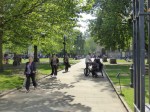
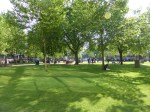
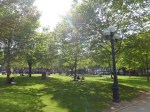
July 4th – In Birmingham in the early sunny evening. The city was at ease with itself. In the warmth, folk milled around languidly, and many hung out on the grass in the grounds of St. Philip’s Cathedral, affectionately know as ‘pigeon park’ to kids or a certain generation. People sunbathed, read, chatted and just relaxed.

I love seeing the city like this.

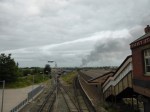
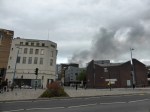
July 1st – There was a huge fire at a plastics recycling plant in Smethwick, on the Birmingham/Black Country border, caused by a Chinese lantern. As I went to work that morning, smokes, although several miles away, hung over Birmingham City Centre. From Tyseley, even further away, it had echoes of great disasters.

A terrible thing, and an environmental disaster. It really is time we banned the sale of these idiotic items.

June 17th – At Spring Road station in Birmingham, I overheard to travellers discussing the white plates visible on the the edge of the opposite platform, down beside the track. They often baffle station users, and their usage is a bit obscure, really.

These are merely a datum survey marker for when the rails are replaced and the track relayed, which happens more often than one would imagine. Before the old track is moved, a surveyor uses a laser level or theodolite to measure the exact position of the rails, and their tilt angle if they have one. The rail height – plus any required offset – is set on the sliding knob, and is used as a datum for relaying new lines.

The legend proclaims this plate no 3; it’s 1105mm to the nearest rail, on the Up Main (UM) line. The cant (or tilt between the two rails to enable safer dynamic cornering of rolling stock) is 2mm.

The (just visible) +474 above the slider indicates that the level set is 474mm above the desired rail height (vertical offset) and a green knob says this is the level the rail should be at as it was designed, and may not currently be at that level. A red knob indicates the actual track position when the plate was installed.

Geometry like this is essential to rail engineers, who obsess over it. Maintaining correct geometry is of prime concern, prevents accidents and ensures trains fit under bridges, alongside platforms and don’t foul each other on bends.

You can often see these marker plates fixed to line side structures or electricity and signal masts.

June 11th – Back in Tyseley, and a change in the weather; it was dark and overcast, but rather warm as I dashed to the station. The changeable weather was reflected in the view of Birmingham City Centre from the railway bridge. Patches of light, and dark, dark clouds, threatening rain. I love this view, and everything it contains; it is Birminghame for me. The train tracks, trees, transmission towers and pub clock, giving way to office block and skyscraper.

Birmingham is a patchwork.

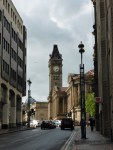
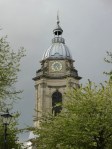
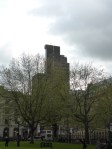
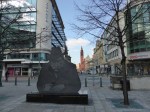
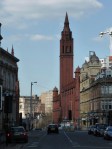
May 23rd – Birmingham continues to fascinate. Finding myself at a loose end for 30 minutes, I took a spin around the city before diving into my favourite cafe to avoid the rain. Birmingham has some brilliant architecture, both old and new, and is sadly under appreciated. Thankfully, Bicktnell, Hamilton & Healey’s New Street Signal Box is listed, and a great example of the Brutalist style, designed as it is to resemble an electrical component. We all know the Council House, but how many ever notice Big Brum, it’s clock tower? The cathedral of St. Philip remains an elegant tour-de-force, complete with cupola and clock, and the remarkable – and derelict – Natwest Tower remains visible, despite the attempts of the trees to hide it. 

This is a great city, and I love it so.

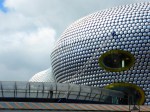
May 8th – I’m fascinated by the Selfridges building that forms part of the Bullring in Birmingham. I’m intrigued by the curves, textures and interaction with the surrounding environment.

It’s a brave, bold piece of architecture, and I love it. I’m particularly fond of the car park link walkway, which looks like something from a 1960s sic-fi film.

It’s a surprisingly local affair. Built and project managed by Midlanders, The discs, freshly cleaned this year, were anodised in Walsall. 

You either love it or hate it, but it can’t be ignored.

April 20th – One aspect of Birmingham that’s improving lots is its bicycle culture. It’s huge now, and growing all the time. It was actually a tough call today to find space in a rack – although the good weather will have bought a lot of fair weather cyclists out.

That Plug fixie is a modern classic – note the hardcore lack of brakes – and is clearly ridden a lot. At the other end of the scale, the classic 80s Dawes Kingpin folder was an eccentric delight. Not so delightful was the cannibalised Giant frame, left to bleach in the sun like dead animal bones after the vultures had stripped them clean.

A salutary warning about locking your bike up properly there…

April 20th – Today, I cycled into Birmingham to meet a friend. I used to know this place like the back of my hand, and loved it as my hometown, but these days, not so much. I mooched around in the gorgeous afternoon sun, but Brum is a little bit lost to me now. All the shops I used to love have gone, and the crowds were dense and impenetrable. The city has moved on, and not taken me with it.

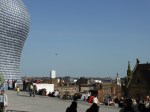
Some things are changeless, though. The gems of architecture hidden in dark corners, or the bold terracotta of the Citadel, or Methodist Central Hall. The view from the Bullring is as wonderful as ever, and Hancock still scornfully watches Priory Circus over his cuppa.

Still there too is the little old fellow who walks endlessly around town all day. He’s been doing it for years – I recall him doing this endless loop 2 decades ago – always immaculately turned out, coat slung over one arm.

When I saw him today, I realised that some old Birmingham features never fade.

April 12th – Back in Brum for the day, and I loved it. I don’t mind commuting further afield at all – an enjoy it when the trains work OK – but it’s nice to be in Birmingham, my city is always a joy. Today started damp, and somehow I managed to just miss the rain all day. But every leg of my travel was threatened by dark, heavy cloud.

It was lovely, though. The skies were dramatic and photogenic, and the air of grim threat made my legs spin a tiny bit faster. But most of all, it was warm. I don’t think it reached ten degrees, but after recent weeks, the wind was warm. The air was warm. I cycled with an open jacket. 

That’s what was lovely, even though the wind was against me all the way from Walsall.