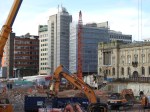
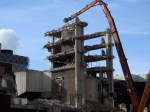

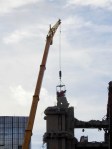



September 30th – Right now, Birmingham is doing what it does best – changing. I was in Birmingham for a sunny, pleasant afternoon that felt like the last of summer, and I continued my fascination with the demolition of the library, 103 Colmore Row and the Birmingham Conservatoire. The Adrian Boult Hall is now gone, the library down to it’s last scraps, and 103 Colmore Row is forlorn and truncated, much like the memory of the architect who designed all of them, the great John Madin.

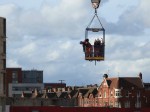
There’s no time for sentiment, because Brum so doesn’t do that; the engineers are driving forward the change in their machines, cutting, smashing and pulverising the modernism to dust. And it’s fascinating, from the jurassic appearance of a resting concrete cutter to the antics of a pair of experts in a cradle slung above the devastation like some hi-visibility acetylene and helmet circus act.

It’s stunning, shocking and wonderful to watch. But I’m glad Madin himself didn’t live to see the crushing of his big civil dream.

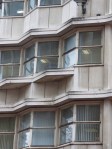
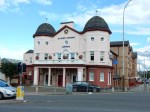
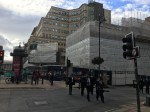
April 15th – I had a late meeting in Birmingham, and the weather was grey and wet. Unusually, though, this didn’t dampen my enthusiasm for the city, which never looks good on a grey day. Finishing my task, I went for a mooch around the city centre and spotted this brutalist gem hiding in plain sight in New Street. 

Architecturally, it seems a mix of brutalism and a kind of stilted, controlled art deco. I have a feeling it’s more modern than it’s appearance belies.

Does anyone know anything about it or who the architect was? It’s quietly stunning.

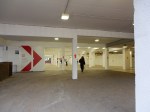
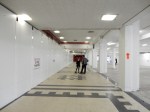
October 9th – While in Birmingham, I passed under what used to be Fletchers Walk, unaware that it had changed so dramatically since my last visit. It’s still recognisably the place I lamented in the spring, with that geometric floor, odd mosaics and very red, red brick exteriors; but the shop units have all been ripped out, and the whole painted white and opened into an underpass.

It’s perhaps more haunting and chilling now than it was before. It feels like some architectural crime scene, washed clear of the horror but the bad atmosphere remains.

Curious.

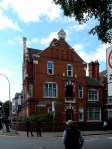
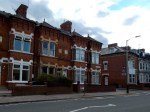
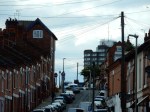
September 1st – Today, for the first time in ages, I had to go to Leicester for a work appointment. I forgot how wonderfully vibrant the city is, and how gorgeously eclectic the architecture is.

Brutal in places, it’s mostly Victorian faux-gothic, elaborate terraces or just plain bonkers. The church spires coexist with minarets, tower blocks and statement systembuilds. The streets hum with chaotic, frenetic activity.

I love where I live with all my heart, but there will always be a soft spot in there for this city, too. I could live here.

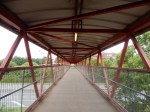
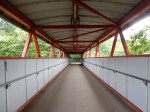
July 28th – Called to Telford mid-morning, I hopped on the train and headed over there with my bike. Being quiet, it gave me chance to study the decaying, scruffy footbridge that links Telford railway station to the town centre. Whilst having an interesting perspective effect, this ugly and intimidating edifice gives a very poor impression to anyone arriving at the town by train.

Very much a relic of the 80s, it’s from an age that discovered the social effect of bright colours and modernist design, but hadn’t yet worked through the issues of Brutalism – the coldness, isolation and intimidation of dark, sharp corners.

An odd anachronism that desperately needs improvement.

January 16th – Scooting between Snow Hill and New Street to change trains on the way home, this snatched photo. On the left, the ‘new’ New Street, ugly as sin, dysfunctional, with a cheap, tinfoil gimcrack cladding that shows every careless dent and poor alignment in fitting. 

In the centre, Birmingham’s postwar Brutalist architecture, and on the right, something altogether older.

In the middle, people, lights and a city hiding and surviving beneath the rule.

I love this place with all my heart. Even the ugly bits.