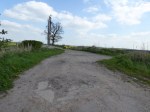
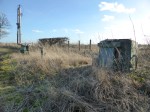
May 6th – Riding back through Haunton to Whittington via Elford, I passed the derelict Royal Observer Corps bunker post at the top of Willow Bottom Lane, just in the corner of the field.

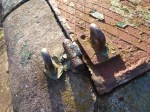
Someone has made a half-hearted attempt to lock it again: It won’t stay locked for long, it never does.

This underground nuclear bunker was intended to house 3 volunteers in the event of nuclear war; they would monitor damage after a blast, and report back on conditions if possible. Their monitoring was on a crude ‘If we survive’ basis, and this bit of Cold War history is obscure and grim.

Since being stood down in the early 90s, these posts – hundreds over the whole country – have been discovered, raided, trashed, demolished and sold; few survive intact and this one itself has been burned out.

But it remains, a grim memorial to a very paranoid time.

You can read more about ROC posts here.

April 7th – Sad to see the decaying relics of a lost period of history I feel we shouldn’t let pass unrecorded. The old ROC post at Elford is in a sorry state. Open, vandalised, robbed. Once the pride of the volunteers who would man it in event of a nuclear conflict, it’s just now a lump of subterranean concrete and metal that nobody knows what to do with.

In similarly reduced circumstances but in better condition, the microwave relay tower at No Mans Heath is looking bare now. When I was younger, this unmarked, unacknowledged communications installation was bristling with horn antenna, dishes and drums; now it carries very little. A few telemetry and mobile data links, and that’s it. 

In terms of engineering complexity, the framework of the tower is hugely intricate, now to no purpose. I suppose, like the ROC post, eventually it will disappear; testament to times dangerous in a different way to our own.

April 18th – A great long ride today, on a warm, wonderful spring day. I headed out to Honey Hill, at No Man’s Heath via Canwell, Hints, Hopwas and Harlaston, returning via Netherseal, Lullington, Edingale and Lichfield. On the way, I stopped, as I always do, at the old ROC post at Harlaston. It was still in a very sorry state, but I was reminded of something. 

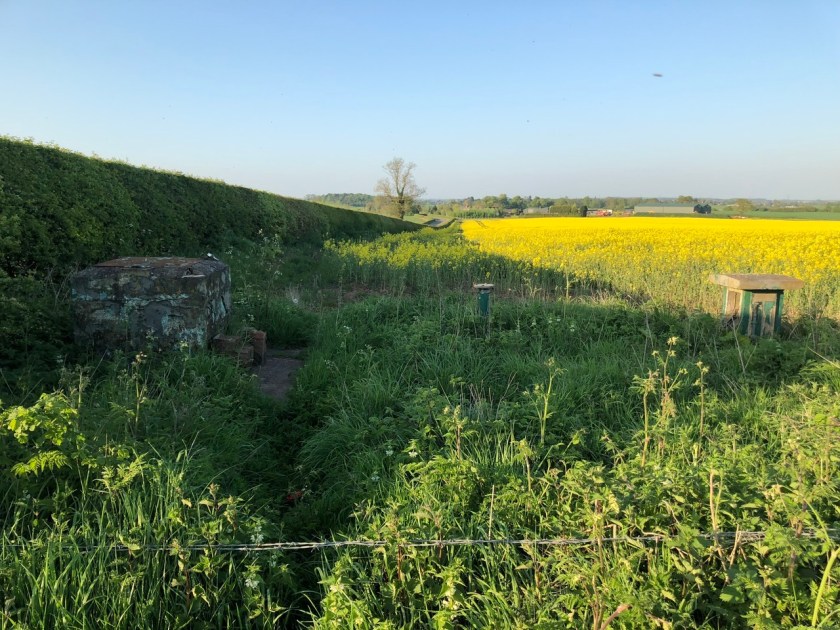
Stopping for a drink and a breather at the top of Willowbottom Lane, just by the bunker, I looked down and noticed a barely visible square of bricks and concrete. This is another reminder of past conflict, for these are the remains of a second world war anti-aircraft watchpost.

High on the hill above Tamworth, it’s an excellent spot for it. A sobering thing on a sunny, spring afternoon.

February 16th – As I passed from Elford to Harlaston, I stopped as I usually do, to check out the state of Harlaston ROC post. What I saw saddened me, as it continues to deteriorate.

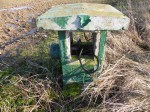
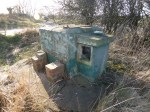
These odd green surface structures are the visible evidence of a small, 3-man nuclear fallout shelter. Intended to be staffed by a group of volunteers from the local Royal Observer Corps, they were a state secret. Should nuclear conflict have begun, the crew would man this subterranean bunker equipped with basic recording equipment, water and rations, and take measurements of radiation, weather, fallout, bomb damage and soforth. This information would be relayed – if possible – through telegraphy equipment installed within. Posts were sited all over the country, and worked in groups of 3. Others existed locally at Polesworth, Rugeley and Shenstone.

In essence, should the Cold War have begun, three people would have entered this hole in the ground, and if they didn’t perish, they would have carried out their orders whilst waiting to die of radiation sickness. It’s a sobering thought.

The posts – and the Royal Observer Corps – were stood down at the end of the Cold War in the early 1990s, and the posts mostly left to rot. Some were preserved by enthusiasts, some bought by cellphone companies – they make great basetation mounts – but the majority were abandoned, and later discovered in the internet age by urban explorers and cold war enthusiasts.

Sadly, the bunkers were left filled with all their equipment – bedding, instruments, lockers, chemical toilets and whatnot – and have mostly now be broken into, stripped and vandalised. Harlaston has been systematically destroyed. The current owner has repeatedly welded the access shaft shut, only to have it continually cut open. When I visited, there we signs of fresh cutting and the hatch was unlocked.

This is a crying shame. This is part of our collective history, destroyed and desecrated by animals with no sense of the historic and social significance.

High on a hill overlooking this northeast outpost of Staffordshire, good folk would have entered this once immaculate shelter to serve us in our time of greatest darkness. Today, it’s trashed.

Scum.
January 29th – The rain finally caught me as I left Walsall. The wind had changed, too, and I found myself mashing into driving drizzle and a distinctly cold headwind. Is this the beginning of a cold spell, I wonder?

As usual on rainy days, every good photo was into the wind and therefore impossible. But I did notice the lights of the service station in Shelfield, which always look attractive, but I never stop to photograph it.

It loos so welcoming – I fuss that’s the idea. It’s one of the way markers of my commute – when I see it, I know I’m halfway home.

February 23rd – Returning home late through Shelfield, I passed Bunker Service Station. I have no idea why it’s so named, but I noted diesel was now 1.43 a litre. People have often asked me how I can afford to keep buying bits for the bike and feed my  gadget addiction – it’s simple. I’ll run for days on a gallon of earl grey, marmite sandwiches and sweet treats like Haribo. I’m not spending huge amounts of dough to sit stressed in a car, watching my sanity and bank-balance wane with the fuel gauge pointer…