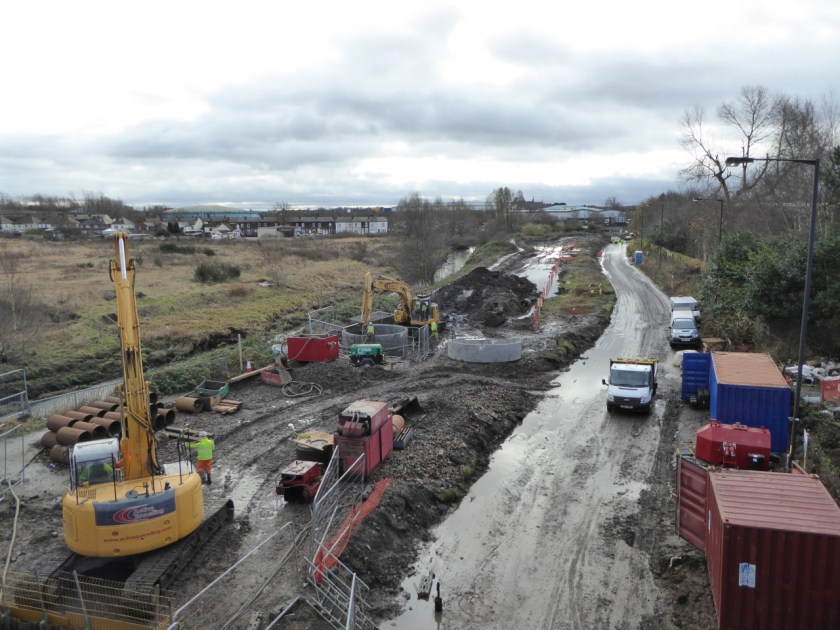
April 4th – I’d had to call into Aldridge after working late and returned via Streets Corner. I noted that the old wall to the 60s shopping precinct on the corner had gone, and excavations were underway.

This is the preparatory work for the next stage of local junction improvements work which will see this entire junction remodelled with new signals, slip roads and crossings.

Peaceful now in the gathering dusk, but a summer of inconvenience and holdups for motorists seems to be on the cards…

Shire Oak has been massively improved, however, so it’ll be worth it in the end.

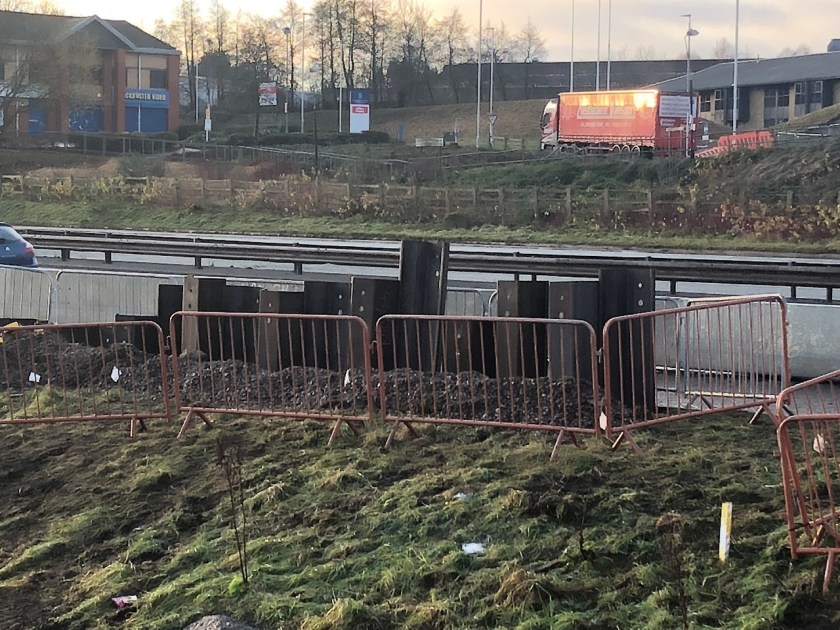
March 26th – In Telford for a meeting, the footbridge project continues it’s bizarre stop-start behaviour, baffling to the uninitiated. Piles are bored and concreted now, sheet piling has appeared along the roadside, and a cavity there had been dug – maybe for a pier or lift-well. Steelwork has been driven into the earth and cut to varying lengths, and there a lot of noise and action. But no visible chap yet, and nothing on the Euston Way side of the station at all. 

I guess this is one of those puzzling projects that will just sudsy come together, but it’s very intriguing to watch.

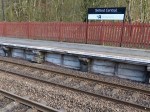
February 22nd – Passing through Telford on a flying visit in the morning, I noticed that the worksite for the new footbridge was oddly quiet. It seems test bores have been completed and are now being monitored for effects on the nearby built environment – including the railway itself.

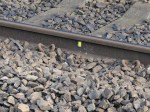
Along the rails are mounted at intervals surveying datum targets which will be monitored – either manually, or by use of an automated theodolite – to see it recent operations are causing any movement.

A fascinating use of technology.

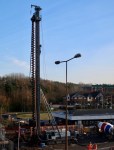
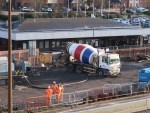
January 30th – Visiting Telford in the morning, the work on the new footbridge there is very serious now. A large continuous flight auger piling rig is drilling very deep piles to support the new structure, and concrete trucks line up to supply it as it works.

In front of the rig, the first pile is standing clear of the ground bounded by the blue sleeve, and on these solid foundations, the new bridge will stand.

Earth is being moved, surveyors measure the ground and excavators are busy. This is a project well underway know and will be worth keeping an eye on.

December 20th – Spotted in Telford on a very brief visit at the new footbridge project, this will only be of interest to those into civil engineering.

The absolute worst sheet metal piling job I’ve ever seen. Not the varying depths – that can be normal, and they’d but cut level afterward; but the sheets are designed to go in true and interlock.

Were they piling guys on the pop?

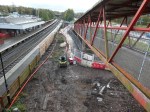
November 14th – I had to go to Telford, and I was keen to see the work on the footbridge replacement is really moving on apace now. 

Sectional fencing is up, footpaths and steps have closed, barriers are up and alternate footways tarmac and ready. 

And the sad realisation that a favourite station flowerbed was set to be lost, with an excavator standing by.

Oh well, that’s progress for you…

August 15th – I had to nip out on an errand at sunset. The day had been fraught with a busy morning and a visit to the dentist in the afternoon, which always terrifies me, so it was good to get out and get my calm back.

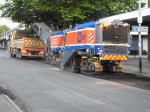
Passing down a blocked off High Street, I realised they were finally resurfacing the road; none of the poncey micro asphalt or surface dressing here; they were planing a huge amount off ready to lay a new layer of blacktop.

About time too.

Fascinated, I watched the operation for a short time; wagons, tankers, diggers and engineers came and went with almost military prescision, right there under Morris’s nose. He had his back to them due to the noise, but I could tell he was enjoying the spectacle, if not the peace.

An interesting and welcome thing.

June 29th – A grey, wet afternoon in Tipton, and I noticed something I’ve passed maybe hundreds of times but not noticed: an odd little bit of civil engineering.

Just on the corner of Wood Street and Owen Road, effectively right on Tipton’s High Street, a circular bench feature, that’s actually concealing the top of a storm buffer.

A storm buffer is a large subterranean tank usually made from reinforced concrete pipe that acts to store rainwater surges in the event of a storm, buffering the deluge and releasing the water slowly into the drainage system at a manageable rate.

It’s unusual to see one proud of the ground, and even more so in such a prominent location.

That’s quite clever, and surprised I’ve never noticed it.

July 21st – It’s true that I am one of those characters that amasses a huge amount of trivia and mental flotsam as I go about daily life, and this is one of those things, but in my defence, I was actually asked about this a month or so ago so here you go…

People who study the road surface (and there are a few of us, mainly on 2 wheels) may notice perfectly circular cutouts, punch-throughs or holes in the endless asphalt. Sometimes they’re filled with tar, or white lining paint. Often, they have the material that came out of them put back in like a tarmac divot. Sometimes, they open into potholes, particularly if badly sealed. But what are they?

These odd features are the signature of the road surveyor, and a road near the end of it’s life. When a road is resurfaced, the tarmac is literally planed off by a large cutting machine. The planings are then taken away, recycled back into asphalt, and relaid. How deep that planing operation goes is critical, as is knowing the depth of the road surface, and what it’s like beneath the blacktop ‘crust’.

When a road is considered for resurfacing, a surveyor will take cores with a drill and round cutter at about 100-125mm diameter, and extract them like a cheese taster sampling a cheddar. They are photographed, measured and replaced (or filled). From this a plan of work can be formulated.

Sometimes cores are taken in pairs, close together; others they are equally spaced along the length or a road, on either side. These, spotted around Walsal today, are in various states of becoming potholes themselves and adding to the problem they were created in the process of alleviating.

I’m convinced that every time I learn rubbish like this, it pushes something useful out of the back of my brain.
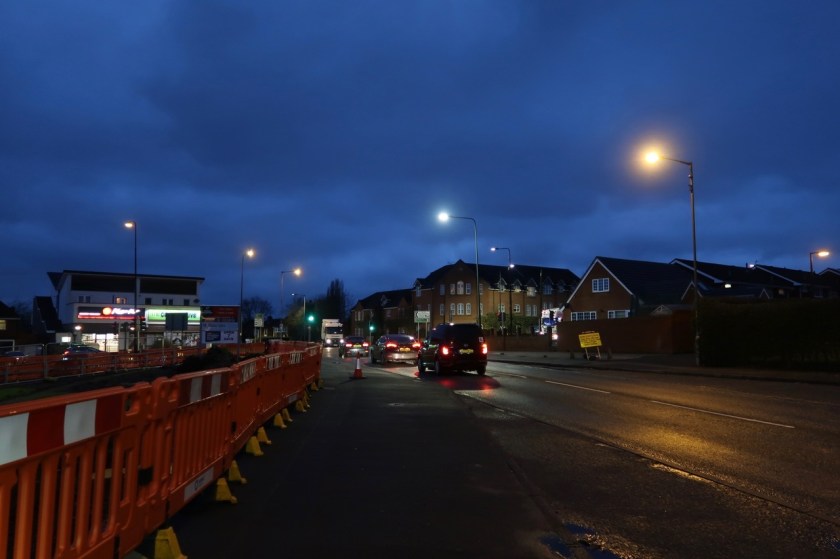
December 17th – A better morning – and rather warm, it has to be said. I dropped onto the canal in Walsall to avoid the traffic, and on the James Bridge Aqueduct, stopped to look at the road improvement works below. The road is being widened in a job that will take months. This area is low, and on the Tame flood channel; they certainly aren’t messing about with that storm buffer – it looks to be at least 3m in diameter.