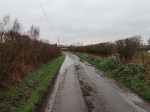
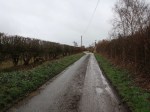
March 29th – On a practical level, the bad weather is taking an awful toll on the lanes. Here, near Springhill this backlane like many has a ridge of wash down mud in the centre, and the tarmac either side is fracturing into potholes and covered in loose detritus and marbles that are slippery and prone to stealing your grip.

The roads now will be in a parlous state, and without much money to repair them, I fear for the condition of minor lanes like Whittaker Lane here in years to come.

We really need to tackle this very serious road safety issue.

May 9th – I had to be out very early for something I couldn’t cycle to, so took in an early circuit of the canal at 5:30am. Not seeing a soul, I enjoyed the peace and quiet. Fascinated at the moment by the sheer quantity of organic flotsam and jetsam in the canal, with everything from blossom petals to dead reed foliage. I suppose it’s a feature of the season, but never really noticed it to this extent before.

There’s something very otherworldly about breaking out of your routine and just riding for the hell of it very early in the morning.

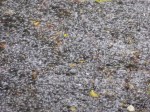
May 7th – A snatched picture combining two of the worst hazards in cycling. One is common, the other seems unique to a particular part of Darlaston. The loose grit – marbles – I’ve discussed at length here; wheel and traction stealing, highly polished grit, it washes down during rain and snow, and gathers in junction voids and gutters, waiting to snatch your bike from under you.

The unique hazard is metal clippings, swarf and shards, and this is Heath Road in Darlaston at it’s junction with Station Street. Around Darlaston Green, all the way down to the Walsall Road this problem slices tyres and causes punctures. Open tipper wagons and skip lorries corner here to get to the scrap yards up the road, and metal drops through their tailgates, shutterboards and  from unsheeted tops. The metal lies flat in the road, where it’s gradually sharpened by the traffic dragging it against the road. 

Automatic sweepers don’t pick it up because it’s so thin, but hit it with your tyres and you’ll quickly flat. It’s a pain in the arse. Look closely here and there’s sharp spikes, wire and razor-thin plates.

Look out for it; avoid the area if you can. In a place where one has to watch the traffic carefully, it’s another hazard to watch out for.
May 5th – Only a short spin around Brownhills as I’d had a bunch of unexpected work crop up. It was pleasant enough though, and decent weather for a bank holiday, to boot. 

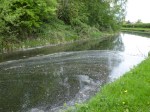
It’s time for the annual warning – this scum on the canal isn’t pollution. Yes, it looks horrendous, but it’s natural – it’s wind-born debris from some shrub or other (never worked out which). It drifts over the surface of the canal and forms in scummy, oil-like ripples.

Nothing to be concerned about, it’s perfectly natural and soon disappears.

February 16th – It was a gorgeous day, and a reminder of what this country is like when the sun shines properly. With the sun on my back, I rode out at lunchtime to check out the floods of the Tame Valley, around Hopwas, Elford and Croxall. 

I was expecting the Tame to be in flood. This wasn’t the case at all – the Tame had clearly stayed in-channel, and although brisk, the Footherley, Black and Bourne brooks were all below capacity, too; although we’ve had record rainfall, it’s clearly been spaced out enough to avoid the horrific scenes locally that we saw in 2007. 

Of course, other areas have not been so fortunate.

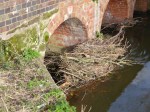
What is evidenced is wind damage. At the hump bridge on Gravelly Lane, Footherley, tree debris blocks one arch, and a whole tree lies similarly before the Elford Bridge. Clearing the detritus from trash screens and under bridges is an essential part of waterway maintenance, and this will have to be removed.

The technicians that do this work have plenty to do in the coming weeks – their work is essential, and I wish them well.