#365daysofbiking Skywiring:

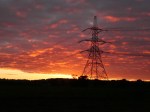
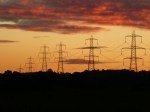
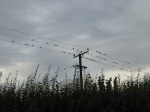
October 4th – On my way home I had business in Shenstone, and as I returned through the tiny hamlet of Lynn, darkness was falling with the most stunning, dramatic sky.

I loved the way id highlighted the overhead electricity lines, which are something I consider beautiful and mysterious. These complex arrangements of poles, cable, metal structures and ceramic insulators are ignored by most, but are essential to our daily lives.

Few study them, and even fewer understand their layout, function and protective equipment. But that’s the whole point: The mystery in the complexity.

Meanwhile, while I was admiring the wiring, I was being watched, and never noticed.

#365daysofbiking I trip through your wires:

September 29th – At Crestacre, on the top of Springhill overlooking Sandhills and Brownhills, the sky was a gorgeous combination of red, orange and blue, and set off the skyline of Brownhills beautifully, even if that did pretty much just consist of Humphries House. 

I was intrigued by the medium voltage electric lines in the foreground, and the set of jumper insulators on the pole’s left. I’ve never noticed them before, and wonder why they’re there?

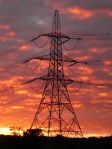
October 26th – The gorgeous and remarkable sunsets also continue. Again, coincidentally passing near Shenstone, I caught an astoundingly dramatic mackerel sky sunset that lasted all of 15 minutes before it disappeared. 

As I left Shenstone station, there were hints in the sky to the west, and as I cycled home, I watched the shy intensify until it almost seemed to catch fire.

Then, by the time I got to Stonewall, all trace had disappeared from the sky and dusk was falling.

And yes, I do love the drama and geometry of pylons, and what better backdrop than a stunning sunset?

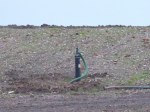
January 5th – In the New Year Quiz on my main blog this year, I asked about the bulkhead pipes visible sticking from the mounds of a couple of local landfill sites; the answer was that they were gas collection points, to feed a gas turbine that generated electricity from the otherwise wasted methane evolved when the buried refuse decomposes.

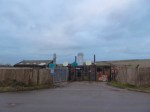
This plant – humming away continuously in the way only a gas turbine can – is just off Brickyard road in Aldridge and has been running for at least 3 years fuelled by as from the Vigo Utopia landfill, generating electricity which is fed back into the national grid.

Refuse operators will paint this as ‘green energy’ – it’s no such thing; it’s not renewable, is finite and is no cleaner than any other methane power plant. It is, however, making use of gas that formerly would have been wasted, so it’s a good thing.

There is a similar setup at Highfields South, not more than a mile away.

August 8th – In contrast to recent days, it was dark and overcast with a very threatening atmosphere for most of the day. Racing home, I could smell rain on the wind, and it felt ominous. 

A bit of rain is welcome; it’s needed. But we haven’t had weather like this for any length of time for a long period, and this felt dramatic and alien.

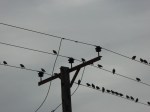
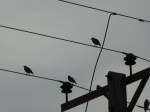
As I rode down Mill Lane in Stonnall, I noticed a flock of starlings had settled on the field, hedgerow and overhead lines. Perhaps it’s just the Hitchcock thing, but even those little birds in silhouette felt menacing…

July 11th – If you fancy a free, breathtaking aerial entertainment display, get your backside down to the Tame Valley Canal, and just look up.

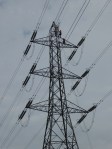
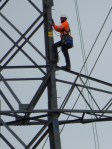
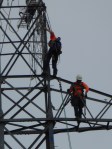
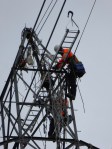
High tension lines run along the canal from a control compound at Ocker Hill to another at Ray Hall, and this interlink is currently undergoing service. Huge scaffold towers and nets span roads, canals and railways, to support lowered lines; engineers scramble and dangle high above from the steel lattice-work, oblivious to the toe-curling peril they appear to be in.

They work quickly and with precision amongst a baffling array of hawsers, catenaries, safety lines and fall arresters, materials and tools being hoisted ip in a sack via a block and tackle hoist. 

And below? I watch, open mouthed at these confident, sure-footed and highly skilled engineers. Whatever they’re paid, it can’t possibly be enough.

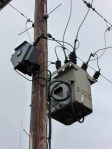
December 18th – Geekout time again. I nipped in to Shenstone in the morning to beat the storm and pick up a Christmas present. On my way, the wind blew me down Bullmoor Lane to Chesterfield, near Wall. On the bend near Raikes, there’s been an electricity pole for years that’s fascinated me. It has a really complicated arrangement of equipment mounted upon it, and it’s effectively in the middle of nowhere. I’ve always been interested in it’s purpose, so I resolved to find out.

After a fair bit of googling, it’s an ‘automatic recloser’, and a really high-tech piece of equipment with a simple purpose; it’s an 11,000V breaker, performing the same kind of job as the ones you get in a modern domestic fusebox.

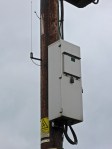
It consists of the unit that switches on and off the supply – the big box at the top, which breaks the three phase supply voltage present on the lines above, and an electronic control unit called an ADVC, which detects when there’s a fault, such as overcurrent in the load. A small transformer sits high up to supply the ADVC.

The ADVC reads the signals in the line, like voltage and current, and should it detect a problem, it disconnects or ‘opens’ the recloser, breaking the supply. Since most faults with overhead lines like this clear themselves quickly (they may be weather, vegetation or vermin related, for instance), the ADVC monitors the disconnected line and automatically recloses – reconnecting the supply – automatically.

The system is monitored by complex electronics with a computerised controller, and can communicate by radio telemetry, hence the antenna; it even has batteries so it can keep working if it’s own supply is interrupted.

I’ve been meaning to find that out for years… you can read more here.

This project takes me to some strange places, sometimes…

May 18th – I’m hoping a linesman or electrical engineer can help me with this one, I’ve never noticed it before.

Approaching Anglesey Basin on the canal at Chasewater, electricity is supplied to the dam cottages by single phase overhead lines. one of the last poles in the run has an anchor cable staked to the ground to stop the change in cable angle pulling it over. The anchor cable, bolted to the top of the pole, isn’t electrically connected to any part of the system, yet has a two to three foot long insulating piece fitted, with a pair of lightning bypass probes to create a safety arc gap. 

Why would they do that? Is is a current limiter to stop lightning melting the anchor or what? Never seen an arrangement like this before.

15th July The landfill operation at the former Vigo Utopia marlpit, in Coppice Lane, Walsall Wood, is nearly complete, which must be a relief for nearby residents who’ve endured two decades of smell and nuisance. What many people don’t know is that this site generates 2MW of electricity and feeds it back into the national grid. That’s enough to power nearly 4,000 homes. Bores are drilled into the decaying landfill content, lined, and the gas of decomposition is pumped out and employed to power two gas engines driving generators. The gas would otherwise be wasted. 

When I passed the site at 5:30pm on a Friday, the plant was humming away. I believe a similar operation is planned for Highfields South landfill, opposite Jockey Meadows.