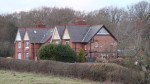
March 8th – Passing again from Shenstone in daylight, I stopped to take in The Little Holms, the western end of Shenstone’s Lammas Land, a public space that runs along the whole upper side of the village from rear the pumping station to the Birmingham Road, along the Footherley Brook.

This lovely spot gives a great view of the Victorian pump house, still in use with twin 200 horsepower electric pumps. With a storage reservoir underneath, this facility feeds Barr Beacon reservoir, and keeps Walsall and North Birmingham fed with clean water from it’s boreholes.

Brought into use in 1892, it pumps water from a 131 feet deep, 12 foot diameter well, with a 597 foot heading. The steam pump was retired in 1957, and now a 60 horsepower submersible well pump tops up a 10,000 gallon tank under the pumphouse.

After treatment there, water is pumped by 200 horsepower pumps up to Barr Beacon reservoir for distribution. These pumps can supply 1,500,000 gallons per day, and are backed up by emergency generators.

The cottages were originally for the workers, but I think they’re private now. I love the attic conversion in the end one – that gable wind is gorgeous.

November 21st – In a familiar bike shed at a client’s premises, a neat illustration that the common or garden bicycle, whilst being a marvel of engineering in many ways, is still riddled with design conflicts and the whiff of mechanical compromise.

Here, a well-used and muddy mountain bike, not a cheap one by any stretch. The lack of mud and water shielding means and mud and detritus carried on the back tyre ends up not just as a skunk-stripe on the rider’s back, but also on the front gear mechanism and transmission.

In areas of hard grit like the Peak District, this continual spray works like grinding paste, gradually eating your wearing surfaces.

All for the want of some shielding.

Still, if you were a designer today, and proposed the derailleur system of gears – relying on forcing a flimsy roller chain between gears using side play as a conformal drag factor – you’d be laughed out of industry.

Except there’s nothing much better.

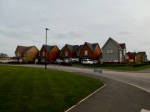
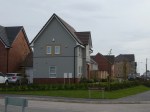
October 31st – Passing down the Darlaston Road to Wednesbury over Kings Hill, you realise that the area is changing. While it’s still very industrial, a couple of the old, large factories here have been replaced by new build housing.

The old Exidoor factory that made panic bolts was lost to apartments some years ago, and over the last couple of years, a pleasant enough, but unremarkable estate has grown on the site of the former Servis domestic appliance factory pretty much next door.

Servis was a household name, started by nearby power press manufacturer Wilkins and Mitchell who are also now gone; they made passable washing machines and the like which were functional, and often very innovative (The Servis Quartz was the first ever electronically controlled automatic washing machine) but suffered from poor quality and reliability.

Gradually outsold and outclassed by competitors due to the traditional British twin failures of lack of investment and corner cutting, Servis fell from UK ownership to various international owners before finally collapsing.

The works, which once even had it’s own brass band, fell silent, was demolished, the ground reclaimed, and now houses sprout from where the ground once shook under the blow of heavy presses. 

Such is the story across modern Britain. We are in the middle of great change.

August 15th – I had to nip out on an errand at sunset. The day had been fraught with a busy morning and a visit to the dentist in the afternoon, which always terrifies me, so it was good to get out and get my calm back.

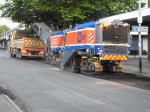
Passing down a blocked off High Street, I realised they were finally resurfacing the road; none of the poncey micro asphalt or surface dressing here; they were planing a huge amount off ready to lay a new layer of blacktop.

About time too.

Fascinated, I watched the operation for a short time; wagons, tankers, diggers and engineers came and went with almost military prescision, right there under Morris’s nose. He had his back to them due to the noise, but I could tell he was enjoying the spectacle, if not the peace.

An interesting and welcome thing.

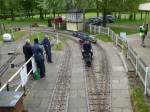
May 1st – Today, I did something I’d been meaning to do for years – I paid a visit to Balleny Green, a little-known narrow gauge railway layout run by Sutton Coldfield Model Engineering Society at Little Hay, between Lichfield and Sutton Coldfield.

I’ve known this place was here for years, but never caught it open. This time, I made a concerted effort to find out when it was a ‘steam up day’ and popped in.

This was just so English. No entry fee. No charges to ride. Just a bunch of people sharing their love of a fascinating, beautifully engineered hobby in the middle of rolling countryside in gorgeous grounds.

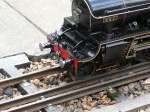
There is a long layout consisting of several tracks – including a miniature one – but on the larger one, which interestingly is dual gauge – passengers sit in or on carriages and are conveyed by small locomotives – today one steam, one electric – through tunnels, over junctions, level crossings, past ponds, signals, signal boxes. It’s gorgeous.

The whole thing is clearly a labour of love.

There were no other attractions, and none were needed: tea and biscuits, and a tin for donations to cover running costs.

All right here on the doorstep, and few know about it. A wonderful thing.

Find out more about Balleny Green at their website here. I’d like to thank the members for a beautiful, life-affirming thing.

August 3rd – The delights of a client’s bike shed again: this clearly quite expensive Giant mountain bike confounded me. I’m sure it’s a great ride, but the number and quality of joints in the aluminium frame are astounding. Look at the fabrication in the seat tube to accommodate the unusual rear suspension arrangement.  And the joints and design on the upper seat stays where they meet the pivot seem bizarre. And the tyre clearance on that crossmember is minimal.

I don’t know how designs like this come about. Aesthetically, to me, it’s hideous, and I can’t see any engineering or user advantages. 

Is this complication for the sake of it?

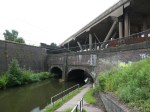
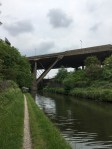
June 10th – Anyone interested in the canals of the Black Country knows about Smethwick Galton Bridge – the beautiful cast iron structure; the multiple railways, roads and two canals intersecting at different heights.

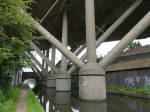
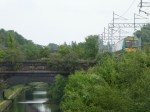
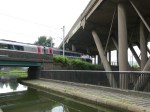
However, there’s something not half a mile away that’s as wonderful; where the M5 crosses a railway, which is running alongside two canals, and crossing a third.

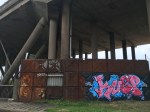
This is a fantastic thing – right next to the sadly derelict Chance Glassworks, Victorian Aqueduct jars with 60s brutalism, which pays no heed to the water. A fine, fine thing that makes one wonder at the progress of engineering, the wildlife that perches in such situations, and the smallness the scale makes you feel.

You may not agree, but it’s beautiful in it’s harshness and ingenuity.

March 1st – Another grey day, but it felt warmer. At dinner time, I had to venture back into Walsall from Darlaston and took the canal, which was a mistake: the works to relay the towpath have made sections not impassible but hard going.

Passing over the Bentley Mill Way Aqueduct, I looked down at the works below. Running three months late, the road has been closed and totally relaid – but the main bottleneck that is the narrowness of  the bridge I’m standing on – has not been touched. I’m at a loss here to understand how anything other than the footpath and possibly drainage has been improved.

Sometimes it’s hard to see the benefit in road schemes until they operate in practice. I hope that’s the case here.

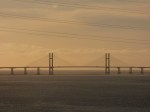
December 29th – Three and a half suspension bridges in one day, cycled two and a half of them. Not sure you can do that many places except the Severn Estuary.

Why the half? Well, the original Severn Bridge is two bridges, really – a huge, remarkably elegant structure over the Severn, and a second immediately to the west over the Wye to Chepstow. To me they are separate structures, as they have markedly different designs, but the Wye bridge doesn’t feel quite eligible.

It’s also a historical tour of bridge evolution – from the early Victorian, beautiful Clifton, so extravagant construction halted because Brunel ran out of money, to the beautifully minimal Second Crossing, one can see shifts in technology and materials, even between the latter two.

I rode the Clifton, The Severn and Wye – and I’m not mad keen on heights. The wind crossing the Severn was astoundingly strong, but the experience was unforgettable. Such wonderful views, great technology and the wonder of genius used to create, not destroy.

My particular favourite were the hundreds of Stockbridge Dampers fitted to the supporting ropes on the Seven Bridge. These are an anti-resonance device and stop the cables humming. They are a wonderful real-world example of harmonic mathematics in action, and it is are also fascinating to see how they’re carefully tuned.

An unforgettable day. More on the main blog later.

October 28th – Last commute by train for a while hopefully, and the morning wasn’t the wet one predicted – in fact, it was warm, and although damp from the previous night’s rain, it was a pleasant ride.

I stood and looked for my train, and noted a northbound one in the opposite direction. The trains haven’t been too bad of late and I remain fascinated by the exaggerated perspective and complexity of the lines, overhead wires and general machinery of the rail system.

Today wasn’t the worst weather, but it made me think about just how resilient these systems are – the engineering shouldn’t be underestimated.