March 24th – Compression of the neck… herons are more and more common now. Barely a towpath ride goes by without seeing one, and on longer rides like last week, I’ll see five or six, which must be a symbol of how clean the waters are now and how the fish population must by bountiful, too. 

This proud bird was on the towpath in Pleck, just by the wall of Rollingmill Street Cemetery, pretty much the industrial heart of Walsall. Wary of me but not skittish, by dismounting the bike and taking things gently I got close enough for some decent pictures, I think.

I adore herons.

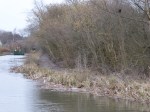
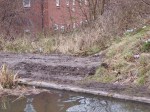
February 28th – Another grey, dull day, with a worsening wind. I had stuff to do in Walsall Wood and headed up the canal to get there. Between Cathshill Junction and Walsall Wood Bridge, work has been ongoing since summer on the eastern embankment. First, it was strengthened with sectional piling at the Black Cock Bridge, and the level raised; now soil has been added to some thickness along much of the stretch, presumably to provide better security agains overtopping and to counteract weather erosion. 

I note that on the bend that was piled, staves have been driven into the bank, and reed beds planted behind, presumably to create a natural buffer against erosion in a particularly vulnerable spot.

Wonder if they’ll get round to fixing the brickwork and voids on the pedestrian side of the canal anytime soon?

February 27th – A lot of the history of Brownhills, Walsall Wood and Aldridge is about what lies beneath. Coal, clay, industrial effluent and landfill have shaped particularly the borderlands between Walsall Wood and Aldridge. Where brick marls were abundant, soon voids in the ground where they had been extracted were too. Into these holes, we tipped refuse in huge quantities, as the remaining clay made a good seal against the contaminant waste.

In the early days, the landfill and waste disposal industry was unregulated, haphazard, and somewhat akin to the Wild West. Waste was put anywhere, and unmonitored. These days, it’s a tightly monitored industry that has to look after its dirty secrets. 

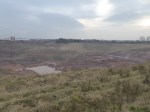
At the Vigo Utopia landfill site just off Coppice Lane, gas turbine engines run 24 hours a day, driving electricity generators from the gasses harvested from the decomposing rubbish. This produces significant amounts of power from 2 generator sets in converted shipping containers, employing gas that would once have been merely vented to the atmosphere. 

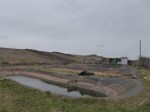
Nearby, a series of bunds and pools lined with thick rubber gather water and liquid pumped from deep within the mound. This poisonous soup is called ‘leechate’, and is allowed to settle out before being disposed of as hazardous effluent. Again, years ago, such concerns were not addressed and sites were allowed to pollute groundwater uncontrolled.

This is ugly, scarred landscape; but we are looking after it much better than we used to.

January 23rd – on a grey, murky afternoon I cycled down the canal from Aldridge. I’d headed for the canal as I often do to escape the traffic, which seemed overly aggressive as I’d hit it during the school run.

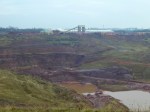
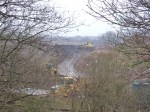
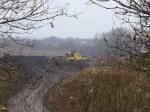
Passing the Weinerburger Brick marl pit at Stubbers Green, I took a look into the void through the fence. It doesn’t get deeper, but it grows steadily, by gradual removal, dumper after dumper of red marl heading to the moulds and then the kilns.

That’s a lot of bricks come out of there. And what a huge scar on the landscape. But the one ever-present thing here – the familiar, warm smell of bricks being fired – is, like Burntwood’s permanent smell of vinegar – one of the ways I know I’m near home.

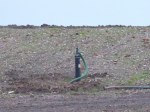
January 5th – In the New Year Quiz on my main blog this year, I asked about the bulkhead pipes visible sticking from the mounds of a couple of local landfill sites; the answer was that they were gas collection points, to feed a gas turbine that generated electricity from the otherwise wasted methane evolved when the buried refuse decomposes.

This plant – humming away continuously in the way only a gas turbine can – is just off Brickyard road in Aldridge and has been running for at least 3 years fuelled by as from the Vigo Utopia landfill, generating electricity which is fed back into the national grid.

Refuse operators will paint this as ‘green energy’ – it’s no such thing; it’s not renewable, is finite and is no cleaner than any other methane power plant. It is, however, making use of gas that formerly would have been wasted, so it’s a good thing.

There is a similar setup at Highfields South, not more than a mile away.

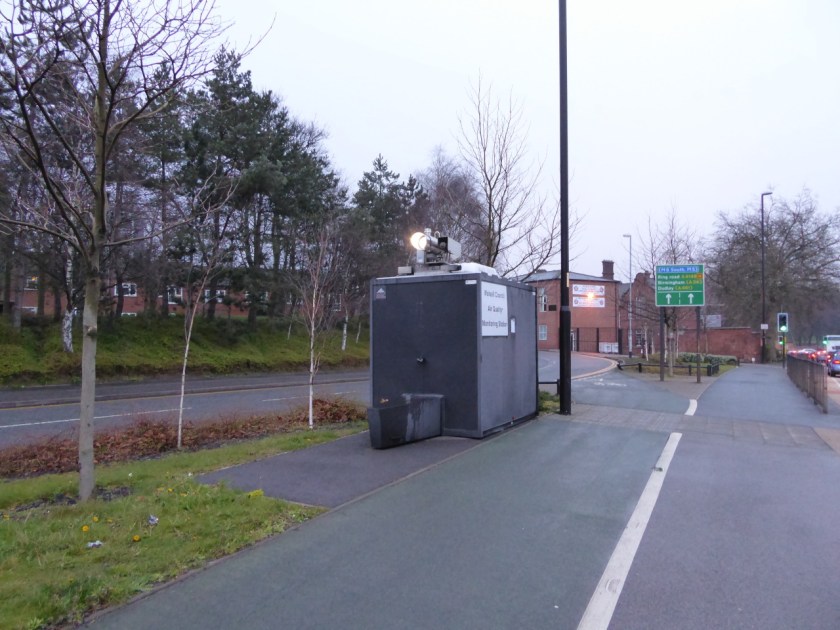
March 27th – Not a great photo, but the light was terrible as I headed home. This curious matt-brown box with a bright white light on top puzzles many folk heading east towards Chuckery on the New Ring Road in Walsall, just by Queen Mary’s School. It’s an environmental monitoring pod which takes climatic and and air quality measurements, and logs them. It features a host of sensors – the white light is a particulate analyser, shining light through the air and measuring the floating contaminants. There will be wind, temperature, humidity, and various chemical sensors humming away in what is actually a vehicle trailer. The triangular cowl on the front is covering the towing hitch.

This is a fairly expensive piece of kit, being used to tell us what anyone in Walsall already knows; the air quality here is terrible – particularly next to a badly designed junction where traffic is often static.

No shit, Sherlock.

January 24th – I was out with the birds, and came home early afternoon. I hopped on the canal near Aldridge, and headed towards Chasewater, where I wanted to see if the lake was still in overflow. On the way, I noticed business was brisk at the Highfields South Landfill, just between Walsall Wood and Shelfield. The site seems to be being filled in three sections, and the one closest is currently being covered in hardcore. Gas is being tapped off from the mound and feeding a generator set connected to the mains, so at least the gas isn’t wasted.

Every time I pass this hole, it’s a bit fuller. Five days a week, trucks disgorge their waste here – things we daily throw away and never wish to see again. The trouble is, we’ll run out of holes in the ground soon. Our rubbish really is becoming an issue – and who wants a landfill nearby?

October 30th – The flytipped fridge problem continues. Recently, the law changed and scrap yards can’t accept old chiller appliances, which must now go for specialist recycling. Sadly, people are still leaving them out for scrap men, who strip the easiest to separate metal parts, and flytip the rest.  Dumped fridges and freezers are currently a huge issue for local authorities all over the country.

When you leave stuff out for the tat men, you are encouraging this scumbag behaviour – please don’t do it.

These are in Green Lane, Walsall Wood, just past the houses beyond the Black Cock pub, just pushed off the back of a vehicle into a lay-by.

This is what happens if you fiddle with waste disposal legislation without thinking through the consequences.

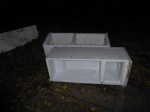
September 16th – The lanes and key-bys of the area (and probably the country) are currently suffering a rash of dumping. The rules have changed, and scrap yards will no longer accept fridges and freezers, so tatters are stripping the metal from them and dumping the remnants anywhere they can.

This discarded shell of a fridge is in Green Lane, Walsall Wood.

I still see discarded appliances left outside houses for the scrap men to take. Don’t do it, because this is where the shit ends up – as far as I’m concerned, anyone who leaves waste out like that is condoning flytipping and should be prosecuted as a flytipper.

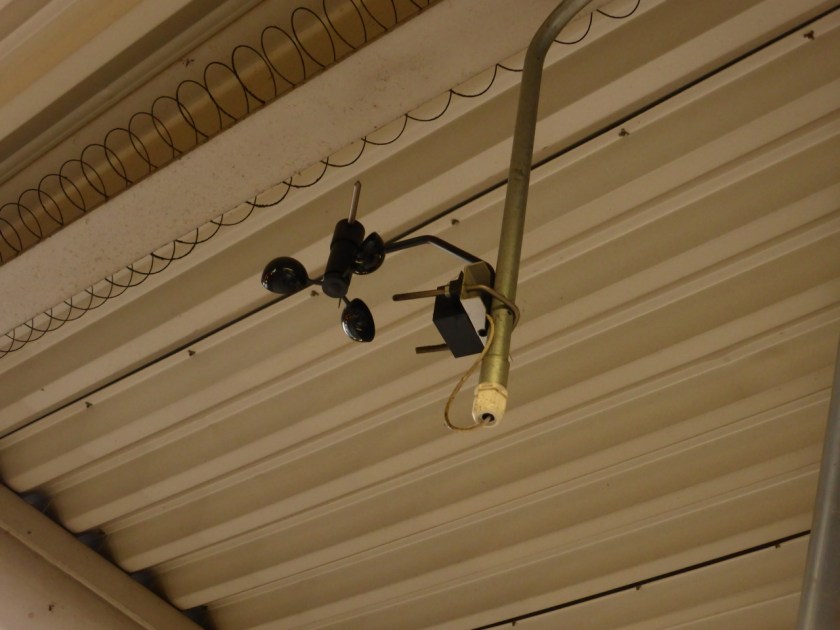
September 9th – Answers on a postcard, please. Looking up on the platform at New Street Station today, I noticed this little anemometer, wind vane and what looks like a humidity sensor. Normal climatic monitoring kit, you’d imagine. Except this is undercover, and at least 25 meters from the open air. 

No idea why anyone would do this. Maybe they’re measuring turbulence caused by the train movements?