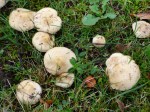
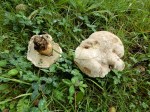
November 20th – Spotted in Victoria Park, Darlaston, toadstools which seem to have been thin on the ground this year – the edible fairy ring champignon. Other fungi forms fairy rings too, but this one is most common, but like shaggy ink caps, they don’t seem to have had a good season.

Nice to see these, though.

November 14th – A very wet, miserable day. i nipped over to Aldridge for some shopping and went via the canal in both directions. Some great fungus is growing on the banks of the new pond at clayhanger, and in a saturated state, they glistened with almost alien textures.

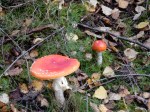
October 11th – The fly agaric are fairly profuse in the usual places around Chasewater. I nipped out late morning, still a bit rough, so kept it short. I mentioned a few days ago that the white spots dropped off the fairytale fungus as they aged – and so they do. The top picture shows an eight-inch monster that’s aged and split under it’s own weight; it’s almost completely free of spots and is starting to fade. Interestingly, the other two examples are younger, and still fairly free of spots.

I love fungi. I could study it all day.

September 28th – Quite a find for me, and only the second time I’ve ever seen it in the wild: orange peel fungus, seemingly growing well on Clayhanger Common, near where I saw the glistening ink caps last week. 

This ascomycete is not particularly rare, and mycologists may scoff at my enthusiasm for it, but this delicate ad small fungi is hard to spot. I’m pleased I found it.

September 12th – These were incredible. I don’t think I’ve ever seen them before.

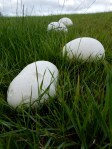
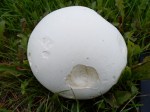
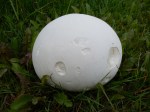
In a field near Harlaston, I spotted their bright white shapes as I sped past. A quick about turn, and I found the largest puffball fungus I’ve ever seen.

Almost pristine, largely globular shaped and the size of a small football, they were like some alien egg rather than fungi, but looking them up at home they are clearly giant puffballs.

The looked like plaster casts. 

A real find – and apparently edible.

September 8th – It’s nice to see the fungi coming through now – I love this feature of autumn. Many folk don’t realise, but toadstools, balls and polypores are just the bloom of much larger organisms living out of sight. They really are unlike anything else in nature.

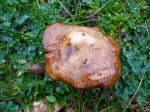
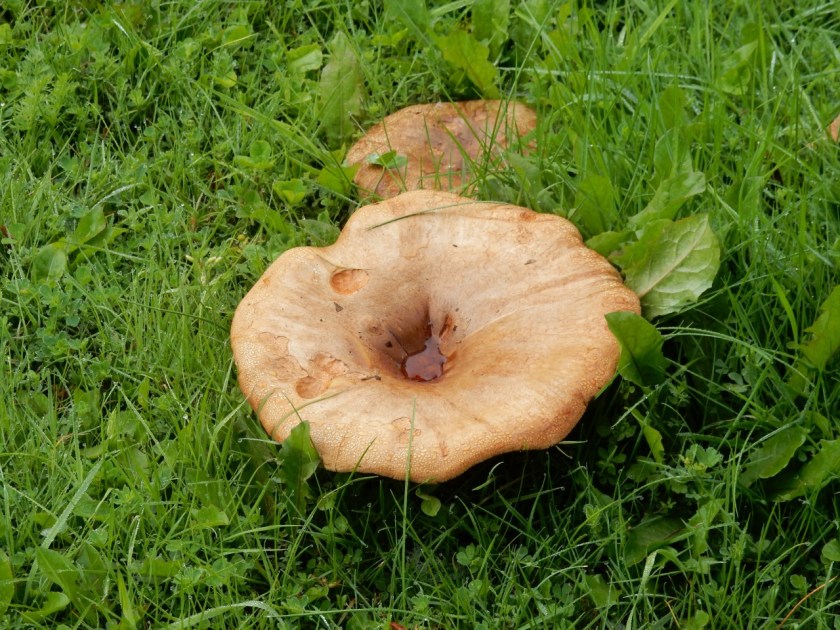
This roll-rim was growing on a grass verge in Wednesbury and was about eight inches in diameter. They start flat and become funnel-shaped as they age: it was a misty, wet morning and this one was gathering condensation well.

August 31st – I rode out via Canwell and Middleton to Middleton Hall for a cup of tea and cake, all the while in steady rain. I nipped down to Bodymoor Heath, onto the canal and up to Fazeley Junction. Back along the old A5 to Weeford, then home via Shenstone.

It was warm enough, and there wasn’t much in the way of wind. The roads were quiet and the riding fast; but it was very, very grey and very, very wet. The countryside dripped silently little droplets of grey summer sadness.

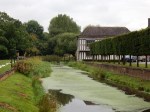
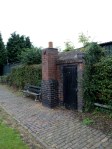
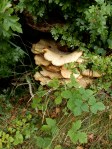
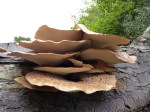
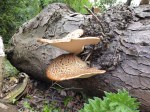
As ever on grey days, there was fun and beauty to be found; the architecture of the canals – not just the bold redbrick house, but the small lock-keeper’s hut with the chimney for a stove (how cosy must that have been in winter?); the Kingsbury lock flight and greenery of the canalside reed bed. Fungus is growing well in the damp, and those polypores were huge. 

Middleton Hall was as stunning as ever.

I just loved the hound tied up outside the cafe. He had an endearing way of looking at you with his head to one side. He was muddy and wet and had clearly been having lots of fun.

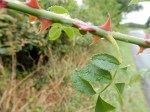
The red and orange spiny, furry growth on the rose stem that looks like a ball of thread? That’s a robins pincushion or Diplolepis rosea – a gall formed, like the oak galls by a wasp. 

I asked a few weeks ago why only the oak is bothered by wasp galls; it’s not only the oak, but mostly. Lime trees, conifers and roses suffer too. Here, a wasp lays 60 or so eggs in a tiny, developing leaf bud, surrounded in a chemical which causes the plant to mutate and grow this furry aberration, which is internally quite solid with cavities for the larva to hatch and feed.

Nature is quite horrific in it’s fascination sometimes. Find out more about this curious parasite here.
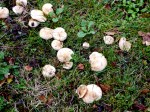
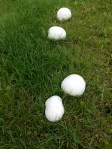
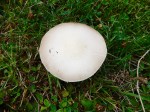
August 4th – No idea what’s happened in the last couple of days, but Victoria and Kings Hill parks in Darlaston are alive with fungi. I assume these are field mushrooms – I didn’t want to destroy them to check for sure. They’re a good 3-4 inches across and look healthy. So nice to see the fungi back, even if it does herald autumn…

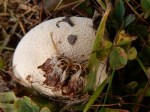
August 2nd – Victoria Park, Darlaston, and a sign of the advancing seasons awakens me to the idea that summer is ebbing away: earthball fungus, looking pristine and fresh growing well in the grass.

Relatives of the better known puffball (indeed, some call the pigskin poison puffball), earthballs have no aperture to let the spores escape, they merely collapse when ripe and allow the wind to do the rest.

They are mildly toxic and can cause bad reactions, including a very bad stomach and allergy-like symptoms, such as rhinitis.

Fascinating fungus though.

May 16th – Everybody go home, I’ve found the king of the polypores.

This is wonderful. A felled tree by the roadside near Cat Holme, and upon it a whole host of bracket fungi. The main clump must be 30 inches wide, and 12 inches thick. It’s the largest and healthiest looking polypore bracket colony I’ve ever seen – fresh and perfect.

I was unaware they even grew at this time of year. You learn something new every day.