#365daysofbiking Galling:

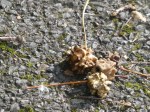
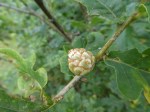
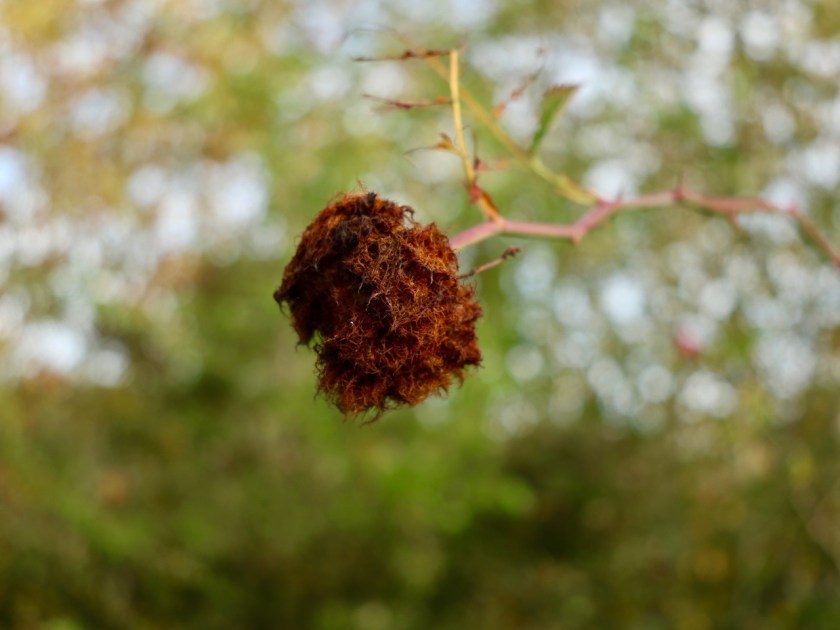
October 17th – I’ve been casually interested into the decomposition of the robin’s pincushion gall I found in the summer in Darlaston.

This once beautiful red and green hairy, spiny gall – created by a tiny wasp laying it’s DNA corrupting eggs in the rose leaf buds of it’s host – is now decaying fast and I’m interested to see how this ball of plant matter wastes away, and if it shows any evidence of the adult gall wasps escaping to freedom.

I’ll never stop being fascinated by these things.
#365daysofbiking The rise and gall:

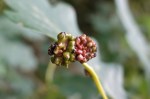
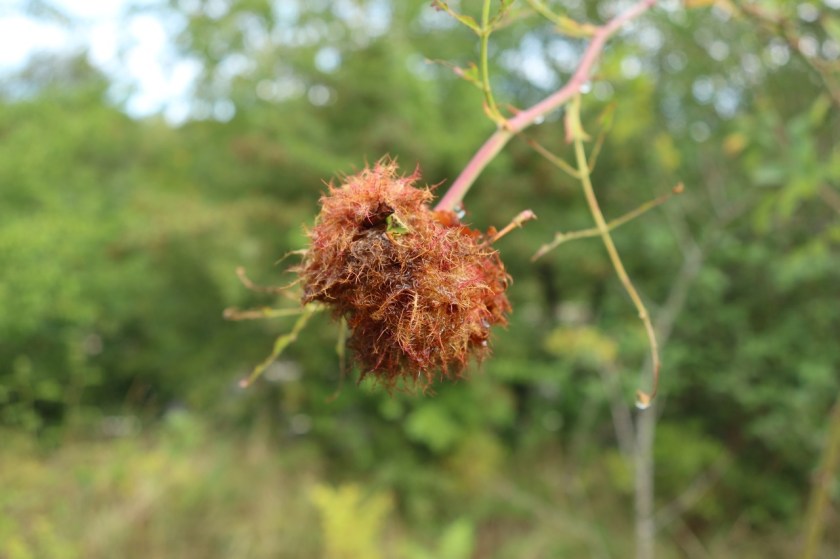
September 12th – I’ve been watching the robin’s pincushion gall I found in Darlaston mature as the weeks pass by. I’m interested to see if it shows any sign of being vacated by the insects who grow inside it, and also observe how it decays, to find out what’s under the ‘fur’.

It’s grown redder, and the fur seems to be dying away, with a cavity open on the upper side. I wonder if the wasps have left?

These creations of parasites – unique to wild and dog roses – are absolutely fascinating and I’ll be keeping an eye on this one as autumn draws on.

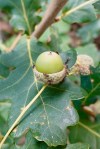
August 23rd – I don’t know what it is in the season, but the acorns this year are prolific and absolutely huge. With the dry summer I’d have expected the opposite, but they are absolutely huge. 

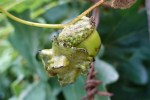
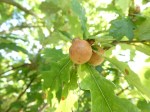
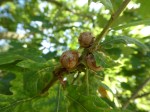
The fecundity of the crop is, however, being affected by the large amount of knopper galls, that from from acorns attacked by the knopper wasp. Also a peculiar seasonal phenomenon, they are very,. very red this year, whereas it’s usually just tinges of colour. 

Wonder why?

August 13th – At Hortonwood in Telford, I found a small wayside oak sapling, which was growing round, large acorns. they were generally healthy and surprisingly large, with only a handful affected by knapper galls – and where they were, the actual effect of the acorn remained small.

The ants were clearly interested in the acorns, but I have no idea why, and I’m wondering if the low gall-count and manner of development is maybe signifying and evolved defence to these parasites.

Certainly is fascinating. Going to be a good crop of acorns this year I think, and a bumper hedgerow harvest generally from what I can see so far.

July 30th – Nipping out of work in the earl m morning on a cafe run, passing a familiar patch of waste ground, I finally found something I’ve been looking for for a few weeks without luck; a robin’s pincushion gall.

This hairy mass on dog and wild roses is, like the knopper and marble galls on oaks, an insect gall; a tiny wasp lays eggs by injecting them into a leaf-bud surrounded by DNA corrupting chemicals that cause this odd growth to form rather than a leaf.

Beneath the bristles, there’s a solid ball of plant matter with cavities within which the larva grow and develop in safety; when ready, like other galls, they eat their way to freedom and adulthood.

The gall doesn’t harm the plant at all. It’s a remarkable thing.

July 25th – These oak knopper galls actually took me by surprise a couple of days ago, but the photos I took weren’t great, so I revisited the saplings they’re growing on today.

I spotted them on a tree near Victoria Park in Darlaston and I don’t think there’s a single normally formed acorn on that tree at all, and yet several adjacent ones have no knoppers at all.

These mutations of normal acorns are of course caused by a tiny wasp that lays eggs in the acorn buds earlier in the year. A secretion the eggs are coated in causes the acorn bud to mutate and grow in a distorted form, forming a gall, with the wasp egg at the centre. 

The larva hatches, and eats it’s way out of the gall, which provides it enough nourishment to grow to maturity.

Insect galls like this don’t hurt the tree, but of course, do affect it’s fecundity.

Isn’t nature amazing?

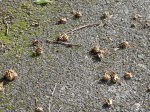
September 13th – Also falling from trees now and altogether less of a hazard are the knopper galls, the genetically mutated acorn-cum-insect-cocoons that are bastardised from the normal oak fruit by the knopper wasp.

These seemingly dead, spent galls will most likely have larva inside them and they will overwinter in the fallen galls before boring their way out in spring – although those dropping in vulnerable positions like these on the footpath will be lost under feet, cycle tyres and to the wind and elements.

It’s not until you think about it you realise what a high rate of attrition there is with such things – just how many larva are lost and how this must affect the fecundity of the knopper wasp as a species.

Remarkable how they survive at all. 

September 11th – I had promised no more wasp galls. Sorry, just one more I missed. 

I’ve been looking at this type of gall for ages and not realised what they are – a small, coffee-bean sized growth, caused by genetic mutation provoked by an injected tiny wasp’s egg. These small, rough galls are tiny compared to the more familiar marble oak galls which are smoother  and rounder.

They function in the same way though, as a growth pod and foot source for the wasp larva that hatches within, and when ready, the wasp will eat it’s way out to freedom.

This poor tree at Darlaston had knapper galls, marble galls, common galls and cola nut galls. And plenty of acorns!

August 14th – Sorry, after this I promise no morale oak wasp galls!

This is an artichoke oak wasp gall, created the same way as all the others, this wasp selects acorn buds, which are corrupted into these neat little artichoke shaped growths to house it’s larvae.

These examples spotted on Clayhanger Common.

That’s it now, I think we’ve collected the set…