February 13th – I wore out a set of front brake pads, and still have a fair few part worn ones glazed out from the problems with the rear brake, which I wouldn’t throw away in case I found a way to reclaim them.

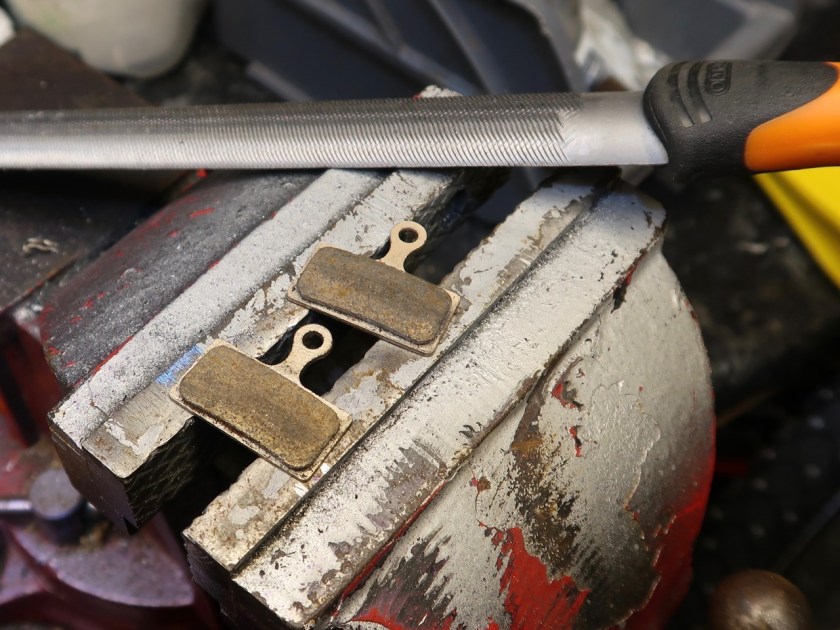
I’ve been thinking about it idly, and I’ve managed to recover a set. I filed off the surface a little with a clean flat file surface. Filing alone doesn’t work, so working on the basis whatever has destroyed them must be oil based, I took the pads, placed them on an aluminium sheet, and gently heated them with a very hot plumber’s blowtorch for ten minutes, until they stopped smoking when I removed the flame.

I then cleaned off the oxidisation with a scotchbrite pad and finally degreased them with a zero residue spray cleaner.

They are as good as new. Without the heat, none of these steps have worked before. 

I guess you could stove the pads in a normal kitchen oven if you don’t have a blowtorch.

It’s saved a few bob, I guess. Be interesting to see if they wear any quicker or glaze again.

September 3rd – It’s been a while since I bored you with disc brake pads, so it’s your lucky day – or maybe not.

I favour a hydraulic disc brake on all my bikes, road or off-road. On road bikes, I think the Shimano 785 based callipers are the bees knees; combined with a decent disc and pads, they control my resplendent girth down the steepest of inclines and without snatching.

The only issue I have – and I’ve covered this before – is the mystery of what exactly happens to rear pads in particular when they overheat. Sometimes, despite the best care, pads will develop a sheen, lose the nice grip and squeal horridly. I’ve been trialling aftermarket alternatives all summer to see if other manufacturer’s inserts are better.

I tried Kool Stop, an expensive brand. They were nothing special, and glazed out. Clarks performance was tepid, but lasted well. My best results have been with Uberbike sintered and semi-metallic. These are an interesting design – 785 road pads normally have a backplate with cooling heatsink fins. Uberbike have separated the two, so you can re-use the cooling fins on a slightly thinner pad, which are only £6 a set instead of the £20 for a set from Shimano. And they work a dream.I had one set glaze out near the end of life, but other than that, great.

I thought the front set had taken the same dive while winding down from the Roaches the day before, becoming squeaky and losing friction, so swapped them in the workshop the next day, to find the pads had worn to the spring, and that was the wail.

I really do recommend Uberbike pads.

February 9th – A puzzle, for sure. Shimano metal sintered disc brake pads for hydraulic brakes: what happens to them that renders them useless beyond recovery?

Usually the rear set, all of a sudden they loose stopping power,  and often become screechy. They are not contaminated with oil, although it feels like it. Deep cleaning in the dishwasher doesn’t work. Ultrasonic cleaner with solvent doesn’t, either. Neither does surface grinding as much as .75mm off the surface.

It’s like they just glaze, and some structural or metallurgical change takes place, and that’s it. Only thing to recover stopping power is new pads. Or using them in the rain; when wet, and only then, do they stop better.

At £20 a set, this is not fun. Anyone any ideas please?

August 1st – A mechanical mystery. Three month old Shimano hydraulic brake pads, which suddenly lost grip and appeared to be glazed or contaminated. The pads are the sintered metal type and are genuine manufacturer parts.

Sometimes, long periods of braking can ‘glaze’ pads. causing them to become highly polished and shiny, meaning they don’t work well. The common treatment for this is to file the surface of the pad and pop them back in. 

These I have degreased, cleaned, filed and even surface ground, but whatever I do they quickly glaze again. New pads of the same type were just fine.

Anyone got any idea what’s going on here? I’m wondering if overheating has caused the pad material to harden…

February 9th – Noticed in Darlaston today, as I passed, so excuse the quick, rough photos. How fabulous is this? A normal terrace house porch, but tiled, with gorgeous deep-glaze tiles, which look original, and minton tiles on the floor.

A gorgeous flash of brightness on a very dull day. Can’t think why I’ve not noticed it before. Although not present in any of the other houses, I’d say this was original and the only one that remains in the row.

August 19th – I’m fussy about brakes. Very fussy indeed. Urban cycling – particularly in heavy traffic – demands the ability to control speed and stop with certainty and dependability in all conditions.

Since I discovered disc brakes a few years ago now, I’d never have a bike fitted with anything else. After using cable controlled versions – the excellent Avid BB7 – these days, I use hydraulic brakes by Avid (part of what used to be Sachs for old timers reading out there) and by Shimano.

They are both excellent kit. Being hydraulic, however, they absolutely devour pads.

Modern cycle disc brakes started on mountain bikes, where braking is usually short, or at relatively low speed. With similar units on commuting and road bikes, engineering questions of heat dissipation, wear and glaze on the pads are critical.

Discs and callipers get fearsomely hot very quickly. It’s not unusual to see my discs steaming on wet rides. Prolonged use can cause the surface of the brake pad to become shiny and lose grip, ‘glazing over’, and the wear is constant. 

There are two general types of brake pad; sintered metal and resin (AKA ‘organic’) – sintered last a long time, are great in the wet but can howl in use and wear discs heavily. Resin pads wear quickly, are silent, and generally offer softer control and better ‘modulation’.

I’ve been very, very pleased with the Shimano brakes, which have been on the bike for about 4-5 months now, but the resin pads they came with haven’t impressed me. The pads for these units come on a heatsinking vaned plate, and are very easy to change, which is a blessing as the rear set were never the same after I cleaned the bike using normal bike cleaner. The front ones glazed out a few days ago.

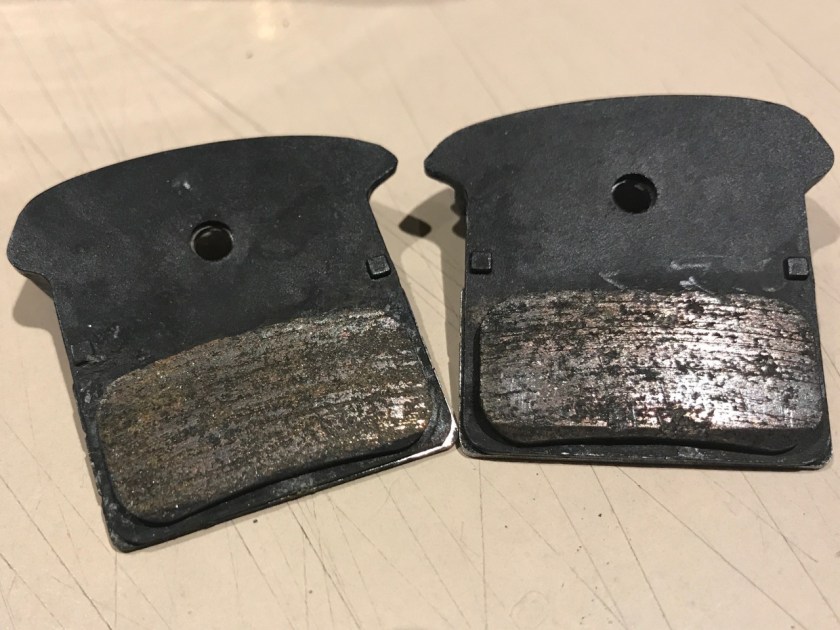
I went to sintered on the back when they became poor, and was shocked at the huge difference made, and the fact that so far they’ve been silent, so today, I popped some in the front, too. (The new sintered pad is on the left; the knackered resin on the right).

Braking harmony restored.

I must say, recent experience is leading me away from resin or organic pads.