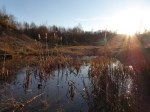
March 22nd – I’m a big fan of Middleton Lakes, the former quarry and gravel pit complex handed to the RSPB. Situated on the Tame near Kingsbury, these mixed habitat wetlands and lakes are a haven for birds of all varieties, and are now attracting bird spotters from across the country.

I remember this in the late 2000s and before, when it was an active site, with conveyors and huge machines operating; now it’s a peaceful haven. In the last couple of years though, work has been carried out installing flood defences in the form of walls and an earth dyke, which stop the Tame flowing into the adjacent canal. The work has been sensitive and well executed.

I noticed today, however, the site was a good bit more manicured than formerly; there are gravel paths snaking over the site, and the odd portacabin. What had once been almost wild seems to be being reigned back in, and I think Middleton Lakes are in danger of becoming over-managed, with little distinction between them, and Kingsbury Water Park adjacent.

This is a great place; I hope it isn’t spoiled.

March 16th – For what was once an old sand and gravel quarry that’s had minimal post-industrial landscaping, Shire Oak Park is a beautiful place, Down by the frog pool at the north hollow, in the golden hour reflected of the very red, red sand soil was gorgeous. It is of course, sandy here – and the stratified sandstone reveals the geology beautifully, but there is also greenery and wildlife. Not just the frogs croaking in the pool, but birds calling and foxes stalking in the scrub. The whole place feels beautifully secluded, and is complex enough to explore and get lost in for a while.

Shire Oak Park is not just a hidden gem of Brownhills, but of the Midlands in general.

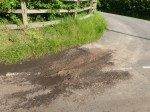
June 28th – Time for a bit of cycling knowledge. After heavy rains – like we had today – the roads are way more hazardous than usual. If it’s the first rain after a dry spell, the surface water becomes greasy and slippery, due to tyre rubber detritus and diesel being washed into the sludge. This makes white lines, ironworks and junctions really nasty. After heavy rain, silt washes of fields and gardens, bring with it loose gravel. This gathers in bands, hollows and dips, often just where cyclists cross junctions. The silt when wet is slippery, but when dry, will steal your wheels from beneath you. The gravel – known as ‘marbles’ to motorcyclists – gets progressively polished by vehicle wheels, and is like cycling on ball bearings. Take care – the hazard continues in the dry, too, and can last for weeks after a storm.

Councils don’t really understand the menace of this stuff to folk on two wheels. I wish they did.

May 25th – Back to Walsall. On my way into Bilston, I travel, as I often do, down Scarborough Road, Pleck. The surface of this road has been terrible for ages, and following complaints most of it has now been patched up, even though I was recently told by a Walsall Highway engineer that surveyors ’…Didn’t consider it dangerous’. I thank the council for sorting it.

Oddly, the last hundred yards or so – containing the most hazardous potholes – remains untouched, though clearly marked for repair. This loose gravel is a danger to all traffic, but to anyone on two wheels – motorised or otherwise – it’s deadly. Motorcyclists christen this loose detritus ‘marbles’ due to it’s slippery, destabilising effect, and it’s a real pain. This needs fixing. It’s time all road engineers woke up to this hazard.

Perhaps the permanently parked vehicles have been in the way, but I wish it could be sorted.