
May 8th – A first for the year: pottering back from an errand in Aldridge the first marble oak wasp galls are appearing on the oaks along the canal towpaths.
That’s a sign the season is already moving on…
May 8th – A first for the year: pottering back from an errand in Aldridge the first marble oak wasp galls are appearing on the oaks along the canal towpaths.
That’s a sign the season is already moving on…
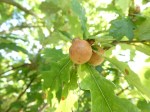
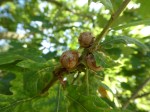
September 11th – I had promised no more wasp galls. Sorry, just one more I missed.
I’ve been looking at this type of gall for ages and not realised what they are – a small, coffee-bean sized growth, caused by genetic mutation provoked by an injected tiny wasp’s egg. These small, rough galls are tiny compared to the more familiar marble oak galls which are smoother and rounder.
They function in the same way though, as a growth pod and foot source for the wasp larva that hatches within, and when ready, the wasp will eat it’s way out to freedom.
This poor tree at Darlaston had knapper galls, marble galls, common galls and cola nut galls. And plenty of acorns!


July 16th – I seem to have it with a cold. I’ve been feeling a bit peaky all weekend with a headache and sinus trouble, and today I couldn’t raise any energy to move until evening – but a short ride in a terrific warm, sunny golden hour was well worth what seemed like a superhuman effort.
In the backlanes of Stonnall, a shed, fallen spent marble oak gall. Spongy, expanded and very different to the marble-hardness of the fresh variety, this had maybe a couple of hundred holes drilled in it where the emerging wasp larva had bored their way out to freedom.
Galls are fascinating and gruesome at the same time. They do captivate me so: I wonder what the tine wasps look like?
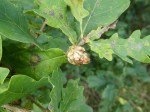

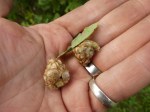
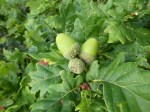
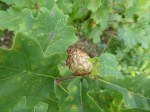

September 4th – This is an interesting find. I’m fascinated by insect galls – the aberrations caused mainly to oak trees by parasitic insects who lay their eggs in leaf and acorn buds and cause them to mutate into safe enclosures for their larvae to hatch and grow.
We mostly know oak apples, the round globes top right – often, like these, with a little hole bored in their surface where the wasp that grew within emerged. Also, I’ve featured a few pictures in the past of the gnarly, fascinating knapper and marble galls. But these are new to me.
This tree at the new pond in Clayhanger was covered in fruits that looked like hops, or alder fruit, as well as healthy, plump acorns. I’ve never seen anything like it, and so asked twitter. My old mate Posh Dave, @tringonometry came to my aid.
These are artichoke galls, yet another variety of insect parasitisation on oaks. You can read about them here.
Both nature, and the usefulness of social media are astounding. Thanks, Dave.

July 4th – A first for the year, an oak gall. I don’t know if I’m too early or if it’s just been a bad year for the tiny wasp that creates these galls on oak trees by depositing an egg coated in a chemical which causes leaf or acorn buds to mutate and grow into a gall, inside which a tiny hatched larvae feeds, before drilling it’s way out and flying away.
I normally see a variety from mid summer on – the smooth green type shown here, marble gables which are also globular, but veined with white and pink, and knoppers which mutate gnarly growths from acorns themselves.
It’ll be fun to see if I’m early or if the yield this year is indeed quite poor.
 BrownhillsBob's #365daysofbiking